Moving Beyond: Yvonne Rainer
On the radical films of Yvonne Rainer
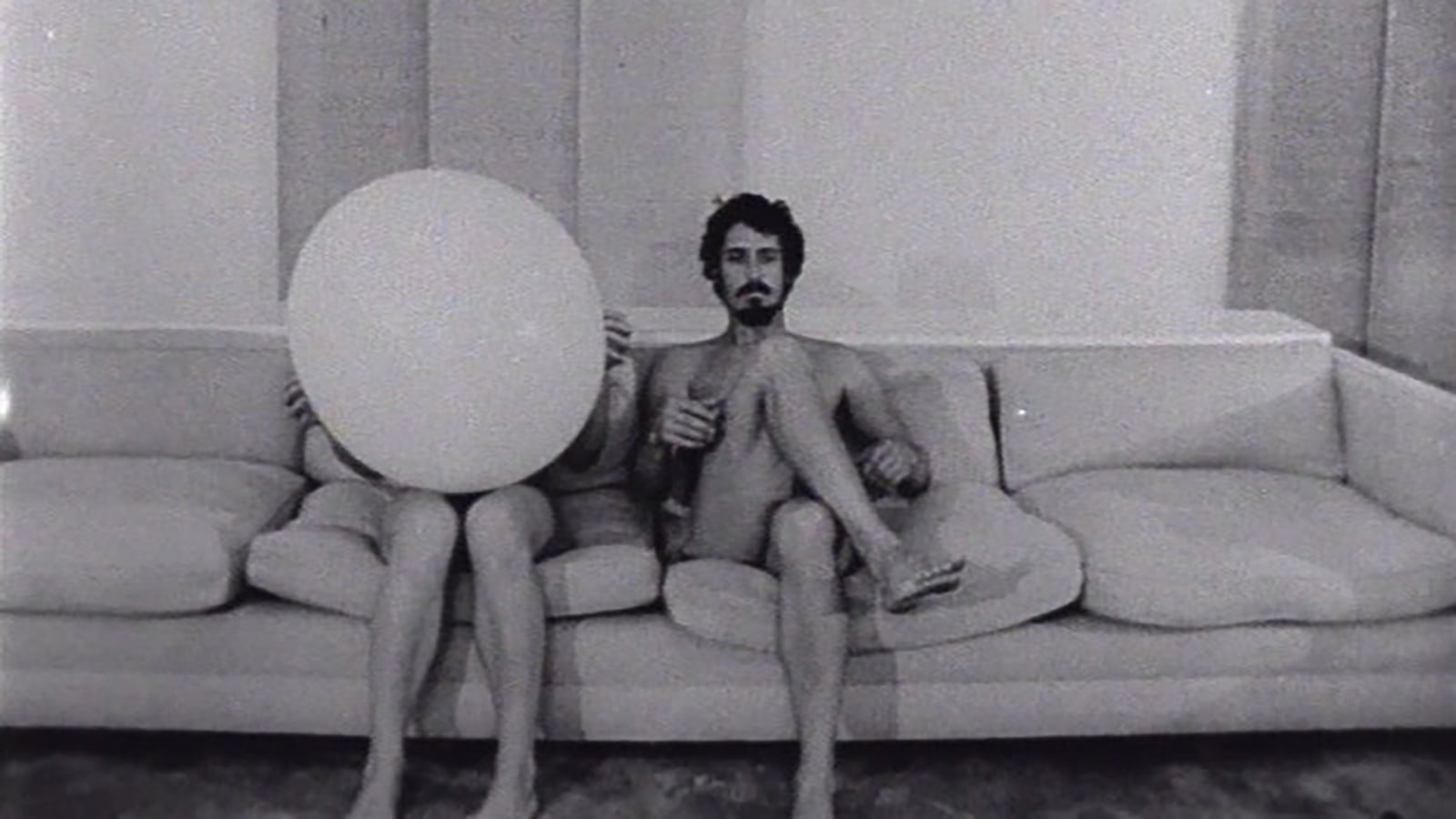
On the radical films of Yvonne Rainer
How do you unhook this audience that dreams with all its eyes open?”
—Yvonne Rainer, “More Kicking and Screaming from the Narrative Front/Backwater,” Wide Angle (1985)
While the current vogue in the culture wars is for representation above all else, in the 1970s feminist artists and writers were consumed by how to reconfigure narrative entirely. From Laura Mulvey’s seminal “Visual Pleasure in Narrative Cinema” to Constance DeJong’s influential postmodern novel Modern Love, women advocated for a new type of story, one that did not replicate a scopophilic, male view. Conventional narrative was regarded as not just an expression of the patriarchy, but a tool for indoctrinating society into it.
One of the most crucial feminist figures attempting to put into practice new forms, whether narrative or antinarrative, was Yvonne Rainer, the pioneering avant-garde dance choreographer who moved into filmmaking. Championed by Annette Michelson (who starred in her 1980 film, Journeys from Berlin/1971), B. Ruby Rich, and many others, Rainer’s films are densely verbose, elusive, dryly comic, furious, fractured, and intimately concerned with addressing a variety of injustices beyond the concerns of feminism, from ageism to gentrification to mental illness. Each work turns received notions of form and feminist praxis on their heads, talking out solutions to (or just expressing frustration at) extremely large problems, and using anecdotes to illustrate how desire and power influence all aspects of our lives.
Born in 1934 in San Francisco to parents with anarchist beliefs, Rainer moved to New York in 1956 with painter Al Held. Once there, she discovered her love of being on stage through her involvement with the Theater Arts Colony. Thanks to the financial support of her mother, she was able to study acting at the Herbert Berghof Studio and Paul Mann’s Actor’s Workshop full-time, but, as she put it in an interview in Charles Atlas’s Rainer Variations (2002), “the method never took hold.” At 25, she decided that she was “‘fucking around’ in more ways than one” (a delicious phrase that appeared in her diary and in her 1976 film Kristina Talking Pictures), and began training as a dancer in earnest at the Martha Graham School. In the afternoons, she went to the Museum of Modern Art to watch films, “mainly ’20s classics and Chaplin and Keaton.”
But it was also during this time that Rainer studied with Merce Cunningham, James Waring, and Anna Halprin—younger, radical choreographers who collaborated with artists outside of dance, like John Cage, and who sought to challenge the established tenets of both modern dance and ballet. A watershed moment came in 1962, when Rainer and fellow dancers Ruth Emerson and Steve Paxton asked Judson Memorial Church if they could use the Greenwich Village space for a workshop led by experimental musician/Cage disciple Robert Dunn. With the creation of Judson Dance Theater, dancers and choreographers had the space to rehearse (privately and publicly) and perform their radical reformulation of the art, alongside artists in the Judson Art Gallery, who were also breaking away from the established, postwar avant-garde and moving into minimalism and postmodernism.
Working with Lucinda Childs, Carolee Schneemann, Elaine Summers, and other artists of various disciplines, Rainer proved prolific at Judson. In her famous “No Manifesto,” written in 1965, she defined herself against the prevailing fashions in the avant-garde and mainstream by presenting a list of “No”s: no camp, no narrative, no eccentricity, no virtuosity, and no “seduction of spectator by the wiles of the performer.” Rainer’s choreography combined everyday, task-based movements with technically complicated ones; her dancers, clad in plain shirts, pants, and sneakers, were instructed never to look directly into the audience. These works were the antithesis of Graham’s preoccupations with the heroic, dramatic, and grandiose: Rainer’s dance did not even insist on a distinction or division between dancers and audience members. “Trio A,” perhaps her best-known work and first performed in 1966, repeated no movements or “phrases” except regular, uninflected walking; it attempted to signify nothing but motion. In 1970, Rainer restaged the dance to protest the recent arrests of artists and gallerists who had “desecrated the American flag,” with dancers wearing nothing but flags around their necks.
Both of these very different performances of “Trio A” were revolutionary in their own right: the former for epitomizing the nascent aims of minimalist dance, the latter for upturning those rules and making a bold political statement, and growing tired of her self-imposed restrictions for choreography. Repetition, revision, and “radical juxtaposition”—a Susan Sontag phrase that Rainer frequently uses to describe her own work—would come to define the second phase of her career. From her first choreographed dance at Judson, 1960’s “Three Satie Spoons,” Rainer’s work frequently incorporated noises and/or spoken words, and it was partly this interest in language that led her to move into filmmaking. Reflecting the interdisciplinary nature of the downtown arts scene, she projected slides and 16mm durational films (such as close-ups of a hand, or a naked couple holding a balloon) on the screens or walls behind her dancers, as well as using other non-traditional elements, like a juggler in 1968’s “Act.”
In 1971, a visit to India exposed Rainer to the connection between gesture and narrative in Kathakali (a type of Indian classical dance that heavily references myths). The experience caused her to rethink narrative form in her own work. Following the trip, and her increasing unease about her leadership role in her troupe Grand Union, Rainer embarked on experiments in film with the same formal rigor as she had in dance while carrying over many of her concerns.
Rainer’s first feature film, the 1972 lives of performers, sought to explore everyday relationships—both the power and the emotion within them. By radically fracturing the conventions of narrative, Rainer challenged typical modes of voyeurism and identification both on and off screen, rejecting the aesthetics and form of the New American Cinema (both the structuralism of filmmakers like Michael Snow and the raw, masculine dramas of John Cassavetes).
The story is as basic and complex as a love triangle—Fernando, who is with Valda, begins to fall for Shirley, but doesn’t want to leave Valda—and related entirely through voiceover. Photographed by Babette Mangolte (the camerawoman/cinematographer who shot five of Chantal Akerman’s films), Lives of Performers blends dramatized scenes of rehearsals with a variety of elements: documentary footage, intertitles, emotionless voiceover from the characters (who share the names of the actors portraying them) narrating or commenting upon their actions, a laugh track, and 35 20-second series of tableaux vivants based on stills from the published screenplay of G.W. Pabst’s Pandora’s Box.
There’s an element of playfulness that undercuts the seriousness of the film’s experimentation: one layer of the audio was recorded during a screening at the Whitney Museum, where the actors reacted spontaneously to the footage of themselves. The script Rainer wrote for the voiceover (before the actors’ reactions were recorded) mimics this, asking questions we (or someone sitting next to us in the theater) might be wondering too: “Why does Fernando have the suitcase? Is he going away or has he just arrived? Why is he in the box with the suitcase? Is he trying it out as a body-supporting device? And what is in the suitcase? Dirty socks?” That Rainer herself speaks these questions is one of the many expressions of her facetious attitude toward being the director of the film and the leader of the dance troupe within it—another layer of questioning power in relationships.
Rainer’s self-reflexive devices work to keep the text open, perpetually shifting between being “in the moment” and removed from it, the recognizable and the abstract. A quote by critic Leo Bersani opens Lives of Performers: “Cliché is, in a sense, the purest art of intelligibility; it tempts us with the possibility of enclosing life within beautifully inalterable formulas, of obscuring the arbitrary nature of imagination with an appearance of necessity.” Like the myths in Kathakali that were easily recognized by their audiences and complicated by the dancers’ reinterpretations, Rainer used the familiarity of the love triangle (common to many Hollywood melodramas) and the stills from Pandora’s Box as building blocks for her radical fracturing of character and narrative. Representing important narrative and visual moments in Pabst’s film, the stills in the book themselves used easily discernible poses and actions (employing Jack the Ripper at one point) to convey the story silently. The Pandora’s Box section is only connected to the rest of the narrative with an intertitle that says FINAL PERFORMANCE, which offers multiple meanings: the last section of the film, the last performance the dancers will give together (implying their troupe will split up), the death of Lulu. Despite being the final thing we see, it refuses closure of the narrative and of identification.
Rainer’s follow-up, Film About a Woman Who… (1974), takes the obfuscation of character even further, referring to the people on screen only as “he” or “she.” It opens with two men and two women sitting on a couch, watching a screen. Rainer narrates the situation, which is also interrupted halfway through with an intentional scratch on the soundtrack: “He feels a growing irritation. He had run into her on the way to the shooting. He hadn’t seen her for a year. Some banter was exchanged. Now he is reviewing the conversation in his mind.” We then see the screen they are watching (the silhouettes of their heads visible): the images alternate between projected text, photographs, film stills, and filmed scenes. Although the photographs show us other places, the films on the screen take the viewer out of this darkened room and into different spaces—the beach, a kitchen, a bedroom—illustrating, complicating, or filling in the story that is unfolding in the intertitles and voiceover narration.
While much of film about a woman who… probes sexual desire and feminine fears of imperfection, Rainer’s third feature, Kristina Talking Pictures (1976), expands her concerns far beyond gender dynamics, and folds them into the relationships between the characters—a tendency that would come to define the rest of her film work. Using a photograph of a female lion tamer with scars on her legs, Rainer created the character of “Kristina,” a woman who was born in Budapest sometime before World War II, escaped the Nazis (but lost family members), grows older, leaves the circus, and then tries to create a dance about her experiences. Her character is distributed among several actors (sometimes within the same scene), as well as being conveyed through the photo, which is pinned on different parts of a loft’s wall. The film also concerns her on-again, off-again lover Raoul, who expounds upon the workings of an oil tanker.
Through fictional and real anecdotes spread across the voice-over, intertitles, and scenes, Rainer works through feelings about victimization and victimizing of varying scales: does committing one “bad” personal action negate a “good” deed done for someone else? Are these contradictions unresolvable, or are they simply things that we need to be more aware of while moving through the world, and try to modify our behavior accordingly? Her perpetual questioning and reformulation of answers is like a form of self-critique or leftist soul-searching. (As J. Hoberman has noted, Rainer’s depiction of life in dingy downtown lofts offered a welcome counterpoint to the idealized, well-heeled liberals of Woody Allen’s films at the time.)
A fascinating instance of such internal debate is when Kristina (portrayed by the actress Frances Barth) bemoans the staginess of an unnamed film to other people in her loft, who might be friends or other parts of her personality. She makes sweeping statements, and they offer counterpoints and ask for clarification. This “conversation” is interrupted with cuts, and Kristina shifts around different spaces of the loft (including the toilet) as she speaks. She then decides to go see a film. An intertitle flashes THE RETURN OF RAOUL, which may or may not be the film she has (they have?) gone to see. We return to the same loft, where Kristina (Rainer) and Raoul (played by her brother Ivan) make small talk in bed; after a while, Raoul’s dialogue becomes a monologue based on Noël Mostert’s Supership about traveling on an oil tanker.
Recitation of lengthy texts not written by Rainer would also form the bulk of male “dialogue” in The Man Who Envied Women (1985). Although the narration is from the point of of view an (entirely offscreen) female artist, voiced by fellow Judson member Trisha Brown, the main character we are given is Jack Deller, a self- satisfied linguistics professor who’s left her for a younger woman. (He enjoys using his “feminist ally” stance to excuse his bad behavior.) The film is framed by his psychoanalytic session: while footage from film noirs plays on a screen behind him, Deller sits on a theater stage in front of an audience of women, coolly smoking and reciting from (among other texts) the personal letters of Raymond Chandler, which are strikingly misogynistic. The connection between the media he’s consumed and his treatment and attitudes toward women comes into sharp focus, literalizing Mulvey’s “Visual Pleasure” essay. (Psychoanalysis also forms the basis of Journeys from Berlin/1971, which combines fragments from Rainer’s teenage diary with thoughts about the political violence performed by the Baader-Meinhof Group.)
The hollowness of his interrogation is a counterpoint to that of the unseen protagonist, who has lost her apartment to gentrification. Using footage from the city’s hearings about downtown artists’ lofts as well as shots of the luxury boutiques they were turned into, Rainer narrates this section herself, sourly noting that “we had met the enemy, and it was us.” Aside from exploring how race, gender, and class meet (particularly when a middle-aged white male artist in the film claims that there really are artists who could pay $1,000 a month rent), these testimonies show a pivotal moment in the history of New York City and of the art world. As new stars like Julian Schnabel began to sell their art for record-breaking amounts, the art market began to dictate the importance of works, and who could afford to make it—a new type of cultural imperialism.
Cycling among anecdotes and digressions, The Man Who Envied Women expresses sadness over injustices beyond the director’s control (the U.S.- supported conflicts in Central America) and the local ones she perceives to be stoppable (gentrification). It also marked the shift away from men’s narrative importance and agency in her later work. Rainer’s final two films to date, Privilege (1990) and MURDER and murder (1996), both made after her diagnosis of breast cancer and mastectomy (as well as the beginning of her relationship with a woman), take on gender in a new way. Privilege uses a reminiscence about the early days of artist “colonization” of the Lower East Side as a framework to deal with the mysteries and misconceptions of menopause, as well as race, class, and healthcare. Rainer casts a post-menopausal black woman as a director also named Yvonne, who interviews her white friend about menopause, a dialogue that turns into a dramatized story about the attempted rape of a neighbor.
MURDER and murder explores a post-menopausal woman’s first lesbian relationship, but also filters the narrative through the memories and reactions of her mother and teenage friend, both of whom are deceased. Although there is a more immediate sense of anger in both Privilege and MURDER and murder, mostly around the dearth of research about both breast cancer and menopause as well as the misconceptions about aging, there’s also a sense of humor, particularly toward the devices and scenarios she uses to explode narrative in each. In MURDER and murder, the lesbians’ relationship builds to a touted boxing match (where both their weights—“135 and counting”—are announced) that quickly ends with them snuggling on the mat (in a pose reminiscent of a post-coital clutch) in their silk shorts and gloves.
Rainer’s filmography since these two works suggests that funding for her ambitious inversions of narrative has become harder and harder. For one thing, an ongoing focus of her project went out of style—post-menopausal women count among the rarest cinematic subjects, inside and outside of the avant-garde film world. And, unlike Akerman, her radical approach was never “borrowed” by male directors later on. At the turn of the millennium, Rainer returned to dance and has continued to work in that medium in addition to writing poetry. Yet as mainstream cinema persists in stultifying (and those heroic, savior narratives work their way into politics), there is a desperate need for filmmakers today to challenge the absolutism of narrative and character the way Rainer did.
Closer Look: An Yvonne Rainer retrospective runs July 21 to 27 at the Film Society of Lincoln Center.
This story is part of the July-August 2017 issue of Film Comment.
By clicking Sign up, you agree to our site’s Terms of Service and consent to our Privacy Policy.
Get full access to Film Comment with a paid subscription. Already signed up? Log in.
Thank you for signing up for The Film Comment Letter.
Check your email to set up your account and get access to select articles, or become a paid subscriber for full access.