


The Stoic Sensualist
When a director knows he's dying, an aura of perverse piety can attach itself to the film he devotes his final days to. And in those rare cases where the filmmaker appears in the film (for instance, Cyril Collard in Savage Nights), he has an opportunity to capture the Grim Reaper in action. Now imagine a film in which the director decides to give himself a truly grotesque onscreen demise—say, being fucked to death by an African spirit wearing a giant wooden strap-on. In such circumstances it's easy to conclude that the fear of death has been completely conquered. The late João César Monteiro's Come and Go (03) is that film. Playing a close relative of his most famous creation, João de Deus ("John of God"), Monteiro brought the curtain down on his filmmaking career with an image that's almost as final as any corpse: an extended close-up of his blue eye filling the screen. How's that for an epitaph of epic eloquence?

Monteiro died February 8, 2003, at the age of 64. It came as a shock because his career had only started to take off relatively recently, first with his sort-of breakthrough, Recollections of the Yellow House (89), and then with the international success of its sequel, God’s Comedy (95). The acclaim for the latter had little to do with its quality—it’s neither superior to nor more accessible than his earlier work. It was simply the right film at the right moment. Dedicated to Serge Daney, this monument to cinephilia suggests an unholy alliance between Straub, Tati, de Sade, and a nondescript porn director, under the direction of a dandy who only cares about two things: pleasure and vice. The notion that the times had caught up with Portugal’s enfant terrible must have made the movie gods laugh. Monteiro’s attitude toward his newfound acceptance is probably expressed by Snow White (01). Taking the form of a lecture, it’s an homage to Swiss modernist writer Robert Walser, and mainly consists of a dozen shades of black leader. This agreeably decadent “fuck you” to those who thought they understood Monteiro caused a major scandal in Portugal’s small movie world, where the film-fund bureaucrats didn’t see enough of their money up on the screen.
João de Deus actually made his debut in 1972 with a brief appearance in Monteiro’s first feature, Fragments of an Alms-Film. He pops up in the beginning, flashes a demonic grin, and gives us the finger. At the Turin Film Festival screening in 2003, the audience laughed at this familiar sight, but the film that followed couldn’t have been further from Monteiro’s usual mischief. A bizarre still life of a disintegrating family in the style of Philippe Garrel and fueled by Breton, Joyce, the quasi-surrealist poet Francis Ponge, and Aeschylus, it revealed a filmmaker in tune with the era of Eustache and Warhol. Further surprises were in store with his next and least typical film, What Shall I Do With This Sword? (75), a hybrid of documentary and fiction that makes sharp use of found footage. Taking aim at American imperialism as symbolized by the USS Saratoga, which stationed itself off the Portuguese coast following the overthrow of the country’s fascist regime in 1974, Monteiro cuts to Murnau’s Nosferatu disembarking from his ship.
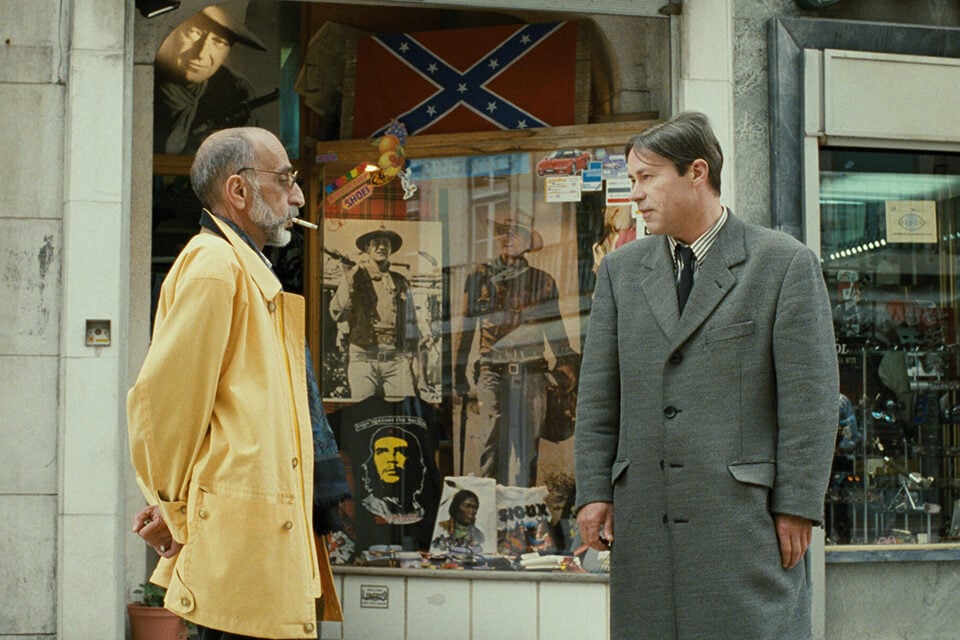
The Hips of J.W, (João César Monteiro, 1997). Courtesy of The Cinema Guild.
Monteiro’s birth date (1939) and background (he attended the London Film School in the early Sixties) suggests he belonged with his contemporaries in the Portuguese new wave of the mid-Sixties, i.e., Paulo Rocha, Fernando Lopes, and Alberto Seixas Santos. But while Monteiro had links to these members of the so-called Vava group (named after the bar in which they all hung out), that was as far as it went. While the Vava filmmakers’ early work was heavily influenced by the French New Wave and tended toward realism, Monteiro was more interested in the materiality and poetics of the image itself.
Monteiro began shooting his first short, He Who Waits for the Dead Man’s Shoes Goes Barefoot (A Cinematographic Proverb), in 1965 but abandoned it after two days. Next he made a documentary, Sophia de Mello Breyner Andresen (69). Distinguished by a sense of language that recalls Straub and Dreyer, the film is less a discrete portrait of the noted Portuguese poet than a record of her poetry. It’s also a poem in its own right, consisting of precise and concrete images.
Fragments of an Alms-Film, however, is a cinematic hand grenade, lobbed with both fury and grace at fascism’s most sacred institution, the family. The incredible crudeness of the scene in which the paterfamilias, wearing a pig mask, capers around while insulting his visiting in-laws is accentuated by Monteiro’s unflinching plan-séquence approach. The rage contained within this single scene reverberates throughout the film, particularly in the stark tenderness of the scenes in which father and son play together in the empty apartment.
Monteiro’s second phase, which consists of two features sandwiching a three-part TV series, all based on Portuguese folk tales, acquires a clear political relevance when seen in the context of the period immediately following the Carnation Revolution and the end of Portugal as a colonial power. All three films ask the same question: What is Portugal? The phase began with Paths (77), a strange beast located somewhere between anthropology and fable. It took a turn with his 1978 TV series, Portuguese Folk Tales, which consisted of The Two Soldiers, The Love of the Three Pomegranates, and The Mother. Here Monteiro exchanged the grainy pathos and underground/camp feel of his earlier work for an aesthetic of carefully controlled artifice that reached its apotheosis with the sets and color schemes of his final folk-tale film, Silvestre (81) . A masterpiece of faux naïveté, Silvestre overflows with miraculous events and wonderment at the misery and violence of the world: artificial limbs, wounded feelings, betrayal, redemption, and people who aren’t what they seem—including some who aren’t even human. Silvestre‘s conception is diametrically opposed to that expressed in Sophia de Mello Breyner Andresen, and yet, as films with female subjects, both anticipate the obsession with women and the sweet fascism of elegance and design in Monteiro’s final works.
Despite its determined, uncompromising rigor, Monteiro’s first phase found him searching for his own language and arriving at a hybrid form. In his second phase he went on a quest for a sense of home. By the early Eighties, having established the treacherousness, vanity, and seemingly contradictory justness of the Portuguese soul, Monteiro was now in search of a direction. An essayistic political-thriller remix, Seaflower (86) suggested a late modernist trajectory (and you can spot Monteiro in a bit part sporting a machine gun, warming up for his acting career and his retreat into a private universe of flesh and phantoms). And then there’s a TV commission, The Last Plunge (92), a reinvention of Sixties realism.
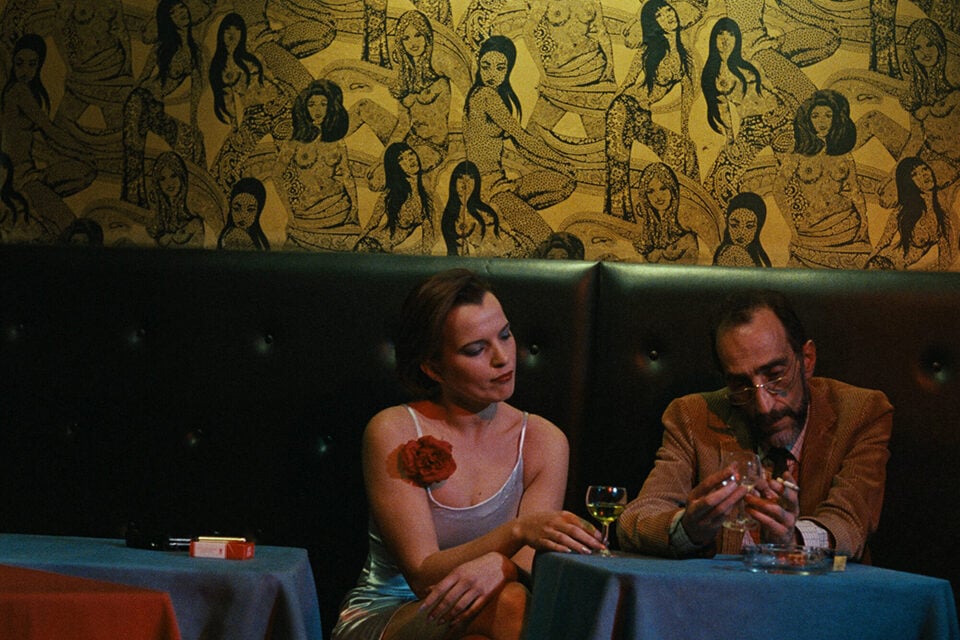
Recollections of the Yellow House (João César Monteiro, 1989). Courtesy of The Cinema Guild.
Both efforts are unconvincing compared to Recollections of the Yellow House, the intervening film that marked the moment Monteiro hit his stride. This final phase surveyed the days and nights of João de Deus and the other characters played by Monteiro, all of them walking through a mise-en-scène that merges theater’s dramatic flourishes with photography’s documentary humility. João is the protagonist of Recollections of the Yellow House, God’s Comedy, and God’s Wedding (98). He also appears in three 1995 shorts (Bestiary or the Parade of Orpheus, Letter of Love, and A Walk With Johnny Guitar) formed from the cinemascope remnants of Monteiro’s first attempt at shooting God’s Comedy, which he set aside because he was dissatisfied with the work (he concluded that the problem was the aspect ratio).
Superficially, Recollections of the Yellow House, a nocturnal tour through an asylum with a somnambulant guide, has more in common with The Last Plunge than with God’s Comedy and the subsequent João de Deus/João Vuvu films. Given that God’s Comedy and God’s Wedding were originally conceived as a single film, until length and production problems forced Monteiro to make two separate works, Recollections of the Yellow House would have been a story about depression, despair, and madness, and God’s Comedy/God’s Wedding about deliverance through the perverse pleasures of the flesh. The latter now climaxes in the spiritual pornography of Come and Go, which seems to consist solely of risqué encounters between João Vuvu and a series of ravishingly beautiful girls (plus a woman in her prime and a bearded lady whom João shaves). Joao projects his kinky fantasies onto all of them, but in the end he’s always consoled by their appearances—as everything vanishes in time and light.
No matter how one considers the interrelationship of Monteiro’s film work from Recollections of the Yellow House onwards, one thing is certain: J.W.’s Pelvis (97), erratic yet elegantly argued, is its apotheosis, a kind of cinephile transubstantiation orgy in which thought becomes flesh becomes celluloid (“J.W.” stands for John Wayne). It culminates with a rare moment of raw politics: found footage of German soldiers becomes the specter from which Monteiro flees, searching for his dignity in disinvoltura (stoicism), or simply paradise—from which he’ll return, looking cheerfully damned, a folly of God and cinema.





Sign up for the Film Comment Letter
Thoughtful, original film criticism delivered straight to your inbox each week.