


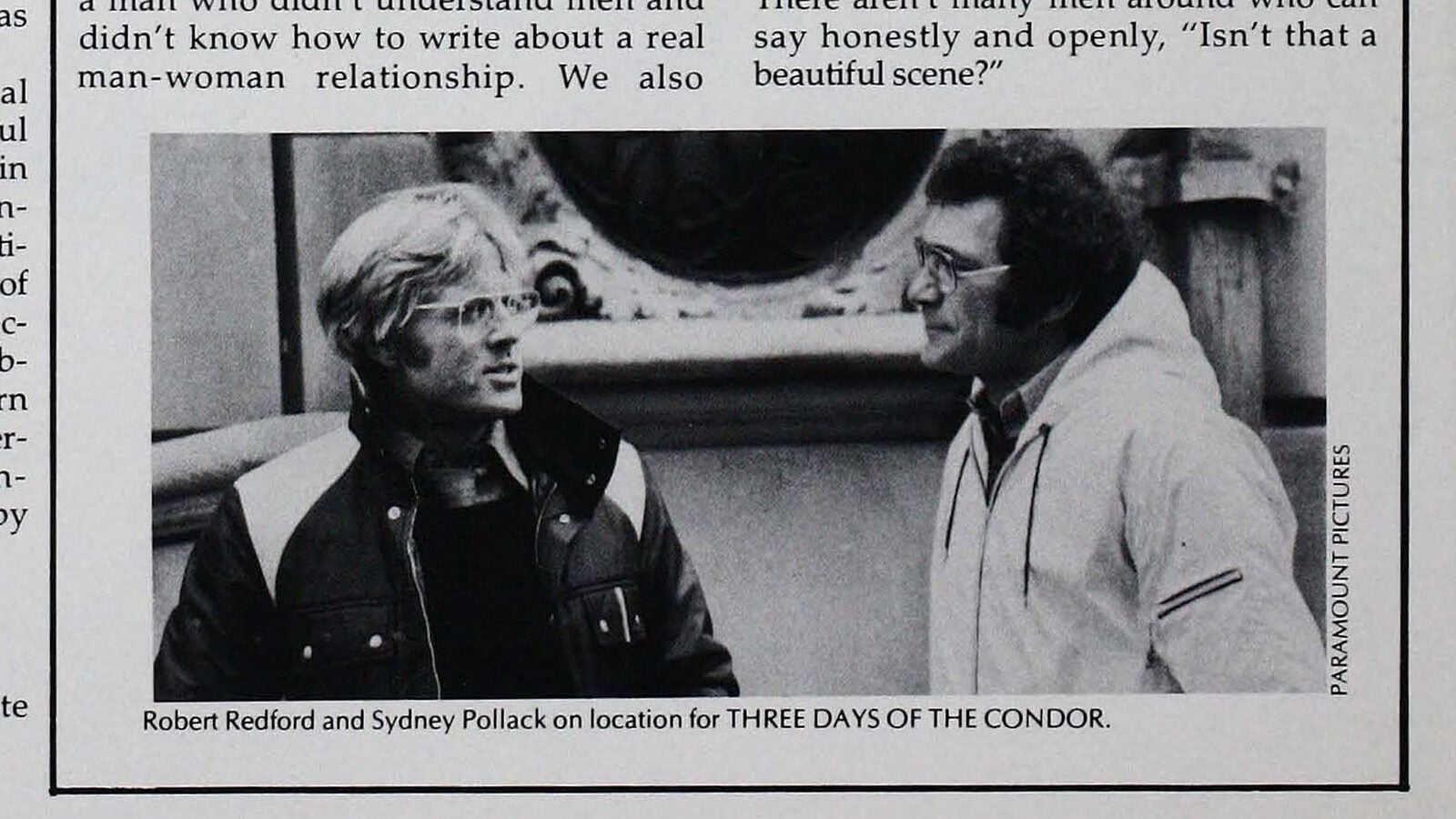
Robert Redford on Sydney Pollack
On Actor Directors: Selfishly, being an actor, I think it helps to have a director with an acting background. Too many of the young directors are obsessed with celluloid—obsessed with making beautiful films. Filmmaking is a whole piece and that includes the actor. I think you can get some very exciting camera work, but it lacks heart.
On Actor Directors: Selfishly, being an actor, I think it helps to have a director with an acting background. Too many of the young directors are obsessed with celluloid—obsessed with making beautiful films. Filmmaking is a whole piece and that includes the actor. I think you can get some very exciting camera work, but it lacks heart.
Working with Pollack: Sydney’s the one director that seems to read me best. More of what I do, with less effort, is made visible. He is able to extract more solid stuff than other directors. There are certain things that I’ll try as an actor that will go past others, which never make it to the screen. Sydney seems very sensitive to it and he’ll pick on it, even accent it. One of Sydney’s strongest points is his sense of rhythm. One of the reasons we get along so well is that we read each other. As an actor I have more faith in him and more trust in his directing me than anyone. It’s largely due to trusting his sense of rhythm.
Jeremiah Johnson: Jeremiah was my project. That was one that was really close to me; it took place where I live. The reason Sydney was so good on it was that he understood how I felt. We went through a lot of anguish on that picture. It went on for months. We’d talk and talk and argue and we could never articulate what we wanted. Choices were made by both Sydney and myself that just weren’t explainable. The crew didn’t know what we were doing. It was just me wandering through the mountains and then suddenly it was put together and there it was. The idea was about a man who decides he doesn’t want to live by someone else’s code. He wants to create his own. He happens to go where the Indians were. It wasn’t that he was attracted to the Indian way of life. He just wanted to go off by himself.
The Way We Were: I turned that project down two times. In the book the character is shallow and synthetic. It was written by a man who didn’t understand men and didn’t know how to write about a real man–woman relationship. We also thought the politics were phony, but Sydney felt the material had great possibilities as a love story. Sydney said, “Trust me; it can be good, and I think it’s something you ought to do.” One of the reasons Sydney wanted to do it was that he identified with the character of an uncommitted man. Finally, I just took the part on faith. Together we totally reworked the character of Hubbell.
Critics: Critics had trouble with The Way We Were because they won’t own up to their own emotions. They feel that it’s got to be off-center or bold before they can accept it. The Way We Were is about two people who come together and why it goes wrong. Intellectually you know they shouldn’t be together, but on a gut level you want them to make it because you like them and because they like each other. That’s a fair emotion.
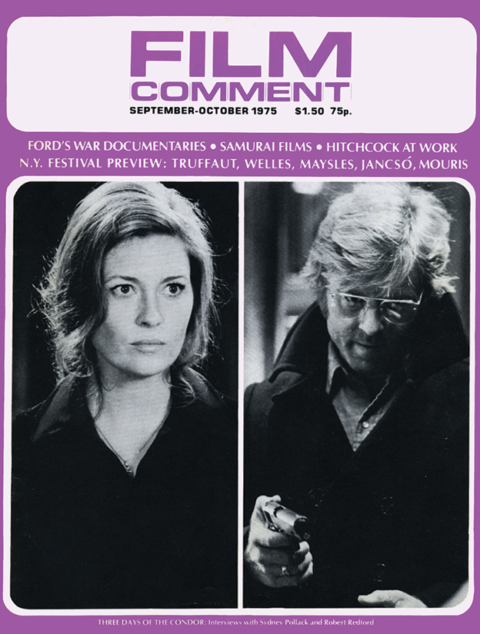
Three Days of the Condor: We usually take something nobody else wants to do. Jeremiah was in existence as a script for a long time. Three Days was a project that was not a very good book and a script that no one liked at all. Sydney and I wanted to attempt a thriller. We wanted to do a pure adventure film, but gradually we got into the area of paranoia. Again we got to the area where there just aren’t simple answers. For instance, you’re hired to protect the interests of the country. Can you spare seven people and lose eight million? It’s an easy thing right now to take a cheap shot at the CIA, just like it’s easy to do a hatchet job on Raquel Welch. Both Sydney and I come from backgrounds that are confusing in terms of what we are now and what we were. Things were wrong. We were both unhappy in misfit situations. That’s why there’s always a complexity in the point of view in all of Sydney’s work, and a look backwards to the past.
Romanticism: Sydney is melancholy, but he’s getting wiser about using that in his work. He used to let moments go on too long, but now his experience tells him when to cut things off. Basically he’s a romantic. I think that’s one of his virtues. There aren’t many men around who can say honestly and openly, “Isn’t that a beautiful scene?”

Sign up for the Film Comment Letter
Thoughtful, original film criticism delivered straight to your inbox each week.