The Aging Artist
This article appeared in the October 17, 2025 edition of The Film Comment Letter, our free weekly newsletter featuring original film criticism and writing. Sign up for the Letter here.
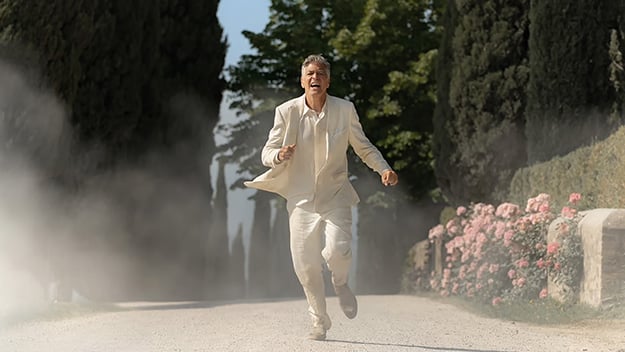
Jay Kelly (Noah Baumbach, 2025)
Can I do it again? Can I make another film, act in another play, write another poem or libretto? This is the quandary of the aging artist: can they find the words, the energy, the motivation to continue? And if not, can said artist live without the practice so central to their being, to their very identity? Or is it so central? My mandate was to write on three films at the just-ended New York Film Festival that, implicitly or explicitly, raise these questions—Late Fame, Jay Kelly, and Is This Thing On? But the real challenge might have been to identify which films from the lineup don’t ask these questions. In Joachim Trier’s Sentimental Value, Stellan Skarsgård wants desperately to make one more film, this one about family history and hopefully starring his estranged daughter, played by Renate Reinsve. In Pietro Marcello’s Duse, Valeria Bruni Tedeschi’s obsessed and glittering diva clings to hopes of continuing her career even as she battles an ailing body. Blue Moon’s alcoholic lyricist Lorenz Hart, played by Ethan Hawke, finds himself in late-career agony after having been ditched by Richard Rodgers in favor of Oscar Hammerstein II.
Sometimes it’s as if the young artist and his older self are two different people, arguing with each other. This is precisely the case with Ed Saxberger, the onetime poet played by Willem Dafoe in Kent Jones’s Late Fame. It’s hard to imagine anyone else at the thoughtful, heartfelt center of this melancholy film, adapted from a stunning Arthur Schnitzler novella by Samy Burch (the screenwriter of 2023’s May December). Saxberger, who published one book of poetry decades ago, in the creative surge of a downtown New York bohemia, now sorts letters as a postal worker and hangs out at dive bars with fellow silver-haired blue-collar workers (think Bukowski without the teaching gigs and continuous production of poetry). His life as a writer is all but forgotten until a chance encounter threatens—or promises—to revive it. One evening, a young admirer, an aspiring poet named Meyers (Edmund Donovan), approaches him on the street. Having recently discovered Saxberger’s book, Meyers shyly but fulsomely urges him to come and meet other fans among his coterie of callow wannabe artists and writers, who call themselves “The Enthusiasm Society.” Perhaps the older man would like to participate in one of their readings, and write an original poem for the occasion? (There’s a predictable catch: Meyers of course wants Saxberger to read and critique—i.e., praise—his own poetic efforts.)
Saxberger duly arrives at the coffeehouse one evening, and is introduced to the all-male Enthusiasts. Arriving later, and bringing an air of theatricality, is Gloria (Greta Lee), a middle-aged actress, whose role in the group is… what? Mascot, muse, hanger-on? Take your pick—or maybe it’s all three. She’s a strange creature in the book as well, altering her personality to suit each man and her purpose, a bit of gravel in the eros. A more contemporary twist might have had an actual woman writer in the group.
The Enthusiasts pride themselves on staying true to an old-fashioned idea of integrity. They reject technology and ridicule competitors at a neighboring table as “influencers” who promote themselves on the internet. Their own model, imagined in dreamlike period footage and background music during the opening credits, is an amalgam of earlier bohemias: the New York School, that motley coalition of artists and writers of different persuasions, Beats and formalists, howling and whispering—meshed with a more recent past, a late-’60s and ’70s free-for-all New York marked by cinephilia, the proof being the movie books glimpsed on Saxberger’s shelf. (Yes, dear reader, back in the day trade publishers were actually putting out anthologies of writing by film critics. And people were reading them!) The ascendancy of the movie critic has apparently escaped the notice of the Enthusiasts; one introduces himself as a critic and then immediately corrects himself—“essayist!”
In the Schnitzler novella, the critic is proud to be one, but distinguishes himself from “reviewers.” This is just one of the sharp observations of the author, whose lightly satirical portrait of bohemian poseurs (in Vienna, replaced by New York in the movie) is so modern as to seem uncanny. (Schnitzler has furnished original stories for a number of films, including Eyes Wide Shut and the magnificent La Ronde.) The author’s turn-of-the-century Viennese careerists differ so very little from ours of 21st-century New York that there was little to change in the script. One astute contemporary addition is that these proudly off-the-beaten-path litterateurs are backed by trust funds and happily deal with members of the publishing industry who want Saxberger to write his memoirs—with a ghostwriter to be provided, and talk of “impact,” “creatives,” and “content.” Yet are we to believe that Saxberger’s ’70s coterie was any less ridiculous, any more heroic?
What the film inevitably loses is a tonal consistency, the sense that Saxberger too is the butt of his vanity as he goes back and forth in his head, trying to find words to create a poem, failing, eventually settling on an old poem for the reading. Release from a sense of shame and failure, and from his pseudo-connection with the young writers, comes in a gloriously cathartic ending, straight out of the novella—a duet with one of the writers in which it becomes apparent that neither he nor the rest of the group has read a word of Saxberger’s. “Let’s make a deal,” he suggests to the young man. “You don’t need to read my poems, and in exchange, I won’t read yours either—all right?” Amen.
George Clooney plays the eponymous actor in Noah Baumbach’s Jay Kelly, “the last of the old movie stars” on his way out, an aging man who’s also a bad dad (his two daughters are challenging presences). Clooney presides over an ensemble of hangers-on, a swirling centrifugal cast that ends up traveling with him through Europe—an apt comparison is 8½. But while Clooney may have some of the surface magnetism of Mastroianni, there’s none of the world-weariness, the sense of futility or even self-disgust, that gave a touch of gravitas to the circus going nowhere.
Most interesting is the stark and increasingly awkward question that resounds with urgency between Kelly and his 24/7 manager, played by a riveting Adam Sandler: can such an inherently unequal relationship, akin to master and slave, ever evolve into friendship? And how, if not, must that rankle? Also terrific is Laura Dern as his publicist and Sandler’s ex-lover. As for the “aging” artist, Clooney/Kelly goes out of his way to prove he’s not on his last legs but on very spry middle-aged ones, as he scampers and runs like the wind over one territory after another, with one excuse after another.
Will Arnett in Bradley Cooper’s Is This Thing On? can’t be considered an aging artist so much as a flailing, middle-aged 9-to-5er who finds himself as an artist. He’s on the verge of divorce, with Laura Dern again vivid and persuasive as his wife. One night, wandering around New York’s West Village, he finds that to get a free drink at a certain bar he must do a bit of improv at the open mic in the basement. He’s not very good, but watching the other stand-ups, he becomes enthralled by their joy and humor and camaraderie. He persists and gradually improves, finding that the freedom to exorcise his demons on stage is much more effective than any divorce therapy. Through confessional one-liners, he discovers late in life a new identity—the memoirist as stand-up comic.
Arnett himself discovered the origin story of British comedian John Bishop, and brought it to longtime friend Cooper. The actor-turned-director seized on the romance not just of two separating partners but also of two New Yorks—the seedier downtown of comedy clubs vs. the pristinely leafy suburbs. He’s good with the children, too (Blake Kane and Calvin Knegten play the estranged couple’s sons), and even at moments of crisis the movie has a spirited, playful feel.
As the wife and husband tussle and talk, they discover that the emptiness they felt was more about who they were or had become within the marriage than the marriage itself. There are times when the film resembles Baumbach’s Marriage Story (in which Dern played a divorce lawyer): at one point Dern, the family barber, cuts her ex’s hair, echoing a similar scene in the 2019 film. The difference is that there’s an equivalence between the two people here, as opposed to the husband and wife in Marriage Story: Adam Driver’s passionate and successful artist vs. Scarlett Johansson’s homemaker with an iffy Hollywood career. In Is This Thing On?, Arnett is not the only one stuck in a rut; Dern’s character was an Olympic volleyball player with glamour and swagger who left her career for motherhood, and now, to her chagrin, must graduate (or descend, in her mind) to the role of coach. No more action. Another identity to embrace in due course. What’s no less compelling is the grace with which Dern plays and looks like a woman in middle age.
Ultimately this is a film about marriage as a paradox. Is marriage possible? No. Is divorce possible? Not really, or not definitively. We live in a world where there are greater pressures on marriage than ever. We want equality but somebody’s got to manage the home; we want individual growth even as we live longer and outgrow earlier selves. It can tie you up in knots. It can also be expansively life-affirming, and the children are part of the equation. It’s not a stop-the-presses revelation, but Cooper makes it feel organic, even incandescent. It’s a feel-good movie, but it’s not simpleminded. For the aging characters here, if not for all of our protagonists, it’s never too late to create or stumble upon a new self, and negotiate a welcoming and sustaining relationship.
Molly Haskell has written for many publications, including The Village Voice, The New York Times, Ms., Saturday Review, and Vogue. She is the author of Steven Spielberg: A Life in Films and From Reverence to Rape: The Treatment of Women in the Movies.