Partly Cloudy: TIFF 2025
This article appeared in the September 19, 2025 edition of The Film Comment Letter, our free weekly newsletter featuring original film criticism and writing. Sign up for the Letter here.
Below the Clouds (Gianfranco Rosi, 2025)
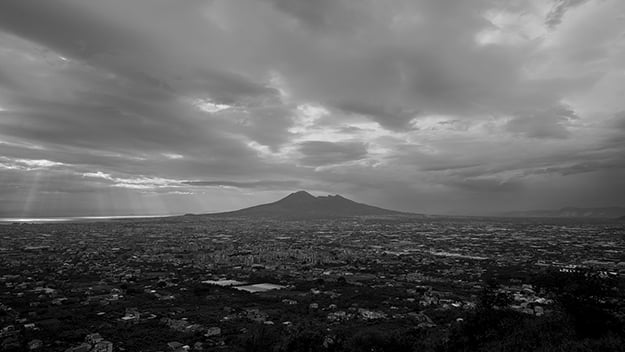
“This is a time machine,” a guide declares to tourists clad in transparent ponchos as they descend into an archeological site in Gianfranco Rosi’s Below the Clouds, “and we’re going back.” Rosi’s magnificent documentary, filmed over three years in the shadow of Mt. Vesuvius in Naples, is about living in close quarters with the past—and with the ever-present threat of a volcanic eruption on par with the one that consumed Pompeii and Herculaneum in 79 A.D. That may sound oppressively ominous, but given the state of the world, from genocidal campaigns abroad to the erosion of civil discourse within our own borders, it was strangely soothing to experience the anxious status quo chronicled in Below the Clouds—and it made for a major highlight of the 50th Toronto International Film Festival.
Shot in black and white, with sweeping landscapes so spectrally luminous as to resemble silver gelatin prints, Below the Clouds brims with gloomy beauty. Behold plumes of cinders, colossal cones of Ukrainian grain, Japanese archeologists brushing dirt from bone, films projected in an empty cinema, archivists exploring vast rooms of fractured statuary with only a single flashlight. There are, in fact, many scenes in which flashlights are the sole source of illumination, an elegant metaphor for our winnowed window on history. “Time destroys everything, but it also preserves everything, then brings it back to us in unexpected ways,” an archivist explains near the film’s end. While Rosi is especially attentive to the city’s relationship to its past, he’s also fully invested in lives lived in the now, whether he’s observing Syrian merchant mariners conversing while working out or exceedingly good-humored emergency-response operators fielding calls from citizens worrying over the tremors that regularly rattle the region.
Cinema as both archeology and a way of bearing witness to the present is also a central theme of Maureen Fazendeiro’s The Seasons, which was filmed in Portugal’s Alentejo region, famous for ancient megaliths documented by archeologists Vera and Georg Leisner in the 1930s and ’40s. Known for her collaborations with Miguel Gomes, Fazendeiro lights upon a ruminative ambiance for her solo feature directorial debut, incorporating excerpts from the Leisners’ journals in voiceover, and adopting a patient, bucolic rhythm as she observes a goat giving birth, an elder singing a traditional saia, children stroking a rabbit, and farm laborers peeling bark from cork trees as though skinning animals. I was beguiled by the way Fazendeiro and co-DPs Robin Fresson and Marta Simões’s camera kept panning over to a midday moon. At the screening’s Q&A, the director explained that the film was a means of making legible the stories sewn deep into this unique landscape.
You could make similar claims about Viktoria Schmid’s Rojo žalia blau, my favorite of the shorts in TIFF’s always-essential Wavelengths program, which celebrated its 25th anniversary at this year’s edition. Schmid’s travels to Austria, Lithuania, and Spain are captured through some process akin to three-strip Technicolor, rendering false the binary between ostensibly natural and artificial palettes. We see trees draped in Jell-O hues, clouds that distinctly resemble cotton candy, and phantom waves blanketing real ones. The film offers no context in which to read its enchantingly strange visuals. I kept wondering if this is perhaps how some animals see the world.
Among the fiction films at TIFF 50, none left me more appealingly unnerved than Nadia Latif’s feature debut The Man in My Basement, based on the novel by Walter Mosley (who co-wrote the script with Latif). Set in Long Island’s historically Black village of Sag Harbor, this slow-burn chiller follows a slacker named Charles (Corey Hawkins), who, following his mother’s death, finds his finances in dire shape and his employment prospects dim. He holes up in the house his family has inhabited for eight generations—many of his ancestors are buried out back—but the bank threatens foreclosure. Possible rescue arrives with the introduction of two very different characters. One is an attractive antiques dealer (Anna Diop) who is willing, reluctantly, to broker the sale of Charles’s valuable family heirlooms—including an impressive collection of seemingly haunted West African masks. The other is a mysterious, affluent man (Willem Dafoe) who offers Charles $1,000 a day to live in his basement for two months—just so long as Charles doesn’t tell anyone he’s there. As the conditions of this rental agreement become increasingly bizarre and Charles’s grievous indifference to his heritage grows more evident, The Man in My Basement reveals itself to be a poignant parable about the perils of not knowing where you come from.
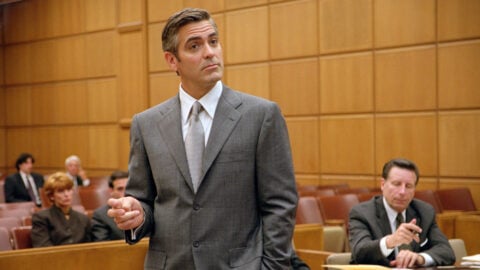
Dead Man’s Wire, the latest from Gus Van Sant, echoes his previous films To Die For (1995) and Elephant (2003) in that it restages a sensational shard of recent American history as a means of exploring collective anxieties that have only burgeoned in the ensuing years. Here, it’s the 1977 story of Indianapolis would-be entrepreneur Tony Kiritsis (Bill Skarsgård), who, after falling behind on his property payments, decided to take his mortgage broker Richard O. Hall (Dacre Montgomery) hostage. Fastening a wire to Hall’s neck that connects to a sawed-off Winchester so that any sudden movement will result in Hall’s head exploding, Kiritsis demands money and impunity, but what he desires most is an apology for the Hall family’s alleged conspiracy to exploit his financial woes and usurp his potentially lucrative patch of real estate. His resentment toward what he regards as institutionalized impediments to class mobility is the story’s engine, but what makes Dead Man’s Wire especially compelling are its playful formal conceits, such as intermittent freeze-frames, and the way Van Sant and scenarist Austin Kolodney weave peripheral characters into the narrative, most notably radio broadcaster Fred Temple (Colman Domingo), whom Kiritsis considers as an ally and ropes into the negotiation process—and whose programs, in a nod to Vanishing Point (1971), are woven into the film’s narrative. Having a DJ in the mix also allows Van Sant to incorporate choice cuts into the soundtrack, such as Roberta Flack’s propulsive rendition of “Compared to What.”
While the hostage situation in Dead Man’s Wire manages to avoid disaster, the same cannot be said for the doomy fiasco unfolding in Romain Gavras’s satirical Sacrifice. The film’s absurd plot gets moving when a star-studded environmental benefit event held inside a mine on a Greek isle is disrupted by a terrorist cult that believes the end is nigh and salvation will come only from depositing sacrificial victims in an active volcano. Among their hostages are an asinine billionaire (Vincent Cassel in Jeff Bezos drag) and Mike Tyler (Chris Evans), a Hollywood action star with a penchant for flamboyant feats of self-humiliation. The buildup to the confrontation between cynical celebrities and religious lunatics (led by Anya Taylor-Joy’s Joan) is frequently hilarious. The midpoint shift from mayhem in the mine to the spiriting away of hostages boasts some impressive set pieces, such as a nocturnal boat ride down a river into the heart of darkness, lovingly scored to Leonard Cohen’s “Who by Fire.” The last act, featuring something of a one-joke supporting turn from John Malkovich, is a little too tidy. What’s consistent throughout Sacrifice is Evans’s superb performance as a man so naïve, so insulated by fame and wealth, so amazingly dumb, that he’s willing to play the hero in any situation that demands one. The film portrays a battle between the privileged class’s assertion of the power of stories to (marginally) change the world and a radical religious cult’s belief in the power of spectacular death to cleanse that world of sin. Which arguably makes Sacrifice the quasi-apocalyptic film for our era of division, delusion, and disaffection.
José Teodoro writes criticism, plays, and prose. His book Nothing But Time: Conversations with Peter Mettler on Life and Cinema will be published by Anvil Press in October.