One Last Job
This article appeared in the January 9, 2026 edition of The Film Comment Letter, our free weekly newsletter featuring original film criticism and writing. Sign up for the Letter here.
Ella McCay (James L. Brooks)
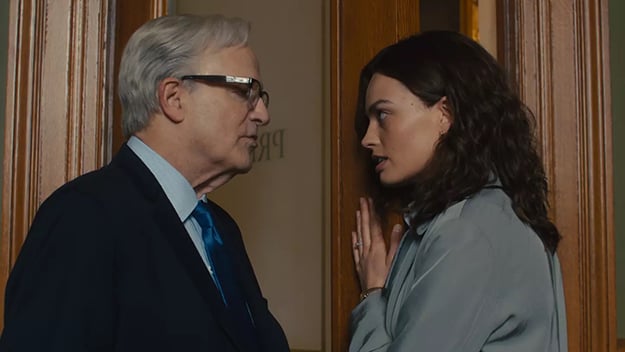
James L. Brooks’s characters have exciting careers. In How Do You Know (2010), Reese Witherspoon and Owen Wilson play an Olympic softball player and a star pitcher for the Washington Nationals; in Spanglish (2004), Adam Sandler’s harried restaurateur is proclaimed “the best chef in America”; longtime Brooks muse Jack Nicholson has played a bestselling author (1997’s As Good As It Gets), a network news anchor (Broadcast News, 1987), and an astronaut (Terms of Endearment, 1983). Ella McCay (Emma Mackey), the eponymous heroine of the 85-year-old Brooks’s first film in 15 years—and, given its box-office wipeout, very likely his last—is also thrust into a glamour profession. The year is 2008, and the governor of an unnamed state (played by Albert Brooks) is soon to resign to take a cabinet position (presumably as an appointment of president-elect Obama), leaving his wonkish, 34-year-old lieutenant governor to succeed him.
Ella McCay’s 2008 is “in a way, a better time,” per the voiceover narration of Ella’s secretary, Estelle (Julie Kavner). The nostalgic nod to a time now perceived as less polarized is a necessary scene-setter for a film whose plot hinges on legislative negotiations rather than our current politics of brute force and state violence. Ella is passionate about pilot program–tested incremental social reforms such as baby baskets and rural dental care (shades of Barack’s interest in behavioral economics, and of Michelle’s devotion to more nutritious school lunches). “Passionate” is the operative word: as the new governor evangelizing for the welfare state, Ella is almost manically earnest, with fluttering hands and wide eyes.
That the film is narrated by Kavner, the voice of Marge Simpson, may invite viewers to equate Ella with Lisa, but Mackey’s depiction of a neurotic Type-A woman unraveling and re-raveling has more in common with another iconic Brooks creation: the unmarried TV-journalist heroine of The Mary Tyler Moore Show. Starring Moore and centered on a local newsroom in Minneapolis, that show, Brooks’s second production for television, announced his interest in high-stress, high-visibility professions and was revolutionary as a workplace sitcom that allowed second-wave feminism to trickle into the domestic sphere one weekly episode at a time throughout much of the 1970s. It set Brooks off on a career spent in large part writing strong but self-doubting female protagonists—women like Holly Hunter’s Jane in Broadcast News, whose boss dubs her “the smartest person in the room” but doesn’t mean it as a compliment.
As Ella’s political mentor, Albert Brooks gives her more cynical advice than he gave Hunter in Broadcast News, in which he played Jane’s work husband: “You have to make dumb people feel less dumb.” Like Jane, Ella is too cerebral for her own good—a critique, flattering in its way, often made of Obama during his presidency. The film is fascinatingly unwieldy in the way it synthesizes multiple, increasingly less rosy-eyed eras of liberal politics into its characterization of one of Brooks’s archetypal working women. Ella’s strident and frequently alienating idealism also brings into play the “likeability” discourse surrounding female candidates, while the plot takes inspiration from the troubled terms of millennial women prime ministers such as New Zealand’s Jacinda Ardern and Finland’s Sanna Marin—both of whom struggled with burnout and salacious scrutiny into their personal lives.
Ella spends much of her first few days in office dealing with her personal baggage. An early flashback of a teenaged Ella introduces her philandering father (Woody Harrelson) as the root of her trauma—a word whose definition she reads aloud from the dictionary for the benefit of her kid brother. (It’s also revealed that Ella got an A on a paper titled “Can There Be Morality in Politics?”) As Ella assumes office, her father shows up in her home state after a long absence, wrangling self-servingly for a reconciliation; her security detail also ferries her over to the apartment of her brother (Spike Fearn), where she worries at him over his agoraphobia and inability to connect with people. And her husband, Ryan (Jack Lowden), portrayed in flashbacks as a Lloyd Dobler–esque teen loverboy who leveraged himself into Ella’s life by making himself into her biggest fan, now feels neglected. Angling for a cushy government post, he also mishandles a brewing scandal about the McCays’ inadvertent misuse of a Capitol Hill apartment for “marital relations,” to quote the flustered governor at a hastily organized press conference.
As early as the Mary Tyler Moore spinoff Rhoda, which depicted its titular character’s marriage and divorce across three seasons, Brooks has, in a very grown-up way, shown the workings of time on couples. One throughline in Terms of Endearment is the marriage of Debra Winger’s Emma and Jeff Daniels’s Flap, which begins in naive hope and rabid attraction before faltering under the pressures of midlife and ending in a rueful deathbed reconciliation; Spanglish is a very fine depiction of a husband and wife drifting apart while still holding on to memories of the person they once fell in love with. Ella McCay shows how the end of Ella and Ryan’s marriage is contained even in its beginnings, as their incompatibility, obscured by Ryan’s passion and Ella’s need for support, is brought bitterly to the forefront by changes in their circumstances.
Brooks’s sitcom background makes him confident in tonal shifts; he takes the movie from a sentimentality that was retro even in 2008 (when hope was so audacious that we had to call it “the new sincerity”) into laugh-track goofiness. When Ella’s brother finally leaves the house to reunite with a former love interest, he gives the sign of a local coffee shop a spontaneous little headbutt, like an exuberant puppy or a sitcom kid who’s always doing the darndest things. That love interest turns out to be played by Ayo Edebiri, who immediately locks into Brooks’s chewy, daffy, screwball dialogue. The scenes between Mackey and Fearn, and Fearn and Edebiri, are the best in the movie, so it’s a shame that they’re also the most peripheral to its central concerns.
The movie’s work-life balance is out of whack. Brooks’s characters, especially his women, don’t just have careers, they have vocations, but by the film’s climactic legislative summit, we’ve barely seen Governor McCay govern. Going back to Mary Tyler Moore, Brooks has been able to filter his leading ladies’ personal crises through professional dilemmas—the classic rom-com love triangle in Broadcast News, which hinges on whether Jane can ever be with someone whose work she doesn’t respect, is also a referendum on public-service journalism vs. entertainment television, and the substance of American institutions more broadly. Ella is warned that she has few friends within her own party, but so much time is spent resolving her childhood trauma that we don’t meet any of these pols until the film is almost over; we’re told, but not shown, how uneasily the values that motivate Ella in life—her righteousness, her selflessness, her belief that attention to detail is the the truth that sets one free—coexist with the horse-trading and fundraising of electoral politics.
And yet my frustrations with the film pale in comparison to my frustration with its failure to connect with moviegoers. Creaky and cringe as it is, Ella McCay is distinguished by the familiar warmth and polished witticisms of one of our most experienced entertainers. Brooks has long sought to distill the political into the personal, as he does here by condensing a nearly two-decade arc of liberal disillusionment into Ella’s retraumatizing and eye-opening first weekend in office. She’s a throwback, in a way, and so is the movie, which attempts to engage in civic dialogue through a purportedly accessible format and was greeted with almost total indifference. It’s cold comfort to hope that Ella McCay will find an audience on streaming, where the success of, say, The Diplomat—or, for that matter, reruns of The West Wing—demonstrates a continued audience for splashy and accessible zeitgeist plays. It would at least be a fitting career-capper for Brooks, who did as much as anyone to bring the zeitgeist into living rooms in the first place.
Mark Asch is the author of Close-Ups: New York Movies and a contributor to Reverse Shot, Screen Slate, Filmmaker, the Criterion Collection, and other publications.