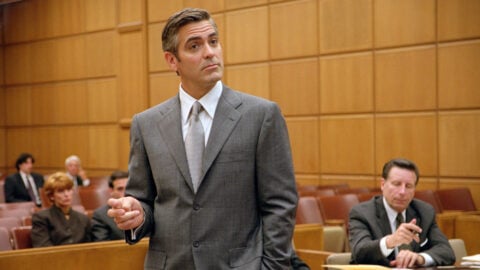
Being Yourself: George Clooney
This article appeared in the April 24, 2026 edition of The Film Comment Letter, our free weekly newsletter featuring original film criticism and writing. Sign up for The Letter here.
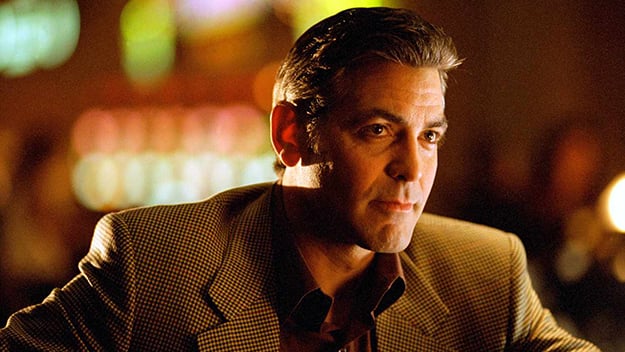
Ocean’s Eleven (Steven Soderbergh, 2001)
There is a scene in Noah Baumbach’s Jay Kelly (2025) in which the eponymous movie star—an industrially entrenched A-lister who’s entered the “lifetime-achievement award” phase of his brilliant career—stands in front of a bathroom mirror. There, he recites the names of other great leading men one after another, alongside his own: “Gary Cooper. Cary Grant. Jay Kelly. Clark Gable. Jay Kelly. Robert De Niro. Jay Kelly.” The words sound like a mantra, or an incantation. To paraphrase Travis Bickle, are they talking to him, or he to them? The anxiety of influence is a doppelgänger for delusions of grandeur. When you stare at the abyss, it (navel-)gazes back at you.
Conspicuous by its absence on Jay’s short list of Hollywood royalty is the name “George Clooney.” The joke is that Clooney is also extremely conspicuous in this scene by his presence. This would be true even if he weren’t playing a character in Jay Kelly modeled—however indirectly, and with plenty of playful humor and room for plausible deniability—on his own celebrity. “It’s a hell of a responsibility to be yourself,” reads an opening title card attributed to Sylvia Plath, although a quote from Bruce Wayne in Batman & Robin (1997) could also work as an epigram, for both Jay Kelly’s wild strawberries–flavored journey down memory lane and Jay Kelly’s melancholy showbiz metaphysics: “To succeed, we need only pick a star and follow it.”
For the record: George Clooney is not Cary Grant, nor Gary Cooper, nor his hero and onetime confidant Paul Newman, though he surely follows them. He isn’t Jay Kelly either, even if they seem to have appeared in many of the same movies. What Clooney is is conspicuous, always. His reputation, like his jawline, precedes him. When Time called him “The Last Movie Star” back in 2008, it was somehow premature and prescient at the same time, an acknowledgment of larger shifts in both the Hollywood hierarchy and celebrity culture at large. Hence the subtext of Clooney’s aging-apex-predator act in Wolfs (2024), a comic thriller about shady underworld types pressurized by themes of professional obsolescence and incipient extinction. “I just wanted to see how an old man would do it,” snarks Brad Pitt’s nameless cipher to Clooney’s similarly anonymous opposite number. Clooney’s spirit animal is increasingly the wily coyote, or maybe the alpha dog who fears he’s part of a vanishing breed. But as Jay Kelly proves—not that anyone was arguing the point—if there’s one thing he can’t do as an actor, it’s disappear.
Which is not to say that he’s incapable of magic tricks. In the right roles, Clooney channels that aforementioned conspicuousness—that heightened quality of recognizability—into a kind of flesh-and-blood special effect. Pauline Kael, who shouted out Clooney’s performance in Three Kings (1999) in her final on-the-record interview (“he was very good”), once called Cary Grant “The Man From Dream City.” Clooney’s gifts put that phrase in reverse. Instead of materializing out of thin air, he’s grounded, earthbound—not a figure of fantasy but a stickler for mischief. “Is this your first time being robbed? You’re doing great,” purrs stickup-expert Jack Foley to a mesmerized female bank teller in Steven Soderbergh’s heist thriller Out of Sight (1998); he turns armed robbery into a come-on. Tasked consistently with playing petty thieves, swindlers, and ethically flexible professional types, Clooney traverses familiar actorly terrain and transforms it, by sheer force of presence.
We want to look at some actors because their beauty is an open book, or a glossy magazine cover. Clooney, though, holds our gaze by concealment; his eyes are like tinted windows to the soul. To invert Kael on Grant, his face muscles never betray him, but they tell on his characters all the time, in increments. Exhibit A: Michael Clayton in the back seat of that taxi cab, an escape artist in a trap of his own making, held hostage by a close-up shot that refuses to cut to black. It’s telling, perhaps, that Clooney excels in roles that require his characters to keep up appearances. Exhibit B: his anguished CIA whistleblower Bob Barnes in Syriana (2005), who’s described by his own son as a “professional liar.” Who else would volunteer to play the hapless, just-following-orders bomber pilot commanded to drop the big one in Stephen Frears’s Fail Safe (2000), a live-to-air network-TV remake of Sidney Lumet’s Fail Safe (1964)? Clooney has often said that one of his favorite movies is Network (1976), which observes falling skies from ground level. One gets the feeling that if Clooney—who decided that what he really wanted to do was direct with 2002’s CIA-themed comedy Confessions of a Dangerous Mind—could have been any American filmmaker other than himself, it would have been Lumet.
Or maybe he’d have been one of the Coen Brothers. Both Confessions and the knockabout football farce Leatherheads (2008) betray the influence of Joel and Ethan. The pleasure of Clooney’s performances for the Coens lies in how thoroughly he punctures his own bubble, so that the gravitas escapes. Clooney doesn’t ever disappear, but in these films, he is a shape-shifter. Long before Jay Kelly wondered how he stacked up against the star of It Happened One Night (1934), Clooney did a spot-on impersonation of Clark Gable in O Brother, Where Art Thou? (2000). Beyond its merits as an old-timey picaresque, that film began an extended and rewarding tradition of the siblings kidding their leading man’s vanity. Notable examples: con man Ulysses Everett McGill’s Dapper Dan pomade dependency in O Brother, star divorce attorney Miles Massey’s nuclear-bleached chompers in Intolerable Cruelty (2003), and U.S. Marshal Harry Pfarrer’s nervous tics in Burn After Reading (2008). Pfarrer’s cloak-and-dagger paranoia plays like a satirical revamp of Syriana, right down to Clooney’s beard. Instead of getting strapped into a chair by his enemies, Clooney’s character in Burn After Reading proudly shows off his own customized homemade sex throne, a just-for-her-pleasure endeavor kitted out with a store-bought dildo. (“I’m not set up to mold hard rubber,” he explains while gazing admiringly at his handiwork.)
“”Every time they send me a script, they say ‘you’re going to play a knucklehead’,” Clooney claimed of Joel and Ethan during the press tour for Hail, Caesar! (2016), in which he plays a hilariously suggestible 1950s matinee idol being force-fed dialectics by a cabal of left-leaning screenwriters. It’s a great piece of casting, effectively transforming Clooney into a liberal caricature worthy, if that’s the right word, of his haters. “Can’t [Clooney] see what the Coens are up to?” wondered Armond White, sardonically noting the conceptual links between Hail, Caesar!’s Blacklist-era pastiche and Clooney’s sophomore directorial effort Good Night, and Good Luck. (2005), about the public battle between Edward R. Murrow and Joseph McCarthy. A better question might be how somebody could miss the wicked self-deprecation of Clooney’s turn as Baird Whitlock in Hail, Caesar! (“What if I name names?” he queries his captors craftily).
Where Confessions of a Dangerous Mind spoofed cloak-and-dagger tropes, Good Night, and Good Luck. felt at the time like an extension of Clooney’s still-fervent activism. It’s every bit as square-jawed and sincere in its evocation of postwar Pax Americana as Hail, Caesar! is wild and woolly. This media-class morality play unfolds handsomely, classically, in (literal) black and white. It’s a solid (not stolid) and thoughtful movie that shows Clooney the director displaying a mix of visual acuity and self-effacement. As CBS producer Fred Friendly, he cuts a dashing, chiaroscuro figure while generously ceding the movie to David Strathairn’s Murrow, secure enough in his stardom to give a supporting performance. There are other examples: one reason why Alfonso Cuarón’s Gravity (2013) gains propulsion as a proverbial one-woman show for Sandra Bullock is that Clooney ensures something is at stake in his own character’s expendability (“Sit back, enjoy the ride,” he says before floating off into space, a benediction not just to Bullock’s character, but also the audience).
It’s telling that for all the Clooney movies that hinge on the premise of actor-as-event—not just Michael Clayton and Jay Kelly, but also Up in the Air (2009) and The Descendants (2011)—he’s often most effective in ensembles. The Ocean’s trilogy (2001-07) is the obvious example, with each successive entry more crowded with stars and more egalitarian, but there’s also David O. Russell’s Gulf War action comedy Three Kings, reportedly produced under duress but still maybe the most persuasive showcase, along with Out of Sight, of the actor’s ability to give even halfway-decent comic dialogue some Pete Sampras–level topspin. “That’s what makes SF so badass,” scoffs Clooney’s insubordinate Special Forces honcho Archie Gates, who turns his tour of duty in Iraq into a treasure hunt. “We got the best flashlights.”
Three Kings’s Altmanesque, war-is-hell horror show puts Clooney’s entire leading-man package on display: the skeptically arched eyebrows; the withering, sidelong one-liners; the tarnished-angel charisma; and the implicit sense of social conscience. The film looks in retrospect like the primal scene of Clooney’s screen persona, as well as of the criticism—lobbed plenty of times in real life, and as a rhetorical boomerang skittering through Jay Kelly’s house of mirrors—that Clooney’s range is perilously narrow, that he specializes in mediated self-portraiture. His response to these observations has historically been succinct: “I don’t give a shit,” he told Vanity Fair, protesting not too much but just enough, implying (without coming out and saying so) that making things look easy isn’t so easy.
Which means, of course, that he does give a shit—about the work, if not how it’s perceived. The final shot of Michael Clayton distills this tension. It works because of how assiduously Clooney works to bypass the fourth wall without quite breaking it. He has the expression of a man resigned to looking over his shoulder in perpetuity (the scene was shot in the middle of Manhattan, amidst a throng of real-life rubberneckers). Michael glances above, askance at, and past the camera, past us, towards some imagined vanishing point. If it’s possible to act in high-definition while blurring the edges, Clooney makes it happen. He’s his own rack focus. Somewhere, an actor wondering if he’s ready for his own sustained close-up will think of this scene while looking in the mirror; the name on his lips may or may not go without saying.
Adam Nayman is a critic, teacher, and author based in Toronto. He lectures at the University of Toronto Cinema Studies Institute, and writes on film for The Ringer, Film Comment, and Sight and Sound. He has written books on the Coen Brothers, Paul Thomas Anderson, and David Fincher.