


Voluptuous Misery
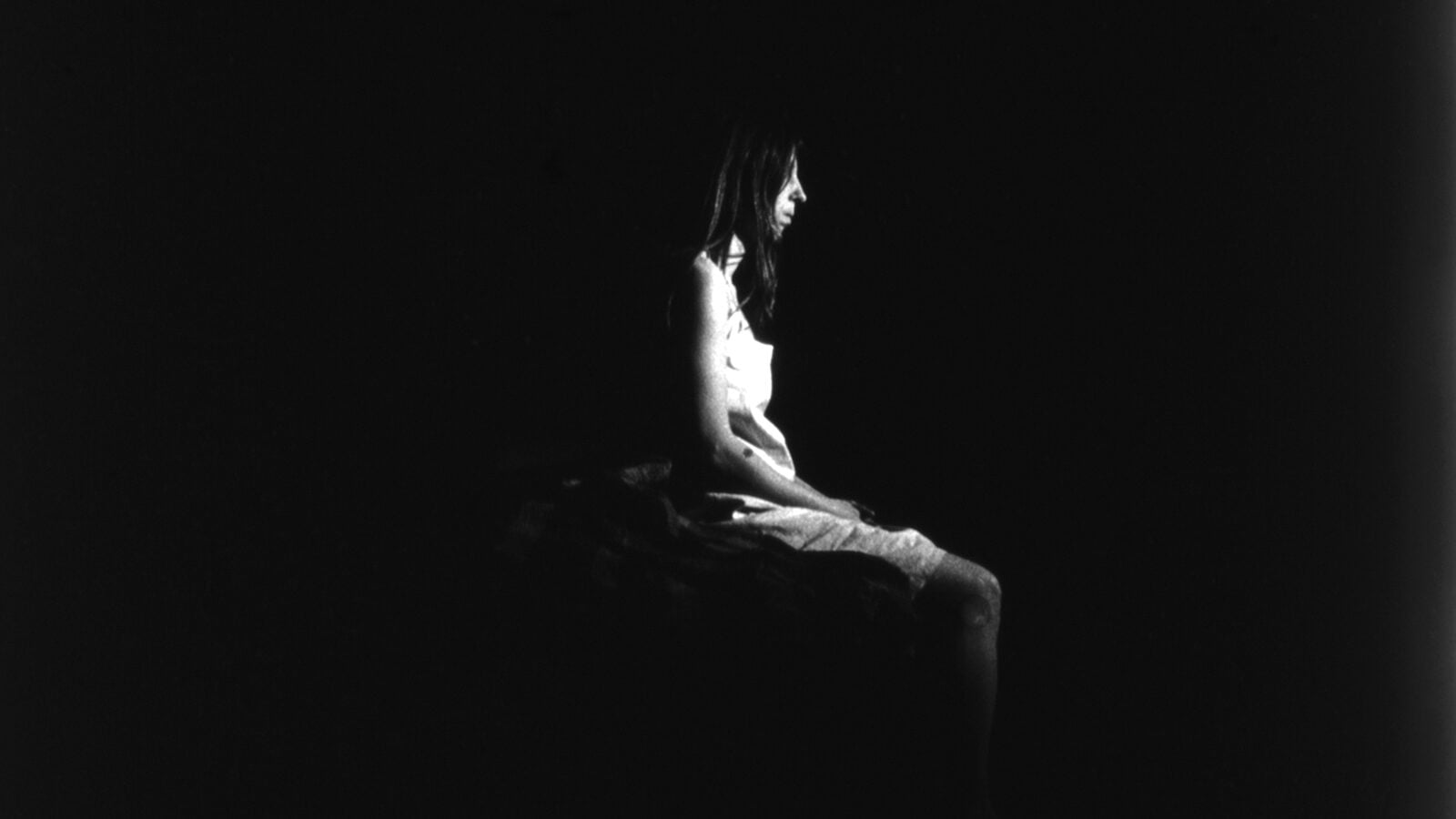
Recalling the incident in Turin that reportedly occasioned Friedrich Nietzsche's final breakdown into madness—his weeping and embracing a cab horse that was being beaten by its driver for refusing to budge—Béla Tarr's regular screenwriter, novelist László Krasznahorkai, has noted that no one seems to know what happened to the horse. But The Turin Horse is only nominally concerned with this mystery. It's more concerned with the horse's driver and his grown daughter, who live in a remote stone hut without electricity, subsisting on a diet of potatoes and palinka (Hungarian fruit brandy); a perpetual storm rages outside, then arbitrarily subsides, over a carefully delineated six days. Their abject life remains fixed on a few infernal routines, such as dressing, undressing, drawing water from a well, or simply looking out the window. (One exterior shot of the daughter doing just that, toward the end of the film, will haunt me for the rest of my life.)
What passes for plot gradually gets even more minimal when the driver’s horse first refuses to pull the wagon, then refuses to eat. Eventually father and daughter also become immobilized, confirming one of Tarr’s helpful statements—that this is a film about the inescapable fact of death. And Tarr is so unconcerned with the usual rules of consistency that he can theatrically light the father and daughter (the latter played by Erika Bók, the little girl in Tarr’s Sátántangó, 95, and Henriette in The Man from London, 08) while she refuses to eat, even though the previous scene, ending in total darkness, has shown the lantern repeatedly burning out. And “What is this darkness, Papa?” is a question that goes unanswered. This film is so bound up in what it’s doing that it can’t be bothered to care about explanations.
The other “major” incidents are no less perfunctory. A neighbor who’s run out of palinka stops by for a refill and expounds on the awful state of the world and those who “acquire,” “debase,” and “destroy” it. Perhaps because this is the film’s only extended monologue, some viewers are lured into thinking he must be expounding the filmmakers’ “message” rather than merely spouting bullshit (which is what the father suggests). But what Tarr and Krasznahorkai are offering is a vision, not a message. The only other visitors, two women and five men, arrive in a wagon drawn by two robust horses to fetch water from the well, all of them insanely cheerful. The father, who clearly despises them (“fucking Gypsies!”), orders his daughter to chase the group away. After one says to her, “Come with us to America,” he charges out of the hut with a hatchet, provoking their curses as they ride off; another leaves her a religious book about defilement that she reads aloud from, haltingly, in the next scene.
The next day, she discovers the well has run dry, but this is no sort of “message” either, neither a retribution nor causal in any way we can be certain about. Like the neighbor sounding off or the lantern refusing to stay lit or the daughter refusing to eat, it’s just another facet of a universe that’s blighted by definition—and one that can’t be sentimentalized as a blight populated by salt-of-the-earth types either. Ever since his 72-minute video production of Macbeth (82) in two shots for Hungarian television (available as an extra on the Facets DVD edition of Sátántangó), Tarr’s universe has operated according to some sort of demonic anti-theology that’s more a matter of feeling than one of principle; it can’t even be counted on to confirm the triumph of evil or pestilence or futility. If this proves to be Tarr’s final film, as he now maintains, this may be because it goes beyond any necessity to reach final conclusions about anything but extinction.
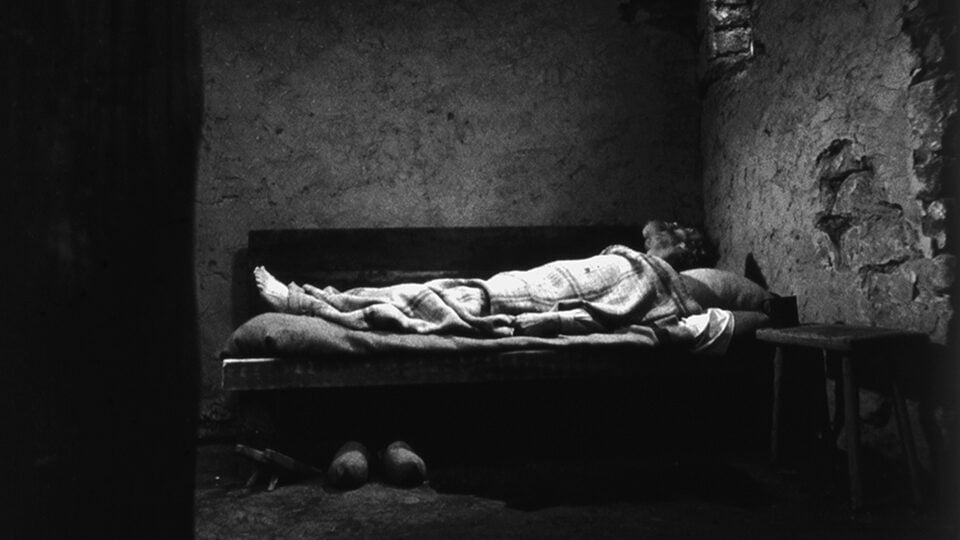
The Turin Horse (Béla Tarr, 2011)
I suspect the father hates the Gypsies partly because they’re so cheerful. I’m reminded of a hilarious early scene in Sátántangó that has no Gypsies but shows most of its major characters peevishly dismantling the furniture in their collective farm with great difficulty before moving out so that the cursed Gypsies won’t get their hands on any of it. (In conversation, Tarr confirmed to me that The Turin Horse, unlike Sátántangó, isn’t really Hungarian except for the palinka and Gypsies—and by the latter I assume he meant the everyday passionate Hungarian hatred for Gypsies more than the people themselves.) Clearly the father doesn’t feel the same way about his gloomy neighbor or even his ill, recalcitrant horse, whom he and his daughter laboriously drag along, in spite of its uselessness, when they attempt to escape after the well goes dry.
And why do they fail to escape? The film doesn’t say—that’s how little it cares about storytelling, apart from conveying the characters and their daily existence. Unless we redefine storytelling as what the camera does whenever it moves, which happens to be most of the time. That comes close to defining the narrative of Sátántangó, thereby implicating us at every turn. But does The Turin Horse implicate us morally in the same fashion? Not really, because the turf has become more metaphysical than sociopolitical. Part of this film’s mystery is how much it can borrow from the expressive materials of Sátántangó—black-and-white stock, a droning minimalist Mihály Vig score, horrible weather, rural setting, slow and perpetual camera movements, the characters’ seeming inactivity, a novelistic narrator summing up what they think and feel and who they are at the end of various sequences-without expressing the same things or serving the same purposes. It’s as if Tarr and Krasznahorkai were contriving to rum a chair into a table, or vice versa. Tarr is so adept at film illusion that many viewers still believe that he actually killed a cat in Sátántangó and that the hut here is some found object, not a constructed set. (Just as Sátántangó used a rain machine, this film uses a wind machine.) Like Kiarostami, he resents Hollywood so much that he winds up beating it at its own game, giving us the impression that he’s telling a story without actually doing so. The Turin Horse may offer an anti-universe following some anti-theology, but it’s one that lives and breathes.

The Turin Horse (Béla Tarr, 2011)
For me the abiding mystery isn’t what the film means but how and why we watch it. “Try not to be too sophisticated” was Tarr’s suggestion the first time he introduced it at the New Horizons International Film Festival in Wroclaw, Poland. A sound piece of advice, but not easy for all cinephiles to follow, especially if the “sophistication” resembles Dan Kois’s pseudo-populism masquerading as common sense in The New York Times Magazine (“Eating Your Cultural Vegetables,” April 29). Going beyond the usual middlebrow philistinism, Kois’s position suggests that audiences supporting art movies by Akerman, Costa, Kiarostami, Reichardt, Tarkovsky, or Tarr (strange bedfellows, these—back in the Sixties they would have been Antonioni, Bergman, Bresson Dreyer, Godard, or Resnais) must be masochists wanting to impose their self-inflicted punishments on others.
Factored out of such reckonings are those who regard Star Wars, Amélie, Slumdog Millionaire, Avatar, Inglourious Basterds, or even The Tree of Life as obligatory cultural vegetables. Meanwhile, denying that sensible individuals can find pleasure in Tarr films ultimately means attempting to outlaw the possibility that any might do so. Part of America’s eccentric mistrust of art and poetry is bound up with a bizarre association of both with class; the usual pseudopopulism deems such pursuits excusable only when they’re interlarded with religion and/or “entertainment” (which in most cases entails colonial conquest, revenge, violence, and/or some form of mush). To fail in this sacred duty apparently means to make films that are lethally boring, so that Rivette’s 13-hour Out 1, ,even as a serial, allegedly can’t be fun and games like Twin Peaks.
Why, then, did I wind up at all three screenings of The Turin Horse in Wroclaw, three afternoons in a row? Largely because of my fascination with how a film in which practically nothing happens can remain so gripping and powerful, so pleasurable and beautiful. I’m usually reluctant to compare an anti-cinephile like Tarr to any other filmmaker, but even though his diverse techniques are completely different from those of Erich von Stroheim, there’s something about the sheer intensity of both filmmakers as they navigate from one moment to the next that makes the usual rules and logic of film narrative and even the usual practice of following a plot seem almost beside the point—a kind of distraction. The world of The Turin Horse isn’t unveiled or imparted or recounted or examined or told; it’s simply there, at every instant, as much as possible and to an extent that seems more than we can think to cope with, daring us simply to take note of it.

Sign up for the Film Comment Letter
Thoughtful, original film criticism delivered straight to your inbox each week.