


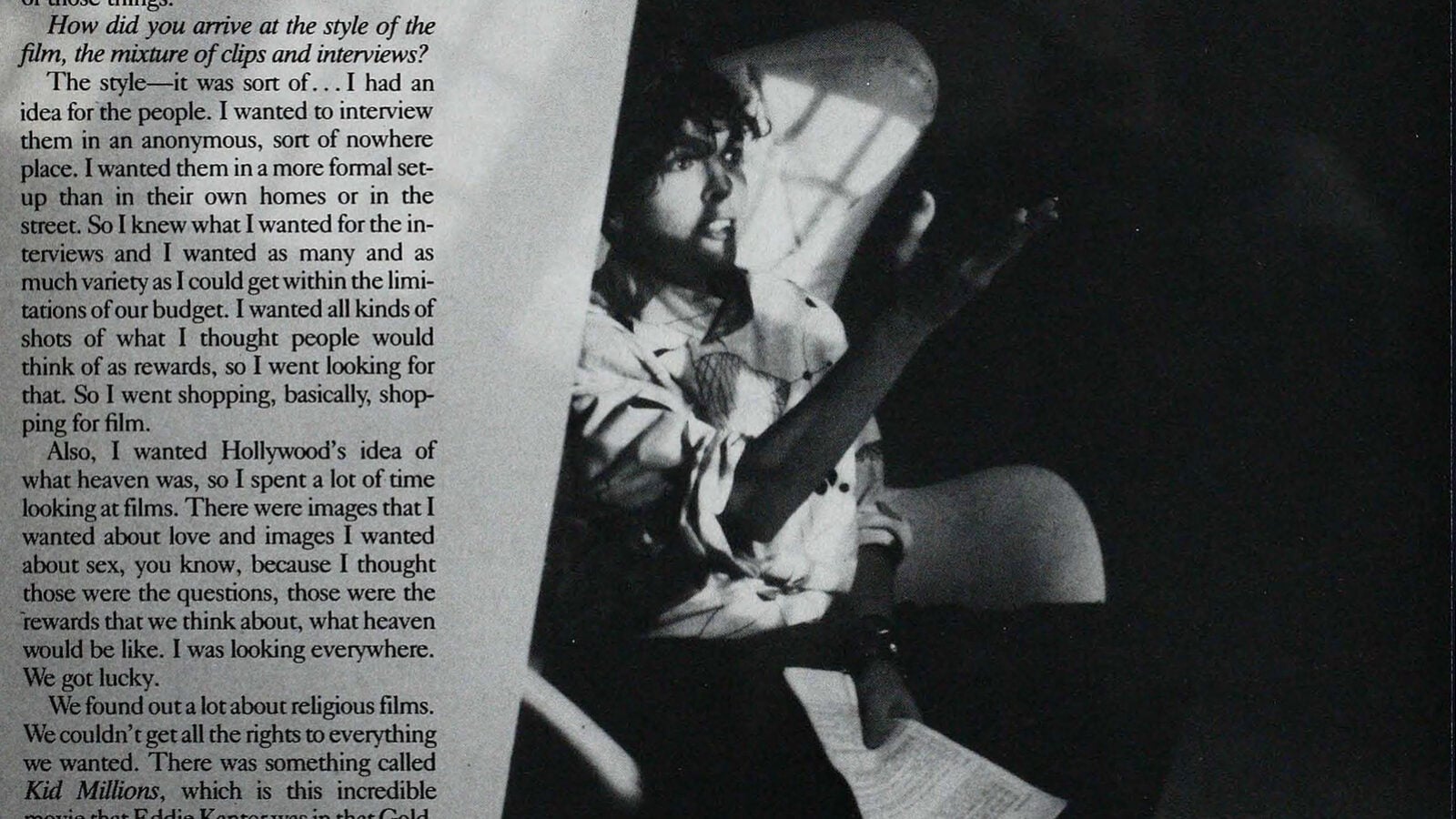
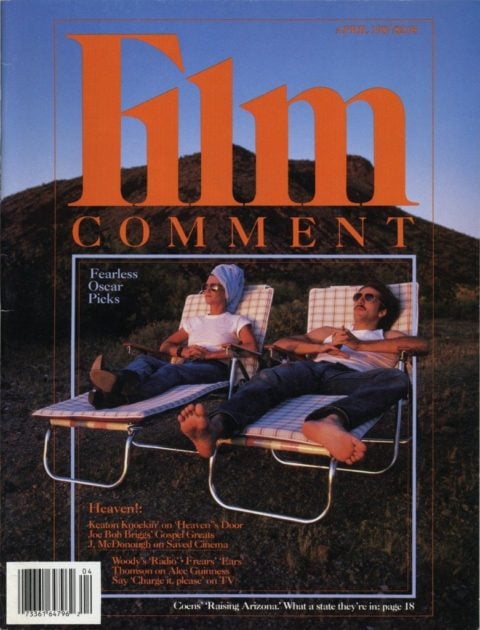
Hotel “Heaven”: Diane Keaton Interviewed
I remember at the end of the movies I liked, movies with happy endings, it thrilled me to think that life was reduced to a fixed moment in time. I was really susceptible to the idea that life, in the best possible way, was a dream. Happiness was something that you wanted to grab onto and stop. Heaven was a notion where everything was perfect; and in being perfect, heaven was motionless.” —Diane Keaton, in her intro to Still Life.
Neither a narrative nor a true documentary, Heaven is a kind of collage of old film clips and Sunday morning religious TV programs (the kind that come after Gumby and before Face the Nation), interspersed with interviews with “civilians,” all conducted by Keaton off camera. It’s a melange of sight and sound, categorized by eternal questions: Are you afraid to die? Do you believe in heaven? Is there sex in heaven (“You make little dead people?” one adolescent asks)?
While the clips and TV shows are mostly in black and white, the stylized interviews—shot on white sets that are both futuristic and retro—are in color. Patterned light or an astral image skim Keaton’s subjects, and like expressionist paintings, suggests states of mind.
Keaton drew from the likes of her grandmother, Mary (Grammy Hall), and her sister, Dorrie, but mostly people she found by scouring Hollywood Boulevard, Venice beach, and shopping malls. She read an interview with Don King, the boxing promoter and revivalist Christian, and enticed him into participating. “I’ll give you a piece of heaven,” King told her, “if you give me a piece of the devil.” King invited her to a boxing match—her first—and Keaton watched it Oreo’d between Muhammad Ali and Larry Holmes.
Heaven is not Diane Keaton’s debut as a director. In 1982, she filmed What Does Dorrie Want? a 17-minute documentary that focused on her younger sister, then a legal secretary. Keaton likes to question basic questions.
As an actress, her characters have been people who were their own best victim, yet who struggled with conflicts that course through contemporary lives. Keaton has struck some remarkable chords: in The Godfather I and II, Looking for Mr. Goodbar, Shoot the Moon, Annie Hall, Interiors, and The Little Drummer Girl. And her turns in Harry and Walter Go To New York, Play It Again Sam, Love and Death, Mrs. Soffel, Crimes of the Heart, and Radio Days surprise, seduce, and compel attention.
One of the most noticeable features of Heaven is just how much Keaton’s eye is at work, looking for different ways to phrase or highlight what we take for granted and so forget to see. This marks her work as a collagist and particularly her work as a photographer. Her first photo collection, Reservations (now out of print), consists of black and white stills of hotel lobbies, void of people but not of their presence.
Reservations stops at the Sterling Hotel in Miami Beach where a plaid couch on a linoleum-pattern floor butts a fake brick wall. At the Ambassador in Los Angeles, two fake firs covered with canned snow sit symmetrically against flocked wallpaper, separated by a fluorescent light fixture (the sort usually recessed into the ceiling). The floor looks like it’s covered in Astroturf.
Keaton also published a second collection, called Still Life (also out of print), which she and Marvin Heiferman culled from archival studio photographs and fanzines. In it, Mr. and Mrs. Ronald Reagan (Jane Wyman) repose, in a 1947 publicity photo, on their chaise lounges on their immaculately manicured lawn, differentiated from Hollywood below by a perfect hedge, while Ron sucks in his gut and Jane appears to hold on to the chair for dear life. Dolores Gray poses with her pink poodles, in her pink color-coordinated car, in a 1955 MGM photo. And in a shot from Paramount’s Easy Come, Easy Go (1967), a fully clothed Elvis Presley stands next to a totally submerged deep-sea diver. One book depicts life in America, the other, life in the movies and the differences aren’t too dissimilar, a point Keaton advances with Heaven.
Keaton talked about Heaven, after an extra-long day of L.A. shooting in director-screenwriter Charles Shyer’s Baby Boom, a comedy about a career woman who inherits a baby. In Woody Allen’s Radio Days (in which the Woody Allen-as-a-kid character, Joe, says: “My most vivid memory connected with a radio song was when Aunt Bea and her boyfriend took me to the movies. It was the first time I ever saw Radio City Music Hall, and it was like entering heaven”), Keaton is a torch-song singer in a ritzy Forties nightclub. When Allen’s camera finds her, singing Cole Porter’s “You’d Be So Nice To Come Home To” (“You’d be so nice to come home to and love/You’d be so nice!/You’d be paradise/You’d be so nice to come home to and love”), the first response is surprise, then appreciation for the layering. The Diane Keaton I met is far more similar to Radio Days‘ effervescent chanteuse (even after a long day of work) than Annie Hall.
Heaven is constructed the way Keaton appears to think: a burst of thought, followed by another, a doubling back and then forward, bundles of thoughts propelled by emotion (rather than vice versa), thoughts that vary in cadence and emotions that vary in intensity. Her thoughts are conceptual, her thinking creative, associative rather than lineal: More I won’t say. Diane Keaton is simply Diane Keaton. And Heaven is very Diane Keaton.
“When you take people out of real life and photograph them in an artificial situation, what you get is a sense that people are truly undefinable. What you want is to place that undefinable quality, which is totally impossible. It is also one of the reasons why life is more amazing than it’s sometimes cracked up to be.”
—Diane Keaton, intro to Still Life.
Where did the idea of Heaven originate?
Well, a few years back, I took a trip with a friend and we were in Salt Lake City—we stopped off at the Mormons’ visitor center there—and there was a film about heaven. It was like a surreal dream, these people sort of floating in the clouds. It just sort of grew after that, just sort of sparked my imagination, all these incredible things, particularly one shot from The Horn Blows at Midnight, which I’d seen when I was a kid. It’s just the most amazing shot, I think, with all these millions and millions of people and this orchestra. An amazing shot.
I thought about doing a religious film, talking to people about religion, wouldn’t that be fascinating and wouldn’t it be fun to sort of research films that already exist, religious films. Of course, I had no idea it would be difficult to secure rights, or any of those things.
How did you arrive at the style of the film, the mixture of clips and interviews?
The style—it was sort of… I had an idea for the people. I wanted to interview them in an anonymous, sort of nowhere place. I wanted them in a more formal setup than in their own homes or in the street. So I knew what I wanted for the interviews and I wanted as many and as much variety as I could get within the limitations of our budget. I wanted all kinds of shots of what I thought people would think of as rewards, so I went looking for that. So I went shopping, basically, shopping for film.
Also, I wanted Hollywood’s idea of what heaven was, so I spent a lot of time looking at films. There were images that I wanted about love and images I wanted about sex, you know, because I thought those were the questions, those were the rewards that we think about, what heaven would be like. I was looking everywhere. We got lucky.
We found out a lot about religious films. We couldn’t get all the rights to everything we wanted. There was something called Kid Millions, which is this incredible movie that Eddie Kantor was in that Goldwyn owns. We got it from William Everson, the film collector and film historian. He was very gracious and let us have clips of whatever we could use; he was really more than generous. So he put us on to this Kid Millions thing, which has the most beautiful ice cream heaven that you have ever seen, and it was in three-color Technicolor. It’s just gorgeous.
Well, we begged and we begged and we begged, and they wouldn’t let us use it because they figured, well, maybe someday [they] could release it. I just want to tell you, it was insane, we were so disappointed. MGM, which I had done a few films with, and [for whom] I had just finished a film, let us use a minute of footage from a lot of those good heaven films for free, except for printing costs and all that.
How closely did you work with William Everson?
He was utterly wonderful to us, right from the beginning. He put us on to films that were in the public domain. That’s why we got lucky. He gave us a lot of ideas, and if I said, “Okay, we need a lot of shots with angels,” he knew. He knew his library like nobody…. His mind is amazing about detail for every film that he owns and films that he doesn’t own, pre-’56. He only has, maybe, a few things from the Sixties; basically, his collection is earlier films.
Why did you choose older film clips?
Because of the expense. We couldn’t even get the rights. You can’t pay those actors, and it’s a big, big deal. So there was no human way we could ever have used anything too new.
You mentioned that when you were younger you saw a film about heaven.
Well, my idea of heaven as a kid was definitely an idea I was curious about and liked and accepted and sort of didn’t think about. So heaven images have always been sort of funny to me. Ridiculous, but sweet.
But they weren’t ridiculous when you were a kid?
I don’t think that as a kid I really had too many heaven images. I had sort of angels and clouds, nothing really specific. I think I believed in it, but I don’t think I really thought about it. I think it was about ice cream—mundane. So when I was a kid, it wasn’t really on my mind a lot, but it really struck me as fascinating later on.
When I saw the film, I thought two things: it demonstrates that people’s concepts are media-induced….
That’s true. It is real hard for people to think about heaven. It’s not really anything more than a hope or a wish, and it’s not something tangible. Obviously it’s abstract and you can only imagine it in human terms. Most people still in active lives don’t think about it at all. It’s not something you think about. You think about dying at times, which is actually why I used that idea of “Are you afraid to die?” because I think that dying is what brought us heaven.
And that was the other thing, that it is about death.
Yeah.
The images of heaven in the film were often destructive images.
That’s true, isn’t it? It’s weird.
It wasn’t necessarily a nice heaven.
It’s like the David Byrne song, “Heaven is a place where nothing, nothing really happens.” It’s so boring. Without conflict… I mean, What is life without conflict? We don’t know. Without conflict, heaven is like a still life. No movement, no nothing. Heaven is just an extension of life here, I think.
It’s interesting that you mention a still life, because there is some similarity between Still Life and Reservations and the film. The sets look like the hotel lobbies in Reservations, and the people look like those in Still Life. Did you intend that?
To take a person out of their normal situation and to stick them in their sterile setting made it more like a dream to me. The whole movie is about something that’s not real. It’s about people’s imaginations. It’s about wishes and longings and hopes. I don’t think of this as a documentary; it’s just a strange little movie. How would you do a documentary about heaven? It’s more about the imagination. I didn’t think it would be much fun to take people off the street and talk to them about heaven.
And it recalls the collages that you’ve done. There was a certain sense of irony in it, of mixing the old with the new…
You just can’t get away from yourself, right? You’re sort of stuck with you. You and your interests. Right?
How about the people? Why those particular people?
Well, we had a lot of people. A lot of the interviews just didn’t work, because they were boring. We needed to get rid of people who we’re not going to listen to, because we’re not talking about an in-depth, serious piece here. The people we used turned out to be the people who had a more vested interest and who had a more poetic, or more angry… Just more. Because you can’t sit there and look at something for 80 minutes and, “Well, it’s just a state of being….”
There were a lot of people who just didn’t work at all. Originally, we thought we’d have a big cross section, but it turned out to be people with a more emotional attachment to it. And the people who often had a more emotional attachment to it were the ones who were lonely, who were angry, who were poetic, who are on the fringes of the mainstream. But lovely. I fell in love with some of those people. I really identified with them. Because I think everybody really longs for something.
New Yorkers were saying, “Why weren’t there more people like us?” It seemed very “California.”
Yeah, well. Yeah. It was. It was “California,” and that’s where we shot it.
Why?
California? Because it’s much more of a melting pot for people with kind of stronger religious feelings. People come to California for dreams. And we shot here because we didn’t have that much money, in truth. It’s not like we could just shoot it in California and in New York and in, you know, Atlanta, or wherever. And I felt California is the place where people come frequently, dreamers…. It’s like Nathanael West, and things like that.
Heaven‘s edit reminded me of gospel music, that repetition.
Well, we initially had a lot of death images. And when we first cut the movie together, we had like 15 minutes of death. We were going to open it with all this dying, all these dying shots. Of course, that did not work at all. So then we thought, What if we had short bursts of it throughout? So we have this overlapping sound from this religious fanatic, like a little buzz from the dentist, a little jarring thing, and just repeat it occasionally. And we have these images, just to remind you that “Are you afraid to die?” is one of the reasons why people think about heaven and what you can get in heaven. Is there love there, and how do you get there, and what is it, and do you believe in it?
So it sort of came out of a mistake. Like a lot of things. It came out of 20 minutes of looking at death images and realizing that nobody’s going to want to watch this. You know, it just doesn’t work—we just cut it down real fast.
We had this guy who has a great voice, Dr. Hymers, a religious fundamentalist here. [Dr. Hymers is also in the movie, in one of the debates.] And I, at home, edited it by repeating certain things out of all of his sermons. I just took out the most dramatic and put them together. Because I thought that sound was important.
It was kind of Paul Barnes, the editor; Joe Kelly, the producer; and I—we all worked together a lot. It was just every day, trying and throwing it out, and trying and throwing it out. That was the way we did it. And then we got it to Skip Lievsay—he’s the best sound guy around. And I said to him that sound was something that we really wanted to play around with. Why not try it? He was great.
The way you chose to shoot interviews. I notice that you shot the older people differently, Grace and Mary…
Mary is my grandmother.
You shot her like a photographer. You shot extreme close-ups on her eye, for instance. Why?
Because they meant a lot. On the second shoot, we did close-ups. We had two bouts of shooting, and we went back and got some people again, because they were people you liked and cared about. So I wanted to get in closer. Because I loved Grace. And I loved Mary.
They showed such strong sensitivity.
I think we needed it. We had the longer, more medium shots, the far shots that show you the set. And we had some funny things—like the interviews—all on the first shoot. But when we saw what we had, we realized that we needed to get somebody that you care about, at least, just a bit. I don’t think that it’s a movie about caring about people, really, but [I wanted you to] be touched by somebody. So that’s when I decided that we had to get in, to get tighter, to try harder with the interviews and hang in with them a little bit more. And then I thought, let’s not get new people, let’s stick with people we liked to give us more.
Did you have any influence on the shooting of the older witnesses in Reds? I was reminded of that right away.
Oh no, not really. No. I did feel that those people in Reds were just so wonderful, just so great.
It was such a daring idea.
Brilliant. It was just brilliant. It was so hard to believe that you could have them and then cut to this scripted movie where we were acting, and it was okay. It gave us the license to tell this story, because they were so mixed about what the actual history was…. The truth is not a rigid thing. The past is seen through people’s eyes who lived it, which is personal and slanted, according to how you feel or think. It was so right. But no, I had nothing to say about that.
I don’t know if it was [Vittorio] Storaro’s idea or Warren’s idea to have the black backdrop and simple, plain lighting. But in Heaven, I wanted to use a patterned light that made you feel like you were someplace else.
“Every one of them is the best possible version of themselves imaginable. They live in the heavens. They’re like mythological beings whom we fashion ourselves after in moments of weakness.”
—Keaton, on film stars, in Still Life.
Why have you chosen to work in documentary form so far, instead of narrative and working with actors and actresses?
Well, it’s like real behavior, real people. And they say things that are surprising. And I’ve always liked documentaries. It’s an excuse to explore certain worlds. When else am I going to get to go to Hollywood Boulevard, you know, hang around, and go up to people and say, “Hey, you know, what do you think about this?”
Is that what you did?
Mm-hmm. Oh yeah, and we went to the Christian Motorcycle Club in Garden Grove to find people.
There’s a Christian Motorcycle Club?
Yeah. We interviewed one of those guys, but it didn’t make the movie. It didn’t work. But it was a great idea. I mean, it could’ve, maybe. But we just did all kinds of things to find people.
Was it hard to get backing because it was such an unusual idea?
I don’t understand it myself. It initially started as a much smaller film, a shorter film, and it grew. And RCA, for some unknown reason—[gave us the money]. I don’t know why; I’ll never understand it. I love them for it, but don’t ask me, I don’t know what they were thinking. But I’m very grateful. Eternally grateful.
Is it harder for an actress to get backing for a film than an actor?
I never really believed that it was happening. It just sort of continued to go. And so it was like this magical thing. I never thought about whether it was easier for an actor to get funding—for a film about heaven? I think women directors are doing pretty good now, aren’t they?
They’re doing better. I don’t know how great they’re doing. But I think we see more actors directing.
I guess that’s true. I think it really depends a lot on the actress—what she’s interested in and how she’s going to make things happen. This was an odd situation, because I’m not someone who really sells something. I’ve tried to, but I wouldn’t know how to…. Well, maybe that’s not totally true. See, I don’t know how some people just get things done. Some people just know how to get things done. I don’t think about it in terms of male and female.
See, I don’t know if this is an industry thing, though. I don’t know if I could get a real feature, a comedy or a drama. That’s another matter. That’s a different animal.
So you pretty much got money right away.
Yeah. It was an idea and we wanted to do it, and I first thought it would be a lot less money and a lot smaller. And I honestly can’t figure it out.
Did RCA want to have input?
They did. We had to show them, along the way, the various cuts. We had to show them the 15-minute death stuff—we put them through that. But they were very good about the whole thing.
Heaven‘s sense of irony reminded me of Reservations. It also reminded me of your acting in a way, too—the serious counterbalanced by the comedic.
Oh really? Hmm. I don’t know what to say about that.
Was it a conscious kind of thing?
Oh God, I don’t think it was conscious. I mean, I thought: “Here’s what I have. How can we make it work?” Real practical stuff. And the only thing I know is that there are some funny things, and that’s good. You have to try to be not too silly toward the end, because everybody’s afraid to die. And everybody hopes for something. And that’s what’s sweet about it, because you feel for those people, you feel for yourself. Because you are one of those people.
I also felt that people who believe in hell were ridiculous and that the idea of hell was something that I could never go along with, ever, because it just is too foolish—it’s just about anger, about hostility, by people who feel that because they got the bad end of the deal here in life, you’re going to be punished in the next life if you don’t follow the rules.
I do think that you can’t get away from yourself. I think that one is a certain kind of person, and given the chance you get a chance, you get the opportunity to express yourself. Then frequently it does have a kind of, oh, yeah, that’s part of… you know.
In the introduction to Still Life you mention the dioramas at the Museum of Natural History….
Taxidermy. Right.
And the people in your film, like the California Indian couple…
Oh, them. That interview didn’t work and we knew that, but they were wonderful to look at.
Did they come dressed that way?
Yeah. [Laughs] But we asked them to, because that’s the way we saw them—at a shopping mall or something. So we said, “Would you come and talk about heaven in your costumes?” And they did. But it wasn’t really right for the movie, because I felt that we should stick with heaven, like the Western, Christian version of heaven. They got a little spiritual there—he was talking a lot about the Day of the Dead—and I just didn’t feel that it was right for the movie.
Why just the Christian version?
Because it’s too big, the other. To get into Eastern or Indian ideas was not about what I was interested in. I was interested in American kind of heaven, Christianity, typical sort of apple-pie ideas about heaven…. It’s not an educational film where you inform people; it’s about what we all know about here in the States.
There’s another film about heaven coming out this year, Made in Heaven. With Alan Rudolph. That’s right. That’s a real movie, right?
Right.
I noticed at certain times in history…
That comes about, doesn’t it? I know.
I was wondering if…
If we’re due for that now?
Yeah. Just why…
Reassurance. People get more interested in fantasies than reality. And escape. I really don’t believe in heaven myself. People just want to be reassured, and they don’t want to think.
Why now?
Probably everyone wants to be sedated.
How did the people you interviewed react after…
After seeing the film? Some people got upset after the interview. Reverend Hands talks about…
He was the man who, in reply to the screenwriter, who asked how we know there’s a heaven if we can’t see it, said we can’t see our brain either, so how do we know we have one?
He was a little annoyed. He told Joe Kelly I was the worst interviewer he’s ever come across. But I can’t imagine he’s come across a lot. I asked him questions that put him on the spot. I asked him about homosexuality. Because he knows that they’re the kind of questions that get people upset. And get him in trouble.
As an actress, you’ve played a lot of very strong women who make big choices and throw themselves into difficult situations, dangerous situations, like in Mrs. Soffel and like Charley in Little Drummer Girl and Theresa Dunn in Looking for Mr. Goodbar. At the end of the films, however, those women are somehow subdued. Theresa Dunn…
Died.
And Charley was broken at the end. I saw that in Betty Blue and Something Wild, too, where two very strong female characters are subdued at the end.
See, but I don’t think that Mrs. Soffel was subdued. She really defied them to the end. And—it’s a true story—she got caught. She didn’t say, “I’m sorry.” She slapped the guy in the face and said, “Yeah, I’m going in and this is the man I love and go fuck yourself.” She had to go to jail. You know she was not subdued.
Charley was like a total lunatic. I don’t think that she was strong. I think she was always weak. And always crazy. She was an arrogant, little, selfish kind of actress who wasn’t very good and who insisted on being good and trying to be good, even though she wasn’t very gifted or talented. So she was going to throw herself into this terrorist world and be somebody. So she was pathetic, all ambition and no gifts. No brains. No nothing. She was not strong at all.
And Theresa Dunn was a case history, if you ask me. A lot of people view that movie as a morality tale. I never did. You know, like, “You fuck, you die.” But I always viewed it as a story about a self-destructive person who was never able to find her strength, because she was on the road to killing herself. So I don’t agree with you about those characters.
I think that Mrs. Soffel was positive, because she experienced real love. And for her, that made her life fuller. And at the end, she said, “You can’t take that away from me if you throw me in jail for a hundred, a million years.” I think she was enlarged by her experience. The other two were just sad people. I think that Theresa Dunn was really sad—sweet, because of that dichotomy in her: she could be with the deaf kids, which made her strong, but she was so crazy about men. It was more about punishment, you know, totally sadomasochistic. That she had to destroy herself that way.
I get the feeling that these aren’t characters you like.
I love them, are you kidding? I completely love Mrs. Soffel. And I felt for Theresa Dunn, because everybody has those elements in their personality. And I felt for Little Drummer Girl—I liked her the least because she was somebody who was so lost. But interesting. I mean, my God, all of us have so many elements in us that are so weak and strong.
You went to the Neighborhood Playhouse, and yet I’ve never heard you say anything about Sanford Meisner.
I also studied with Marilyn Fried for years—she’s a very important person to me. Sandy had this way of teaching which was really just about playing off other people and learning how to be real in a situation. He was very important to me. He gave me a way of approach which was natural and, I think, alive. And very simple, too. He was very smart and a very gifted teacher….
Are you working on anything else, as a director?
Well, I want to do a music video. I want to do a few music videos, which are much more about choreographing your shots, working with professional people.
And you’ll continue acting?
Well, sure. I think I’m an actress. But I’d like to do more directing. It’s less emotional, and it’s fun because your mind has to think in a different way.
Any subjects in mind?
No. I have a movie that I want to try to get on, and I want to try to produce a couple of fictional things. But we’ll see. I don’t know what’s going to happen.
How do you feel about growing older and the parts that are available for older actresses?
In the movies? See, look, I don’t think there are any rules. I don’t think you really know. In general, older people on film—there’s just not as much call for, not as much money to be made from it. I think all things can change, and as for me, I have no idea.
How do you feel about growing older?
I feel like everybody feels. I think it’s something that happens to us all, and I don’t think that it’s particularly easy….
What did your grandmother [Grammy Hall] say about growing older?
About the time we were doing the film, she just wanted to die. Because everybody was gone, and she didn’t want to live anymore. And she was very honest, brutally honest about everything. She was Catholic, which makes no sense. She got no comfort from being a Catholic. She just thought, “Well, I don’t know if there’s a heaven.” I respected her for that. But I also love people who have a dream, if it gives them some comfort. And they don’t punish people with their thoughts.
And are you afraid to die?
Of course, definitely. I don’t want to die. Are you?
Yes. Although when you’re older there seems more to leave behind. When you’re younger, it seems that it’d be easier.
I don’t think so. It really depends. It could be right for you. But I’ve seen some old people, because I do this volunteer work at this home [Keaton is a volunteer at the Jewish Home and Hospital for the Aged in New York], who are ready to let it go. And that’s kind of graceful. Maybe it is better to live your full life, if you’re lucky enough to have a full life. And then maybe it’s easier to let go. However, I can’t imagine it, to be honest with you.
Sign up for the Film Comment Letter
Thoughtful, original film criticism delivered straight to your inbox each week.