


Breaking Away: Diane Keaton Unbound
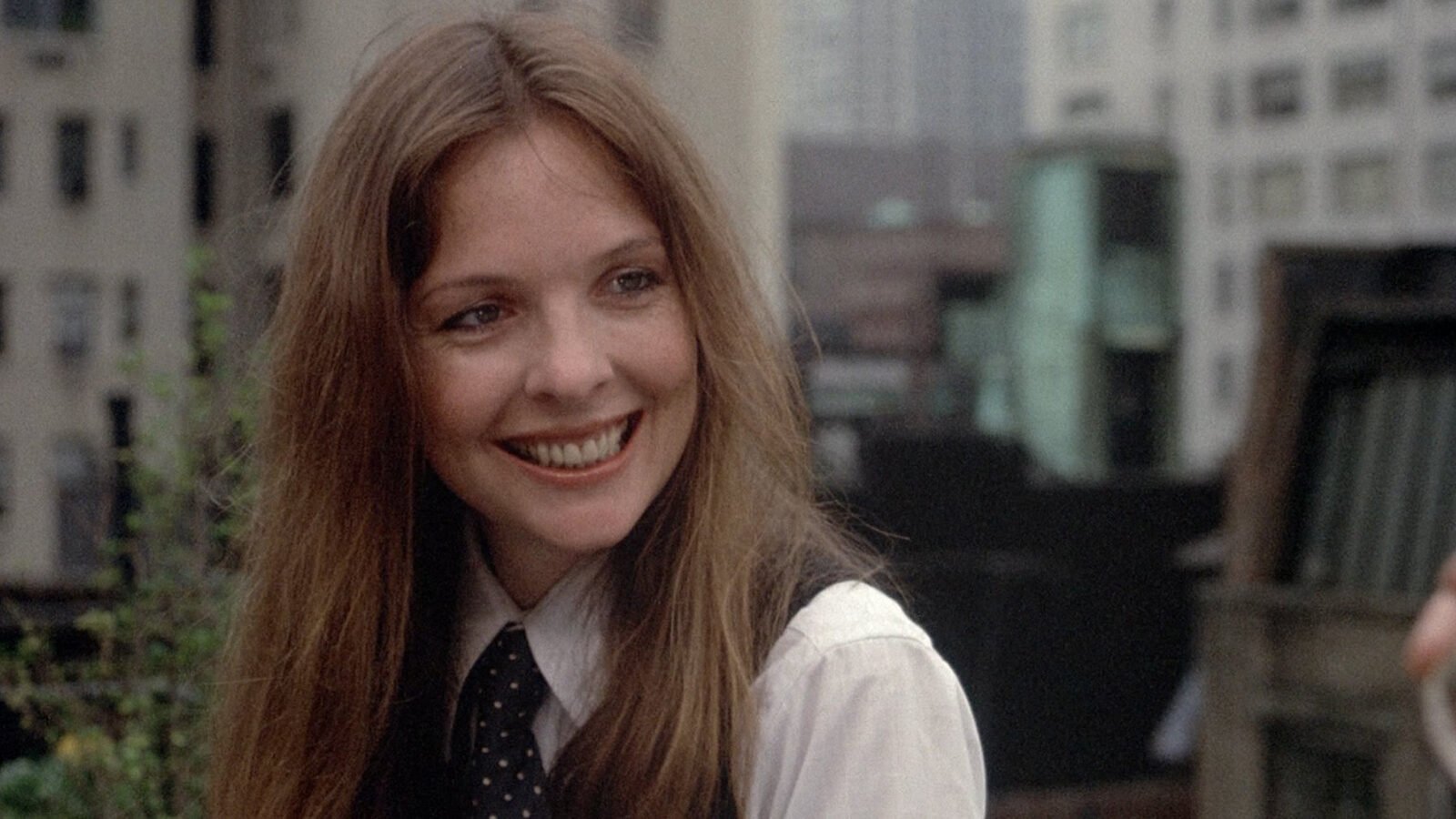
When praising Diane Keaton, we can start at worse places than Annie Hall in 1977. Yet those of us who saw her and Woody Allen’s most beloved film when it was originally released may watch it today with a pang of regret. Is it really 30 years old? Where is Annie now? Somewhere, we hope—albeit less giddy, but hopefully not as spiky and hysterical as the Long Island playwright Keaton plays in Some- thing’s Gotta Give (03). Do Annie and Alvy Singer send each other e-mails? About what—Bergman, Alexander Sokurov, lobster bisque? And why, in the intervening decades, has American cinema failed to produce a female character as loopy and cherishable as the apple-cheeked actress wannabe with the silent-comic wardrobe? The answer to the last question is simple: it was Annie’s Keatonness that made her unique.

She is eternally delightful, of course, in her Oscar-winning performance. The courting ritual on Annie’s balcony holds up, and the subtitling of her and Alvy’s thoughts still spawns copycat scenes. The lobster fiasco in the Hamptons has an unrehearsed spontaneity that prefigures Keaton and Allen’s handheld sequences in Manhattan Murder Mystery (93), but it’s more truth than fiction—a revealing vérité flash in which her merriments clearly unfeigned. How smart Allen was to zigzag between the wilting and blooming of the romance—Annie getting irritated by Alvy’s “anal” approach to moviegoing just before the Marshall McLuhan scene, Annie basking in Alvy’s compliment that she’s polymorphously perverse (not that she knows what it means), Annie truculently floating out of her body as Alvy climbs on top of it with minimal foreplay.
Then there’s the scene at the tennis club in which the beaming Annie hustles Alvy to ask her out. Thinking she’s blown her chance, she turns to the door and says something nobody had said in a movie before: “La-dee-da, la-dee-da, la-la . . . yeah.” She doesn’t trill this gaucherie—attributed by Allen to Keaton and by Keaton to the script—to puncture pretension, which it usually does, but to express incredulity at her own ineptitude at getting dates with a non-jerk like Alvy. Nothing more perfectly captures Annie’s lyricism or the awkward, winning musicality of Keaton’s flow. Allen was surely making the point that, once the dust settles on a relationship (on the rare occasions it does), we may recall lovers through the nonsensical or endearing things they said, like a reassuring essence.
Yet the sweet, frilly interjection has become a millstone—if not for Keaton herself, then for the appreciation of her complex screen persona. That it’s quoted in most of her press to this day shows how willing audiences are to reduce an actor to a symbol with the help of a sentimentally remembered catchphrase (the fate, too, of Bogart and De Niro). The less comforting things Keaton has said and espoused remind us that being adorable was just one of her bowstrings, and not the most taut. Toward the end of Manhattan (79), for example, Keaton’s Mary Wilkie realizes she’s not in love with her current lover, Isaac Davis (Allen), but with his predecessor and best friend. “I’m not the person to get involved with . . . I’m trouble,” she tells Isaac. The words themselves aren’t memorable, but Keaton—typically framing her character’s imminent defection with offhanded self-deprecation—made them sound like a death sentence.

Reds (Warren Beatty, 1981)
The “la-dee-da” syndrome gets to the heart of the governing fallacy about Keaton: that she is, above all, a comedic actress. It’s an idea sometimes fostered by the woman herself and by those who compare her with such screwball greats as Carole Lombard, Irene Dunne, Jean Arthur, and Katharine Hepburn. Asked on occasion for a supportive quote, Allen has bracketed her with Judy Holliday. What, then, of the Keaton who played Mary Wilkie, Kay Adams in The Godfather films (72, 74, 90), Renata in Interiors (78), Louise Bryant in Reds (81), Faith Dunlap in Shoot the Moon (82), and Kate Soffel in Mrs. Soffel (84)? Annie aside, these are the roles in which Keaton has done her finest work, and they are laden with disappointment, despair, and—per Allen—neuroses. From her mid-twenties through her mid-thirties, she regularly portrayed women who chase lost causes to the point of self-destruction. There is a strain of tragedy in her choices, too, though it might be construed as realism: she was excellent as terminally ill women in Marvin’s Room (96) and The Family Stone (05), and she cast Andie MacDowell as one in Unstrung Heroes (95), the best of the six movies and TV films she has directed.
Keaton is important—and the word sits uneasily beside the name of someone so determinedly unassuming—because she caught the feminist moment more than any other leading Hollywood actress, if more by chance than intent. Not even politicized stars like Jane Fonda or Vanessa Redgrave appeared in so many Seventies and early Eighties movies about women grappling with social confinement and the liberating possibilities of sexual freedom. Kay, Louise, and Kate all fight their way out of constricting marriages, and Anna Dunlap in The Good Mother (88) has done so before her screen story begins; Kay is literally imprisoned at the Corleones’ Lake Tahoe compound in The Godfather: Part II, and Kate is metaphorically incarcerated at the Pennsylvania prison where her husband is the warden. Louise, Kate, and Anna are rejuvenated by sex with antiestablishment figures.
It is not the fact of Keaton’s appearances in such movies that marks her as a feminist but what she did in front of the camera. She gave one of her bravest performances in Looking for Mr. Goodbar (77), in which the promiscuous Theresa Dunn is not truly liberated but a woman whose smiling encouragement to all those men thinly veils the psychological damage inflicted on her by her father.
By her own admission, she was “terrified” when she took the role of Kay, the trusting girlfriend first seen, in bright orange amid so much black, on the arm of Michael Corleone (Al Pacino) at his sister Connie’s wedding in The Godfather. But she was not entirely intimidated. “Yeah. Right. Sure,” Pacino recalls her saying when they and other cast members were introduced to Brando and it was tacitly agreed they should treat him like any other actor. The male enclave on the set mirrored that in the narrative, though Keaton did become part of Francis Coppola’s inner circle.
Her few scenes in the saga are indelible. Returning from Sicily, Michael finds Kay escorting children home from the school where she teaches and insists she get into his limousine. She’s reluctant to get involved with him again, arguing that “senators and presidents don’t have men killed,” but he chides her for her naïveté. This sets up the notion that, by the time of the Senate hearings, Michael has become perversely presidential and Kay has emerged as a Jackie Kennedy–like figure—the immaculately dressed, long-suffering consort. She has been shut away because Michael knows her conscience poses a threat to his activities. But her journey is heroic. When she tells him she aborted their third child, a boy, because she feared what he might become, Michael hits her—and she’s still registering her contempt for him as she crumples onto a sofa. It’s astonishing that Keaton is generally regarded as a funny girl given that, in her great dramas, she constantly coiled and sprang in fury at her husbands and lovers— Michael, John Reed (Warren Beatty) and Eugene O’Neill (Jack Nicholson) in Reds, and especially George (Albert Finney) in Shoot the Moon.
Picking up on her jitteriness in Play It Again, Sam (72) and having enjoyed her in Sleeper (73) and Love and Death (75), Allen drew out grayer moods in Keaton: Manhattan’s Mary and Renata in Interiors are exquisite studies of women whose vaunted intellectualism masks struggles with intimacy and low self-esteem. Damaged like her sisters by a sick, controlling mother, Renata has become an emotional isolationist—a selfish, brittle woman who takes refuge in her morbid poetry and sneers at her self-pitying novelist husband and directionless youngest sister (Mary Beth Hurt). If there is beauty in misery, Gordon Willis found it in his close-ups of Keaton, sublimely unsettling in one of her darkest performances.
Though Faith in Shoot the Moon takes a younger lover when George leaves her for his mistress, the film would render a feminist reading simplistic. It absolves neither of the parents for the way their tangled love lives threaten the well-being of their kids, especially the adolescent eldest daughter—yet it doesn’t blame them either. It is the Keaton film that most persuasively confronts the mess of adult emotions, and in Finney it gave her a partner with whom she could get down and dirty. Their dogfights have genuine bite and snarl, and their rapprochements are tender, knowing, and painful. Alan Parker frequently shoots Keaton with her back to the camera, and her hunched shoulders make you want to hold her. In one single shot, she pulls her hair aside as she weeps by a window; in another, she murmurs the lyrics to the Beatles’ “If I Fell” and takes a drag on a joint as she soaks in a bath, but she can’t stave off her anguish. Keaton’s body language always speaks volumes.

Something‘s Gotta Give (Nancy Meyers, 2003)
She has seldom been a sensualist. “You probably think I’m too cerebral,” Mary tells—or asks—Isaac at her most kissable moment in Manhattan. But she was uncannily vibrant and frankly sexual in Mrs. Soffel. Pauline Kael wasn’t a fan of Keaton’s performance but appreciated Kate’s rapture: “Ed [Mel Gibson] has been holding her against the bars and she has been speaking like a moral exemplar when suddenly, in mid-sentence, she lets out a dirty little giggle. We know then that Kate is living in a fever dream and doesn’t want to wake up.”
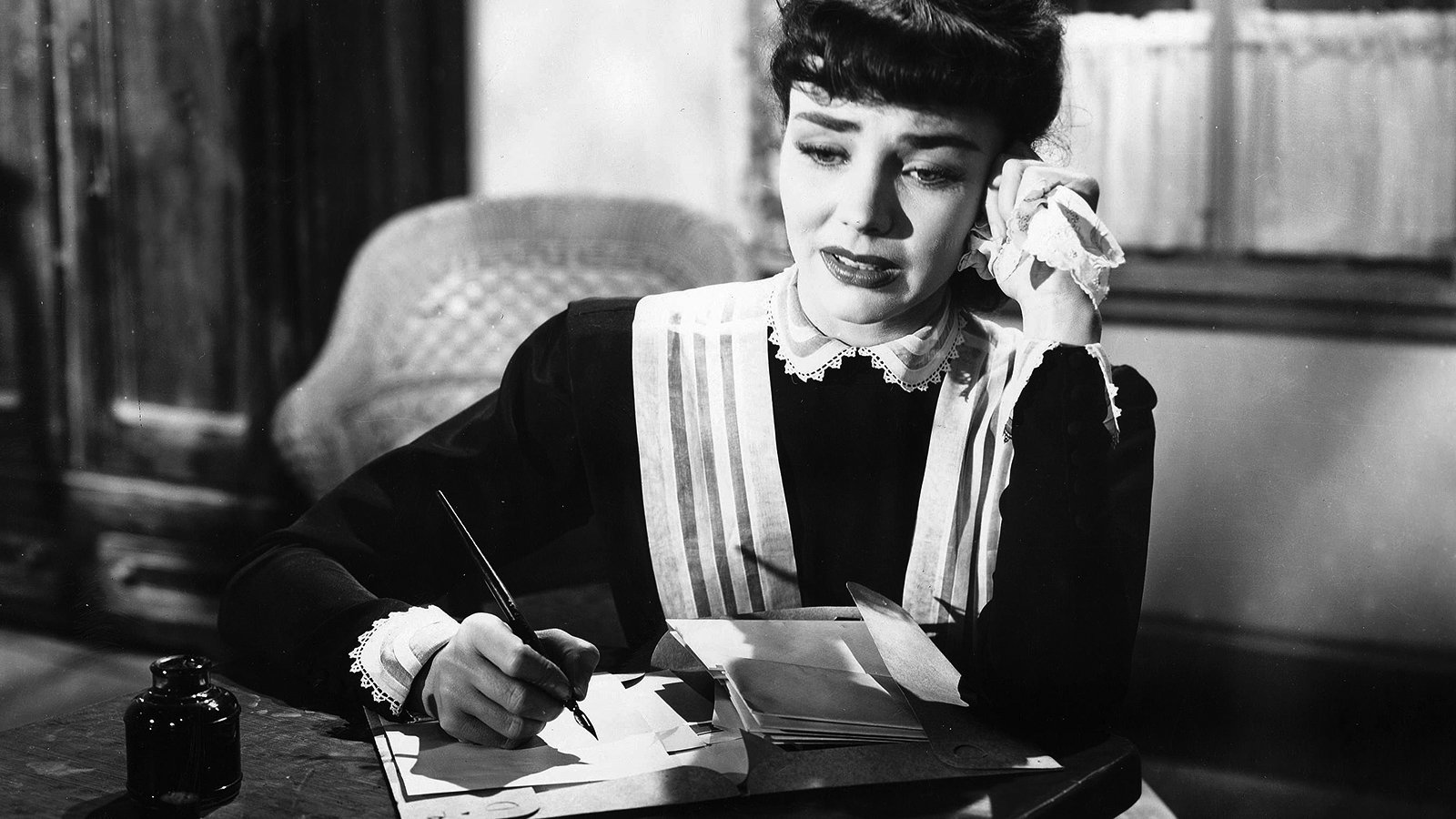
Reds is Keaton’s summit—not least because Warren Beatty let the camera gaze on her beautiful face: in times of sorrow, Keaton’s eyelids, like Louise Bryant’s, droop mournfully at the corners as if her tears have weighed them down. Beatty also had the sense to build the film around Louise’s private journey as John Reed’s adored but neglected wife rather than Reed’s public journey as a Communist revolutionary—and around his then-girlfriend rather than himself. The storming of the Winter Palace and Reed’s travels through Baku are epic in scope, but they are dwarfed, in emotional terms, by Louise’s storms and squalls, and the images of her wandering on the shore with Reed and plaintively singing “I Don’t Want to Play in Your Yard” during the Provincetown idyll, staring from a train window at a bloodied Russian soldier on the opposite platform, and gleaning that Reed has died in a Moscow hospital.
What is Keaton’s secret? What makes us care for her so much? It could be that she has something in common with the real Louise.
When Reed casually admits his infidelities to Louise, she takes off for Paris in high dudgeon—no matter that she slept with O’Neill during one of Reed’s absences on labor movement business. We are still getting used to their separation and Louise’s bid for independence when one of Beatty’s witnesses recalls a moment from her girlhood when she had asked an aunt what she thought of Louise. “Well, she had something that just appeals,” the aunt had replied. The words have the ring of authenticity in that they convey how an adult may try to explain the inexplicable to a child—vaguely, without candor. They suggest that the allure Bryant held for Reed, O’Neill, their radical friends, her editors, her other husbands (the dentist, the diplomat), the sculptor Gwen Le Gallienne, and many more, was irreducible.
The witness’s reminiscence is still in the air when Beatty cuts from her to a fleeting medium shot of Louise wearing a cloche hat. She’s writing as she sits in a bistro. There she is, a stranger in Paris, playing at solitude but horribly alone. The world may be on the cusp of a maelstrom, but not every left-leaning woman in the 1910s is cut out to be an Emma Goldman. Bryant’s integrity is defined by her feminine pride. Yet there is humility, too, in Louise’s devotion to Reed—the same humility that’s apparent in all of Keaton’s characters, from the timid to the reckless. It’s a kind of grace, that “something that just appeals.”
There has been the odd disaster in Keaton’s career, like The Little Drummer Girl (84)—though no one can fault her nerve. Among the girls, she was more fun in The First Wives Club (96) than in Crimes of the Heart (86) and The Lemon Sisters (90). The reunions with Beatty in Town & Country (01) and Nicholson in Something’s Gotta Give were strictly nostalgic. The latter’s championing of a middle-aged divorcée as a sexual being was well meant, but the prolonged howling in which Keaton indulges following her character’s breakup with Nicholson’s roué was, well, unmelodic. Yet the film made money and reaffirmed her popularity as a comic star. She was better as the dying matriarch whose liberal tolerance comes with a cruel streak in The Family Stone. The Christmas comedy descends into slapstick and mush, but it begged the question: was her brood freed by her passing, as Renata and her sisters were liberated by their mother’s death in Interiors?
Keaton has been a movie actress for 37 years and a director for 20. It says much for her enduring charm and her iconic power that she remains in demand and that her career has taken on a new momentum. Capitalizing on the success of Something’s Gotta Give, the recently released Because I Said So and the upcoming Mama’s Boy should consecrate her as the most attractive single boomer mom on the planet. It’s not a role that Annie Hall would have envisioned for herself, but it’s hard to think of a more positive one for an energetic 61-year-old. That’s not to say Keaton shouldn’t shake things up and play a harridan, a snob, or a graying femme fatale—maybe returning to haunt Woody one last time? To paraphrase the title of the Cole Porter song she sang in Radio Days (87), she’s always so nice to come home to.
Graham Fuller is a film columnist for Interview magazine.

Sign up for the Film Comment Letter
Thoughtful, original film criticism delivered straight to your inbox each week.