Time Has Told Me
This article appeared in the October 17, 2025 edition of The Film Comment Letter, our free weekly newsletter featuring original film criticism and writing. Sign up for the Letter here.
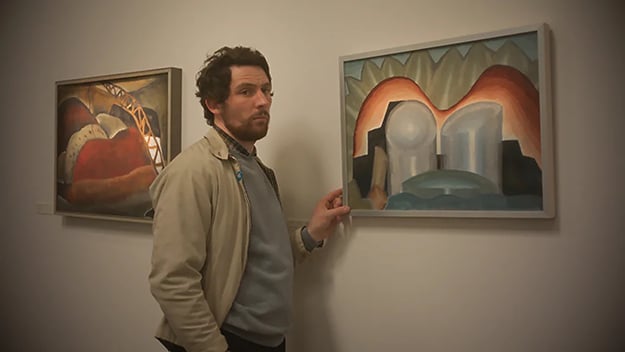
The Mastermind (Kelly Reichardt, 2025)
Kelly Reichardt’s The Mastermind is a deceptively laid-back affair: the palette is warm and autumnal, the humor is low-key, and the rhythms are organic and jazzy. But, as in many of Reichardt’s films, a sense of unease, or even menace, bubbles under the surface. The film is set in a placid pocket of suburban Massachusetts in 1970, as the unrest of the era seems to hover just out of frame. Only in two moments do things literally come to a head: first, midway through the film, when a young wife, Terri, played by a quietly fuming Alana Haim, hurls an alarm clock at the head of her husband, art-school dropout and aspiring master thief J.B. (a perfectly rumpled Josh O’Connor). The second comes at the end, when a cop suddenly clocks the head of an anti–Vietnam War protester.
Both eruptions take J.B.—short for James Blaine Mooney, a speaking name in the Dickens tradition—by surprise, as if he never expected his time to run out. He simply does everything too late. The saying goes that “even the best-laid plans go astray,” but J.B.’s plans aren’t even that good—as multiple characters point out, maybe he just didn’t think things through very well. The film opens with J.B., Terri, and their two loose-limbed, goofy kids (played by newcomers, and twins Jasper and Sterling Thompson) wandering through the galleries of the fictional Framingham Art Museum. As the the more talkative kid rambles through a schoolyard riddle about truth with his mom, J.B., his eyes trained on a sleeping security guard, cautiously grabs a tiny, carved wooden figure of a colonial soldier from a display, and pockets it. Composer Rob Mazurek’s skittering jazz score gives us a window into J.B.’s image of himself as a suave thief—one that’s belied by his sudden return to his quotidian family life: “Dad, do you know where otters come from?”
But the family trip to the museum is just a dry run. J.B.’s real master plan is to steal a handful of paintings by early-20th-century American modernist Arthur Dove. Why he wants these paintings, and what he’s going to do with them, is never satisfactorily explained; we suspect that he may not really know himself. As he lays out his scheme in the basement of his split-level ranch-style home, his accomplices, a couple of local fuckups, are skeptical, if not outright hostile. J.B., however, remains unfazed, telling them that they’ll be in and out in “eight minutes.” For once, he actually has time to spare: the heist starts about 25 minutes into this 110-minute film, and turns out to take only six total minutes of screen time, in and out. He and his goons pull off the theft, albeit with many, many hitches. The remaining three-fourths of the film tracks the slow fade of J.B.’s hopes for success, and his graduated exile from his family, his friends, and, finally, from free society.
Throughout, Reichardt toys with the tropes of the heist film, especially the suspense generated by scenes of criminality playing out in real time, as in caper classics like Le Cercle rouge (1970) and Topkapi (1964)—movies about men who are always one step ahead of the law, committing (relatively) victimless crimes that preserve their status as outsider heroes. Reichardt treats the heist as an interlude in an otherwise normal day in J.B.’s life, as he juggles childcare and his mother’s nagging phone calls. The filmmaker subverts our expectations for the genre, particularly through elongated shots: instead of building suspense, these fermatas make the action comedic, deflating our—and possibly J.B.’s—assumptions about how heroic heists play out. In one very funny scene, J.B. drives out to a nearby farm in the middle of the night to hide the paintings in a hayloft. As he struggles to carry his handmade crate and the four paintings up a wooden ladder, he comes off more like Buster Keaton than Alain Delon. Eschewing the tension-building crosscutting of a traditional thriller, Reichardt holds a flat, medium shot of the loft, cutting only to show J.B. going back down and then up again, as pigs grunt in the background. The whole scene takes a full five minutes, and we hold our breath the whole time—not because we anticipate danger, but because by now we know J.B.’s tendency to fuck up.
Cinematographer Christopher Blauvelt shoots fall in central Massachusetts through a soft haze; every earth-toned image of mid-century Framingham is suffused with a gentle fog. But the period clothes, cars, and buildings are perfectly ugly. There’s nothing nostalgic about the film’s vision of suburban America. Early in the movie, as the Mooney family lounges at the home of J.B.’s mother (a concerned Hope Davis) and father (Bill Camp in comically high-waisted shorts), a news program about the Vietnam War protests plays on the TV. We hear an activist being interviewed over a close up of a bored J.B. playing checkers with his son: “I think it is generally true, though, that there is tremendous feelings of powerlessness, cynicism, apathy on the part of large numbers of people.” This is as close as the film comes to explaining its main character’s choices, or his motivation to have “blown it all up,” as his slightly dropped-out friend Fred (John Magaro) puts it when J.B. hides out with him and his skeptical partner, an exhausted Gaby Hoffmann, in rural New England.
Reichardt has always been preoccupied with the ways in which our private conceptions of time bump up against the broader sweep of history. In Old Joy (2006), two friends diverge over time, having slipped out of phase with each other over the years. In Meek’s Cutoff (2010), the pioneers’ colonial fantasy of manifest destiny is utterly incompatible with the geological cycles and indigenous cosmologies of the American west. And in First Cow (2019), the fostering of a community, the seeds of which are sown by a relationship between two men, is crushed by a fledgling frontier capitalism. Her last film before The Mastermind, Showing Up (2022), dwells on the ways in which the practice of making art can suspend the rush of daily life, with its overwhelming deadlines, requests for rent, and familial obligations. As David Berman sings, “Songs build little rooms in time.”
J.B., in contrast, is not burrowing out his own pockets of time; he is adrift, a cork on the ocean. He’s almost entirely passive as the world closes in on him, at one point telling Fred that he doesn’t want to go to Canada—his surest means of escaping capture—because, he says, “I don’t think I’d do well in another country.” When he finally makes a decision to head to Toronto, he’s a few dollars short of a full fare, another missed opportunity in a life seemingly made of them. Instead of a charismatic antihero, the rugged individualist of American myth, Reichardt’s mastermind is a cipher, devoid of personal or political convictions, content to bob along on the tides of history until the waters swallow him whole. J.B. has neither the modest artistic ambitions of the heroine of Showing Up nor the grander political motivations of Jesse Eisenberg’s ecoterrorist in Reichardt’s Night Moves (2013). He can’t even bring himself to care that much about his family—in a revealing moment near the end, he tells Terri over the phone that about “three-fourths of what I’ve done was for the good of our family.” As fun and funny as The Mastermind is, it just might be Reichardt’s most chilling portrait of America to date.