The Best Scenes of 2025
This article is part of Film Comment’s Best of 2025 coverage. Read all the lists here.
The Secret Agent (Kleber Mendonça Filho)
Two teenage boys pushing a giant subwoofer down a desolate, nocturnal Tokyo street. A heist in an autumnal New England town comically distended by a station wagon whose cargo hold can only be accessed by hand-cranking a window. A room full of fugitives, united by little else than exile and persecution, cautiously meting out their secrets—revealing fascism’s far-reaching, sometimes invisible ties. The three scenes from the films of 2025 that have lodged themselves unshakably in my mind all stir the viewer out of the solipsism of the classic movie plot, in which the world around an individual is shaved away, the morass of time is whittled down into a neat teleological shape, and context is cut to the measure of the frame.
In Neo Sora’s Happyend, set in a slightly dystopian Tokyo, the subwoofer appears like the monolith in 2001: A Space Odyssey: large, dark, and otherworldly. Techno music emanates from the device as our two teenage protagonists, Yuta and Kou, drag it through subways, across bridges and down streets, manifesting a sinister incongruity: music meant for reveling crowds rings out instead in quiet emptiness. A pair of cops stop the boys, citing the noise as a disturbance, and then proceed to harass Kou—who is of Zainichi Korean descent—about his residence card. The moment drives home the ways in which “peace and quiet” can be an alibi for authoritarianism. There’s nothing a closed system fears more than something being out of place.
Kelly Reichardt’s The Mastermind warps the temporal tropes of the heist genre. Instead of moving at breakneck speed, cross-cutting between multiple timelines, and ratcheting up suspense, the movie—shot on 16mm—hews closer to slow cinema. Art-school dropout J.B. (Josh O’Connor) steals some Arthur Dove paintings from the local museum with discordant languor, and then spends much of the movie drifting about, dazed and confused. The pause that the hand-cranked window inserts into a clumsy robbery racing against time underlines the film’s pointed dissonance: J.B. wants to move at a pace that’s out of sync with that of the world around him (and, seemingly, beyond his own abilities). It’s a foreshadowing of the movie’s remarkable ending, where the protests against the Vietnam War, unfolding on the periphery of J.B.’s self-interested and misguided adventure, finally swallow him up. Try as he may to put on his blinkers, he cannot escape the flow of history.
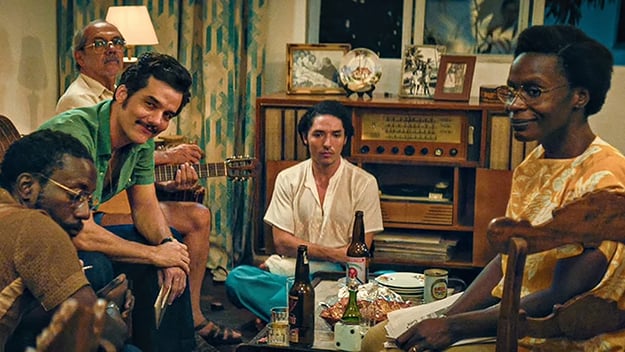
Kleber Mendonça Filho’s The Secret Agent is abundant with indelible scenes—whether the opener, in which the protagonist, Marcelo (Wagner Moura), drives into a gas station where a corpse lies decomposing on the ground; or the scene in which a shark with a severed human leg protruding from its belly is laid out on an examination table; or the sequence where that same hairy leg, now come to life, kicks its way through cruising spots in Recife, Brazil, a sly metaphor for the police’s crackdown on gay men. But one particular moment from the film that has stuck with me has no blood, gore, or flights of allegorical fancy. It’s when the residents of a sanctuary for people on the run gather for an evening of solidarity and music. The year is 1977, and the film concerns the Brazilian dictatorship, from which Marcelo is trying to escape with his son. But in this scene we understand that his story is but one thread in a web of horrors, both local and global, that stretch far beyond the film’s widescreen frame. An Angolan couple is fleeing the civil war in their country; a young man, presumably queer, has escaped his bigoted father and uncle; the matriarch of this safe house has secrets and scars she refuses to divulge.
The scene is a lesson in cinema’s powers: in the right hands, the medium can capture the true texture of historical time, as something that knits us all together, and yet, exceeds any individual’s grasp.