Something in the Air
This article appeared in the August 22, 2025 edition of The Film Comment Letter, our free weekly newsletter featuring original film criticism and writing. Sign up for the Letter here.
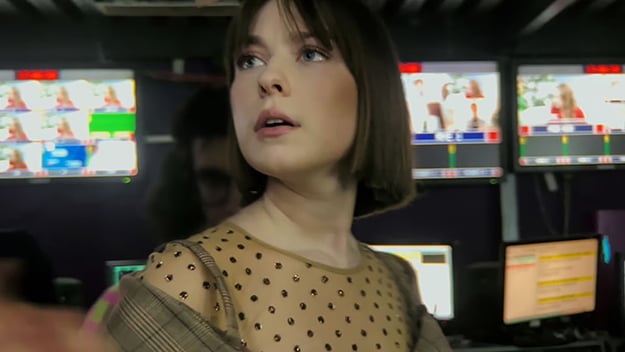
My Undesirable Friends: Part One – Last Air in Moscow (Julia Loktev, 2024)
Staggering out of a press screening of Julia Loktev’s My Undesirable Friends: Part One – Last Air in Moscow, I overheard a critic saying, “There’s a lot to process.” “Yes, there is,” I snapped at him. “But that shouldn’t prevent you from realizing that it’s a masterpiece.”
Intimate and epic, My Undesirable Friends: Part One depicts Putin’s Russia devolving into fascism during the last months of 2021, and then shredding the last vestiges of democracy, coincident with the regime’s full-out military invasion of Ukraine in February 2022. The focus of Loktev’s five-and-a-half-hour documentary is a small cohort of oppositional journalists, most of them based at TV Rain, the last independent video channel in Russia. Founded in 2010 as a youth-focused niche cable station, it was staffed largely by young reporters, producers, and technicians, many of them women, for much of its 12-year existence. By 2021, it had been kicked off cable and lost its advertisers but continued as a subscription website. When Loktev, an American filmmaker who emigrated with her family from the Soviet Union in 1978, read that TV Rain and all its journalists were required to brand themselves as “foreign agents,” she contacted Anna Nemzer, a Rain senior host, to say that there might be a film in the situation of journalists who were “othered” simply for reporting on opposition to the Putin regime.
When I first saw Loktev’s doc at the New York Film Festival in October 2024, it seemed unlikely, despite the threats to democracy that were already all around us, that the U.S., too, would become a fascist state. A mere 10 months later, I’m no longer that sanguine, and the all-too-prophetic My Undesirable Friends now feels like the real-life horror movie of the summer.
Basically a verité documentary (no narration, no talking heads), My Undesirable Friends: Part One is divided into two sections, which are in turn divided into chapters, five in all. Each chapter begins and ends with brief explanations that set the scene and tell us where we are headed. Thus, at the end of chapter one, which is titled “The Lives of Foreign Agents” and covers fall 2021, we are told that by the winter of 2022, all the characters we have met had been forced to flee Moscow, and now live in exile. It’s a Brechtian dramatic strategy, to reveal the conclusion of the story early on, so that we focus not on what might happen next, but on how it is happening.
Loktev directed, produced, shot, and co-edited (with Michael Taylor) the movie. Nemzer, who is Loktev’s and our guide through the first three chapters, is credited as co-director. Loktev shot the entire film on an iPhone, and she turns its limitations into advantages. It forced her to shoot only close-ups, and her finely tuned editing has disposed of any shaky handheld movements that might have called attention to the filmmaker as the proverbial fly on the wall. Even when her subjects talk directly to her, we forget that the camera is between them and us. The effect is the feeling that we are there: in the frantic studio of TV Rain where preparations for New Year’s Eve celebrations butt up against reportage of protestors gassed and hauled off by police; in the nearly empty office of Memorial, the NGO archive of the history of human rights abuses from Czarist Russia through the Bolshevik revolution to the present day, which is shut down and accused of “depressing children” with a negative depiction of Russia (sound familiar?); and in crowded apartments, where families and friends and animals gather to eat, drink, and strategize.
The tone of the 198-minute, three-chapter first section titled “Crackdown” is very different from the 125-minute, two-chapter second section titled “First Week of War.” In “Crackdown,” everyone is operating at a level of near-hysteria, wild laughter merging with barely choked-back tears. Irony is a survival tool, as when Nemzer, talking about government “fuckery,” quips that “they had laws in the Third Reich too.” This is not mere sarcasm or cynicism. It is holding a vision of the way things should be while fully acknowledging the way they are. It is a shield against cognitive dissonance—not admitting how bad things are so one can refuse to admit that they inevitably will get worse. “Crackdown” is a black comedy.
“First Week of War” is a horror-thriller. There is a gap of roughly six weeks between the two sections, during which Nemzer leaves with her husband and child on what she believed would be a weeklong working holiday abroad, but which turns into permanent exile. Loktev’s focus shifts to Ksenia Mironova, a TV host in her early twenties who is already a brilliant storyteller. Her partner, Ivan Safronov, is in prison, accused of treason. Mironova knows that if she leaves Russia, people will say at his trial that “his whore abandoned him.” The Russian army is amassing at the Ukrainian border, but the “foreign agents” are not allowed to use the word “war.” Journalists are detained, and the FSB, Russia’s security agency, is following everyone. When word arrives that the police are about to shut down TV Rain, the characters whom we have come to admire and love finally realize that they must put their entire lives into two suitcases and leave.
Mironova understands that she’d be of no use to Safronov if she were imprisoned, which she surely would be if she stayed. She entrusts her cats to a friend, still believing she’ll return soon. But it’s now been three and a half years, the war rages on, and our “undesirable friends” are still exiled and working as journalists around the world. Loktev has filmed them in 12 countries and is currently editing Part Two of this epic work.
Film Forum is showing the two sections of My Undesirable Friends: Part One separately (i.e., two tickets are required). If you don’t see both halves, you will not appreciate how extraordinary Loktev’s achievement is. As a sign of how prescient the film is, it has no distribution (neither theatrical nor home video) anywhere in the world. See it at Film Forum. It may be your only shot.
Amy Taubin lives in New York City, where she writes about movies and art.