Interview: Geeta Gandbhir on The Perfect Neighbor
This article appeared in the October 15, 2025 edition of The Film Comment Letter, our free weekly newsletter featuring original film criticism and writing. Sign up for the Letter here.
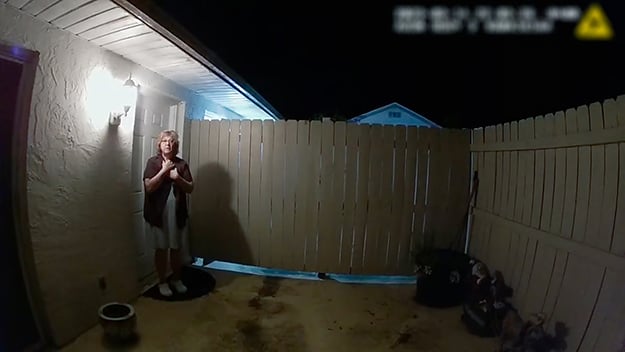
The Perfect Neighbor (Geeta Gandbhir, 2025)
For those of us fatigued by the carnivorous cycle perpetuated by narratives and images of police brutality, Geeta Gandbhir’s latest, The Perfect Neighbor, functions as a balm. Which is not to say that this is a feel-good film—Gandbhir’s chillingly detailed documentary tracks a story that unfolded over 16 months in an inland Florida town, and ended in the demise of Ajike Owens, a beloved Black mother of four, at the hands of her white neighbor, Susan Lorincz, who was emboldened by racist paranoia and Florida’s controversial stand-your-ground laws.
But The Perfect Neighbor achieves a kind of reclamation. The documentary is assembled almost entirely from body-camera footage recorded by the cops whom Lorincz frequently called to the neighborhood, in an attempt to restrict her Black neighbors and their kids from living their lives and enjoying public space. Local law enforcement’s presence on the scene was thus near constant—but Gandbhir draws our attention to the gaps in their footage. When the only real moment of violence occurs, as Lorincz shoots Owens through a closed door, there are no police or cameras around. In inverting the use of technologies intended for state surveillance, Gandbhir delivers a subtle yet powerful critique of the failures of institutions that purport to protect us.
Last January, shortly after the world premiere of The Perfect Neighbor at the Sundance Film Festival, I spoke with Gandbhir about the making of the film, her personal connection to the story, and her subversion of the true-crime genre.
Can you tell me about the first time you became aware of this story?
Ajike Owens was a close friend of Kim, my sister-in-law, who lives in Ocala [Florida]. They were raising their kids together, celebrating birthdays together, all that sort of stuff. They were each other’s family. So when Ajike was killed, we got a call from Kim’s sister, Tameka, who is an activist and organizer. She was returning from Jamaica, but her plane was diverted to New York because of the weather. My husband and I picked her up, and after hearing her story, we told her she wasn’t going alone. We got on a plane and went down to Florida with her.
We decided to start filming because we were really concerned that Susan would not be arrested due to Florida’s stand-your-ground laws. We wanted to make the media aware of the suppression going on with local authorities, and make sure justice for Ajike was a possibility. When she was finally arrested four days later, we remained concerned that she would be set free by a jury, because, again, Florida’s stand-your-ground laws are often weaponized against people of color. White people use it as a license to kill. The legal team did a FOIA request for all the materials the police department had, which then became public record. That’s when we first saw the body-camera footage, and we realized that it went back two years. Susan had been calling the police on the community for two years.
So we went through all the footage. Originally, we were trying to use it to help the legal team, but in watching it, I realized that this was the film. The footage paints a portrait of the community before the tragedy. Being that there’s so much gun violence in this country, unfortunately, we often see the aftermath of a shooting but not what the community was like before. For us, that was critical. Police body-cam footage is used to surveil communities of color in order to protect the police, so we wanted to flip that on its head and use it to show the point of view of this community—this tight-knit, diverse community of families just living their lives, being joyful, and taking care of each other.
Knowing that there’s this familial connection behind the film adds another texture to it.
We thought we would do a film that followed the family for a year and their attempts to get justice and impact change. But to be honest, I also made this film to mitigate our grief. We wanted to understand what had happened for ourselves. It’s only been a year and a half [since Owens’s murder], and we’re still grieving. It was a way to put purpose to the pain.
What makes the film so effective are your deliberate choices to establish the constant police presence in the neighborhood—and then there’s this absence of the police during the one actual moment of crime. That gap in the footage is really palpable.
The only person who ever called the police into that community was Susan. This is a community that has experienced systemic racism and the bias in policing; this is a community that never called the cops. It would not be their choice. Ajike tried several times to do what neighbors do to resolve disputes and talk directly with Susan, and she was greeted with hostility every time. My opinion is that the police had dismissed Susan as a nuisance, and so she took matters into her own hands. I think she thought that she would walk, you know? Again, these are really dangerous laws that embolden people. It’s not just in Florida; there are other states where castle doctrines exist and are part of the legal framework. It’s mostly used by white people against Black and brown folks. I believe that’s what happened here.
There’s a growing trend on YouTube where people take a similar approach to that of your movie, and catalogue and time-stamp police body-camera footage to track a crime story. Were you aware of this trend before?
No. I’d seen crime interrogations online. There are organizations like Witness that use such footage, and there’s also a film, Incident (2023), that uses body-camera footage. But because crime was not the focus for me, I didn’t think about it in that way.
Popular documentaries now exist in two categories: celebrity biopic and true crime. Your film adds a wrinkle to the true-crime genre. Was that a conscious choice?
I do not think of this film as true crime. This is a story that happened to my family, and I made it to mitigate grief. One of my concerns coming to Sundance was that I wasn’t sure there was a place for it in the world, because it can’t be categorized. You’re making something that hasn’t been seen before, and that can also be problematic in this culture where so much is algorithm-based. I wasn’t too interested in the commerciality of this; I just wanted this story out somehow.
One year after making this, I showed it to Ajike’s mother, Pamela [Dias]. She was a witness every step of the way, we never would have done this without her permission—but I warned her it would be really hard, and she didn’t have to watch this. We could just shelve it. We could put this out into the world because it makes an impact—or we could forget it, and it’ll just have been my process, me doing something to help me get through this moment. But Pamela is the bravest person I know. She watched it, and managed to get through it. I think it took her a while, but she said she wanted to try to put it out into the world. She takes a lot of strength from Mamie Till, Emmett Till’s mother. There’s a lot of traumatic stuff there, but her attitude is the same: the world needs to see what happened to my baby. The way Emmett Till’s mother had an open casket at his funeral after he was lynched, so people could see what happened to him.
The film ends with Susan’s trial, which wrapped up in late 2024. Did you always want to end with that final verdict?
No, as you know, trials often get pushed. There’s no schedule to them. It was supposed to be in June, and then it was pushed to August. Originally, we thought it was going to be in November or December of 2023. Once Susan was arrested, which you saw was the most ridiculous kind of circus, with her refusing to leave the room—once that had happened, we thought that we could end the film there. We could have a title card saying that the trial was pending, and hopefully that would keep people engaged. It just so happened that the trial happened in time to add it in. At one point I questioned whether we should interweave the trial throughout the film, and I thought, absolutely not. It is a full story up until the arrest—and then the family gets to have the last word.
You’ve talked about how the film was a kind of “grief work” for you. I’m wondering: do you have a great hope for the film?
The hope is always very lofty: to change some of these laws that put so many people’s lives in danger, especially those of people of color. I believe there are 700 deaths a year due to stand-your-ground laws. That’s 700 people who could still be alive, and that’s important to me.
And I would love to fulfill Ajike’s wish for her legacy; that’s sort of my mission. This may sound crazy, but I think I talked to her in my dreams. I want her to rest and to feel that her children are cared for. I want her to know we’re carrying on in her name.
Ruun Nuur is an independent cinematic practitioner, co-founder of NO EVIL EYE CINEMA, documentary programmer for the Vancouver International Film Festival, and producer of They Won’t Call It Murder (2021).