If You Build It
This article appeared in the July 25, 2025 edition of The Film Comment Letter, our free weekly newsletter featuring original film criticism and writing. Sign up for the Letter here.
Low Cinema
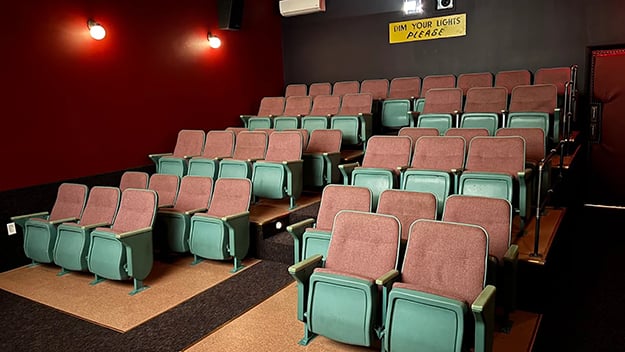
The Low Cinema, a new single-screen movie theater in Ridgewood that opened in May, is a nostalgic trigger for millennial New Yorkers of a certain vintage. The lobby carpet features a kitschy pattern of film reels, ticket stubs, and bags of popcorn—it’s the kind of carpet that I might have dropped Starburst wrappers on while watching All Dogs Go to Heaven in a strip-mall multiplex in 1989. It was sourced, per John Wilson, filmmaker and co-founder of the Low Cinema, from “a place called Carpet Time in Queens, which had a remnant of this movie-theater carpet that no one had wanted, if you can believe it.” Much of the rest of the decor—an Another 48 Hrs. (1990) promotional clock; Hall of Fame–style plaques of stars such as Sandra Bullock—was acquired from garage sales, an abandoned drive-in theater, and the now-demolished “Hollywood Burger King” on Myrtle Avenue. A papier-mâché E.T. sculpture was made by Wilson himself.
The vibe is “kooky video store,” Davis Fowlkes, who co-founded and runs the space with Wilson and critic Cosmo Bjorkenheim, told me when I visited the theater last month. Currently open at least five evenings a week, the Low has so far screened the kinds of mainstream middlebrow ’90s movies that today’s audiences can no longer take for granted, like The Birdcage (1996), as well as second runs of new releases such as Andrew DeYoung’s Friendship. Second-run releases are themselves a relic of the comparatively flourishing theatrical environment of the 1990s, when seeing “something that starts soon and looks good,” as Robert Forster’s Max Cherry says in Jackie Brown (1997), was a worthy reason to get out of the house.
Today, American audiences are increasingly forsaking the communal theatrical experience in favor of small screens and streaming. And yet, several new cinemas like the Low are popping up in New York City. The Metro Theater, a historic Upper West Side movie house that has been defunct for two decades, was recently purchased by a nonprofit led by film producer Ira Deutchman after a long fundraising effort, which now continues to support the cinema’s renovation. The team behind the Rockaway Film Festival—which, for the last seven years, has held outdoor screenings in the Rockaway neighborhood of Queens—is working toward establishing a full-time, year-round cinematheque. These initiatives are betting that the trend of waning big-screen viewing is not inevitable, and that the vibrant era of moviegoing to which the Low’s decor harkens back is not a retro novelty. They believe that, given the option, audiences still prefer collective experiences of art and urban space over atomized ones.
According to film programmer David Schwartz—whose recent MoMA series, A Theater Near You, featured signature programming from notable and historic New York City film venues—this is an “anemic” time at the multiplex. As Schwartz noted to me when we spoke over coffee a few weeks ago, Hollywood is in its slop era, but a new release at an AMC or Regal in Manhattan will still set you back around $20 and be preceded by half an hour of advertisements. Meanwhile, repertory houses and independent venues are having a moment. Schwartz said that when he started out as a programmer in the mid-1980s, the city’s rep and second-run houses had been largely killed off by the VCR. There were fewer venues, and those that hung on were mostly affiliated with museums and nonprofits—Anthology Film Archives had acquired the old Third District Magistrates Courthouse, but wouldn’t open as a cinema until 1988; and Film at Lincoln Center, which hosts the New York Film Festival every year in the fall, had not yet begun offering year-round programming at the Walter Reade Theater. “It felt like a smaller landscape,” Schwartz said. “Today, you go through Screen Slate and there’s six things every day.”
***
If anything, this relative abundance just proves that there are still gaps to fill and audiences to serve in the New York City rep scene today, which is where initiatives like the Low Cinema, the Metro Theater, and the Rockaway Film Festival come in. They take their cues from the more localized model demonstrated by existing New York City institutions such as Light Industry and Spectacle, as well as pop-up cinematheques like the Ridgewood Community Cinema, which tailor their ambitions, to greater or lesser degrees, to a community that can support them.
The Low founders live in Ridgewood, and believe the streetscape should have a movie theater—or, ideally, several, like it used to. “One of the greatest pleasures I’ve had in New York to date,” Wilson says, not entirely self-deprecatingly, is watching neighbors sit on the bench outside the Low—an installation inspired, he explains, by William H. Whyte’s 1980 study The Social Life of Small Urban Spaces, and the “philosophy that people tend to sit where there are places to sit.” (It is a seedlet of protest against the trend of hostile architecture that was a recurring interest on his HBO show How To with John Wilson.) As a shared urban space, the bench is a metonym for the theater itself.
The building housing the Low, which has 40-odd seats (sourced, the founders think, from an old megachurch), is owned by Antoinette of Antoinette Cleaners, next door. The lease is for five years. The money for renovation and initial costs, about $160,000, has come out of the co-founders’ savings. They faced the usual challenges of getting a DIY space to code (to sell alcohol, you have to sell food; to sell food, you have to install a commercial sink), and received help from contractor and carpenter friends to rip out the drop ceilings and the floors that had rotted under the radiators, hook up the plumbing, and lay out the theater. Applying for nonprofit status, which entails an extra layer of bureaucratic process, would open up new funding streams, and may be an option down the road, but the founders are also attracted to the idea of the space being “self-sustaining” and covering operating costs with revenue. In defiance of profit-seeking investors and steep commercial rent prices, Wilson believes that modestly scaled theaters like the Low can “spring up somewhat chaotically.”
The projection and audio setup cannot handle DCPs, and the Low is not up to Academy standards for Oscar-qualifying theatrical runs. But distributors such as Park Circus (which handles a vast library of studio titles) have been understanding of the second-run model, and these days, studios such as Warner Brothers are increasingly reluctant to ship out their own library titles, preferring to take a cut from a venue that sources the film off a Blu-ray. This is perfect for a place like the Low, which can run discs, old VHS tapes, and digital files into a prosumer projector from a player, a computer, or an indie filmmaker’s external hard drive, as well as 16mm. Screenings have also included documentaries by Kubrick aficionado and conspiracy obsessive Tony Zierra, whose work is a wormhole Wilson believes more audiences should go down, and bodybuilding movies co-presented with the volunteer-run weight-training organization Woodbine Strength, also based in Ridgewood. The casual, drop-in nature of much of the programming (“like [the] TBS Superstation,” jokes Fowlkes) makes the implicit argument that moviegoing is an everyday pleasure—a principle exemplified by the Low’s curation, as well as its very presence in a storefront just off Myrtle Avenue.
***
The Low was previously a windowless barbershop and then a warehouse apparently used by the multilevel marketing scheme Cutco to store boxes of knives. In contrast, the uptown Metro Theater was once a single-screen movie house with an Art Deco facade and 550 seats. Built in 1933 on Broadway between West 99th and West 100th Streets, the Metro fell into disrepair and became a porno house in the 1970s. Dan Talbot, the legendary distribution and exhibition impresario, tried to revive it as a repertory and art-house theater in the early 1980s, before it was passed from owner to owner, all of whom struggled to operate it at a profit before it finally closed in 2005.
“You can trace the history of neighborhood theaters through the history of the Metro,” Deutchman, who founded the nonprofit Upper West Side Cinema Center with programmer Adeline Monzier to buy and restore the Metro, observed. “The fact that the building has survived is more a real-estate story than anything else.” The exterior was designated a city landmark in 1989 and previous owners sold off the air rights, so there are limited uses, other than showing movies, to which the space can be put. The UWS Cinema Center bought the building this spring for nearly $7 million, raised from donations and grants secured through the governor and state senate of New York. It is now embarking on a $20 million capital campaign to restore the historic exterior to its former glory and completely make over the gutted—but, conveniently, not landmarked—interior.
The Upper West Side Cinema Center is a 501(c)(3) organization. “To get investors into a for-profit, you have to show that there’s going to be a return on the investment,” Deutchman said. In an era when the large theater chains, still feeling the effects of post-COVID-19 declines in attendance, are burdened with billions in debt, and their fortunes rise and fall with the fate of each new savior-of-cinema blockbuster, a cinema is a bad bet to turn even a modest profit, let alone return the kind of alpha sought by larger investors. But “to get donors into a nonprofit, you only have to prove that you’re doing something valuable enough that it deserves support.” He pointed to four separate constituencies that the Metro is depending on for patronage: the historic-preservation community; the residents of the Upper West Side, who appreciate a source for street traffic after COVID-19 emptied out storefronts; film lovers happy to have a non-multiplex option between Film at Lincoln Center on 65th Street and the Maysles Documentary Center on 127th Street; and distributors looking for a place to book first-run art-house titles in a neighborhood that has historically supported such films.
The Metro hopes to open in about three years as a five-screen theater showing a mix of first-run, repertory, and community and educational programming. The names involved in the capital campaign may be boldface—Ethan Hawke, Martin Scorsese—but Deutchman believes in local audiences. “Every theater is a neighborhood theater,” he said. “The Upper West Side is an incredibly diverse community—one of the reasons we’re putting in five screens is to make sure that we’re catering to the entire range of people who live within walking distance of the theater.” Located between Central and Riverside Parks, and just south of Morningside Heights and Harlem as well as Columbia University, the Metro will serve an archetypal Manhattan art-house audience, but Deutchman is also optimistic about younger moviegoers, socialized during the pandemic, who “realized that they don’t want to be locked in a room by themselves—there’s a real urge to be around other people.” He sees green shoots in the success of contemporary horror films, particularly those released by independent distributors and appealing to an audience curious to expand their own boundaries. “In my day, the joke was that the formula for a successful art film was sex plus good reviews. Now the same formula exists, but it’s horror plus good reviews.”
***
Schwartz concurs that rep audiences are getting younger; the theater “feels like a hip place to be” these days, he said. That’s the kind of optimism fueling the Rockaway Film Festival, which will host its eighth edition later this summer. RFF began as “proof of concept for a cinema” in Rockaway, Artistic Director Sam Fleischner, who co-founded RFF with Program Director Courtney Muller, told me in an interview. There’s no movie theater at all on the peninsula—teenagers have to commute an hour to Sheepshead Bay or Atlas Park to see the new Marvel movie, and art-house and repertory fare is an even farther schlep.
Per Fleischner, the early spark for RFF came from “a local real-estate maven” who suggested that he start a film festival in Rockaway; she provided the home for the first two years, a warehouse in Arverne. During the COVID-19 pandemic, the Rockaway Brewing Company, a few blocks away from the warehouse, invited the festival to project films onto their exterior wall, and eventually allowed them to take over the vacant lot next door. After the brewery moved out in 2023, RFF turned the building into an indoor cinema that opened last year. Like Low Cinema, the Arverne Cinema is a labor of love. Building the outdoor and indoor spaces cost around $30,000; they were made with salvaged material from parts of the boardwalk damaged during Hurricane Sandy. (A “neighbor with a backhoe” helped out, Fleischner said.) Seats and audiovisual equipment were sourced from shuttering Long Island multiplexes.
RFF is now searching for a less “scrappy” year-round home, and embarking on a large-scale capital campaign. This involves building relationships with local government and larger foundations to supplement the grants, sponsors, and individual donors who have thus far enabled Fleischner, Muller, and Managing Director Kathy Del Beccaro to work on RFF full time and keep ticket costs to $10 or less, with free programming for local residents and children. RFF’s eventual year-round home will have between 100 and 150 seats, and be “big and loud and dark,” Muller said—high-quality enough that, the founders hope, first-run distributors will be open to working with them, even without the guarantee of weeklong bookings.
This is a transitional moment for cinema, Fleischner argued to me, as a historically commercial medium that, given the increasing premium attached to spaces for communal experiences of culture in a fast-gentrifying urban landscape, finds itself seeking more and more support from patrons habituated to subsidizing “high art” like opera and ballet. Another major selling point is the ability to serve a variety of audiences—a necessity in Rockaway, which Del Beccaro noted is “pretty infamous for having many different siloed communities. There are like 12 distinct communities that hardly have occasion to get together with one another,” plus millions of summer visitors.
“So many megaplexes have failed because they’re run by people who don’t care,” Fleischner said, “[but] if you’ve been to any of the independent repertory theaters in New York in the last decade, it’s incredible to see how excited the audiences are.” What unites RFF, the Metro, and the Low is that the people behind them do care—not just about the movies, but about the communities they bring together and the spaces they animate. The Metro will have a lobby café intended to get Upper West Siders back out onto a retail strip decimated by the prevalence of food delivery. The Low has been hosting regular children’s matinees during the weekends, which have spotlighted work by the 9-year-old daughter of the theater’s 16mm specialist—including a short, made with her friend, about time travel and a newsboy strike. RFF’s dreamed-of theater will be a “space to gather,” Muller said, promising not only eclectic programming but also a venue where other local organizations can host symposiums, fundraisers, art shows, or mutual-aid events.
Art spaces are public spaces, and the way that capital has remapped both in our cities is neither sustainable nor inevitable. All three of these initiatives embody faith in a populace hungry for alternatives.
Mark Asch is the author of Close-Ups: New York Movies and a contributor to Reverse Shot, Screen Slate, Filmmaker Magazine, the Criterion Collection, and other publications.