A Time of Mischief
This article appeared in the January 9, 2026 edition of The Film Comment Letter, our free weekly newsletter featuring original film criticism and writing. Sign up for the Letter here.
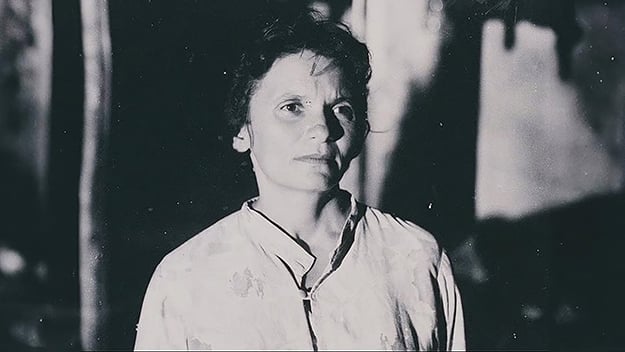
Man Marked for Death, 20 Years Later (Eduardo Coutinho, 1984)
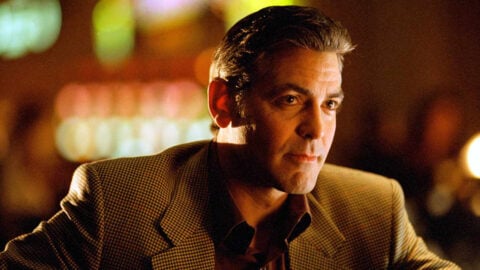
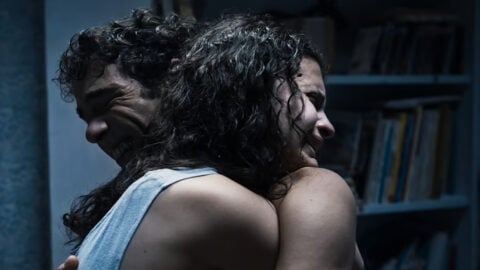
Kleber Mendonça Filho’s new film, The Secret Agent, is the story of a man targeted by the forces of Brazil’s military dictatorship in the 1970s. But it’s also a series of vivid, suggestive, sometimes fantastical digressions that attempt to capture something of the wired and bizarro energy of Brazilian society under the dictatorship, as if the only way to paint a full portrait of that era is through a mixture of indirection, myth, autobiography, genre tropes, and other motley cinematic impulses that fire off in quick succession. The film, set during Carnaval and absorbing some of its heady spirit, is obsessed with the texture of popular culture in Brazil; it is, among other things, an archive of the various urban legends, newspaper serials, and radio programs that were animating a society in crisis.
Above all, it’s a film whose substance is cinema itself. Since his last movie, the essay film Pictures of Ghosts, Mendonça has become increasingly focused on how moviegoing was once a central element of popular life in his hometown of Recife. The Secret Agent is in some ways an attempt to resurrect the now-somewhat dilapidated downtown of that northern Brazilian city as a vibrant place that was, in Mendonça’s words, “marked all over by fantasy worlds”—a place in which commercial cinema, and the sacred space of the movie theater, did more than anything else to shape the social imagination and organize people’s impressions of extreme, chaotic, state-sanctioned violence.
Mendonça is curating a selection of nine films that inspired The Secret Agent in a series at Film at Lincoln Center running until January 13th. Mendonça was a critic before he was a professional filmmaker; his movies have long spoken the language of cinephilia, and the series shows that he is as indebted to Brazilian Cinema Novo as he is to Hollywood genre films and the international auteur canon. John Carpenter and Martin Scorsese, although they’re absent from the lineup, have always loomed large in his universe; with Carpenter, he seems to share an interest in alternative political communities mounting some kind of struggle in a fallen world. With Scorsese, he shares an obsessive and accumulative mentality, where meaning itself becomes overdetermined by an ever-growing pile of images and sequences whose cinematic particularities preoccupy the filmmaker more than their structural coherence.
But what’s notable about this series—a mixture of horror, science fiction, paranoid thriller, crime procedural, and personal documentary—is not necessarily the films’ general influence on Mendonça’s style or approach, but rather how specific elements from each of these films seem to be contained within The Secret Agent. The bitten-off leg in Orca; the corpse covered with newspapers and surrounded by candles in Lúcio Flávio; the dusty police archive in Investigation of a Citizen Above Suspicion: in a sense, Mendonça has stitched together a collection of images from these movies and reconstituted them into The Secret Agent. One imagines him a bit like Dr. Agatha Webb in one of the series’ hidden gems, Body Parts (1991)—a mad scientist attempting to recreate a composite living being out of severed limbs, each with their own consciousness and will.
The series, in many respects, transforms Film at Lincoln Center into The Secret Agent’s Cinema São Luiz: Mendonça has programmed several movies you might have seen if you lived in Recife in 1977. Michael Anderson’s Orca, released that year and which Mendonça saw in theaters as a child, is superficially a Jaws rip-off, but it’s really an excuse for Richard Harris and Charlotte Rampling to Bogie-and-Bacall their way through a camp Moby Dick; the titular killer whale’s chief skill, much like that of the hairy leg in The Secret Agent, is bluntly slamming into things. Héctor Babenco’s Lúcio Flávio, a lurid and brutal depiction of crime and police corruption that was a sensation upon its release, shares with The Secret Agent a sense of the dictatorship’s ramshackle cruelty—the notion that the regime can be partly understood through the noirish vision of men driving around in a car, up to no good. Mendonça even includes stills from Lúcio Flávio and Jorge Bodanzky and Orlando Senna’s Iracema in the brief photo montage that opens the film.
But the most important (and rarely screened) film in the series might be Man Marked for Death, 20 Years Later (Cabra Marcado para Morrer), from 1984. In the early 1960s, Brazil’s reformist Goulart administration supported initiatives bringing together left-wing students and rural farmworkers. Around this time, the young filmmaker Eduardo Coutinho began making a social realist film about the murder of a Peasant League unionist in the northeastern state of Paraíba. He cast non-professional actors, including the victim’s real-life widow Elizabeth Teixeira, but production was halted by the military coup in 1964. The footage was confiscated, and Teixeira was briefly imprisoned before fleeing to Rio Grande do Norte and living under an assumed name. In the waning days of the dictatorship in the early 1980s, an older Coutinho sought out Teixeira, her children, and the other remaining cast members to revisit the original footage with them and learn how they had weathered the past two decades. The resulting documentary is a layered and moving exploration of an unusual conjuncture in Brazilian history and its far-reaching effects on the lives of camponesas and their families.
Mendonça is deeply indebted to Coutinho; he has said he “never really [misses] an opportunity to screen Cabra Marcado.” Like The Secret Agent, Coutinho’s film depicts a family violently torn apart by the regime, and it bears some of Mendonça’s other hallmarks—an emphasis on the place of images in the daily life of a community and even a preoccupation with the transformations of the built landscape of Recife. (In a particularly Kleber-esque moment, Coutinho revisits the site of the detention center where an activist was held in the city, noting that it became a cultural center in 1976.) But Man Marked for Death also registers the transition from a 1960s student left, oriented towards collective action, to a fractured and dispersed movement 20 years later, coming out of retreat and focused on projects of individual repair and restoration. In his brilliant essay on the film, critic Roberto Schwarz writes that in the early 1960s, “it was the future of the country that was involved, and individuals were concerned only as means within this larger context.” What’s at stake in the 1980s, he continues, is “the redeeming of existences and projects . . . of an individual nature.” Schwarz ends the essay by teasing out the film’s subtle and radical implication that in a “serious world,” the intellectual class represented by the filmmaker himself may not have a place.
To the extent that this class still very much exists in Brazil, Mendonça is one of its chief representatives; his movies have come to be widely celebrated by progressive Brazilians and international tastemakers alike. Like Coutinho, Mendonça has a deep and genuine appreciation for the dignity of ordinary Brazilians, and his films have an atmosphere of dedication and tribute to everyday people negotiating severe social turbulence. The Secret Agent, for one, overflows with sympathy for the outcasts of the dictatorship era. Its central character finds himself hiding out in Recife with a couple fleeing the Angolan Civil War, a single mother living under a death threat, a queer teenager on the run from his father, and their caretaker, a 77-year-old pistol who claims to have been part of the Italian Resistance in World War II.
But Mendonça’s work registers yet another transition in Brazilian cultural production. To the extent that he is emblematic of a generation that came of age in the 1980s, his commitment to cinema seems to have preceded his engagement with political struggle, and his relationship to popular movies has always been paramount in his sense of self. The series at Film at Lincoln Center suggests that The Secret Agent is marked as much by the noble political allegiances of Coutinho as it is by the libidinal world of genre cinema—if for no other reason than that Mendonça himself is constitutionally drawn to both. The fact that Man Marked for Death stands on an equal footing with the gory B-movie Body Parts in the filmmaker’s gallery of references—and that neither film’s integrity is compromised by Mendonça’s metabolization of it—gives The Secret Agent some of its distinct power, but also some of its uneasiness, its sense of irresolution that seems to embody the country’s relationship to its own past. Mendonça may or may not share Coutinho’s aspiration for a “serious world” somewhere on the distant horizon, in which his own contributions would be extraneous, but he relishes as his raw material the strangeness and absurdity of this world and the fantasies it has used to understand itself.
At the end of Man Marked for Death, Elizabeth Teixeira gives a rousing, impromptu speech. “How can we not fight for better days?” she says. “Whoever has a good life, let them stay out of it!” She was in her late 50s at the time Man Marked for Death was filmed, and even then she already seemed to come out of a bygone era. In the iconography of documentary photography, she’s almost reminiscent of Florence Owens Thompson in Dorothea Lange’s Migrant Mother or Allie Mae Burroughs in Walker Evans’s Alabama Tenant Farmer Wife, fixed eternally in historical memory. As of this writing she is, almost unbelievably, still alive at 100 years old. She is one of the heroes of our world, a living testament to the profound courage and resilience of ordinary people struggling against overwhelming injustice. It’s one of the unexpected and vertiginous pleasures of this series, ingeniously programmed by Mendonça, that it makes you wonder what she might think of Orca.
David Beal lives and works in New York.