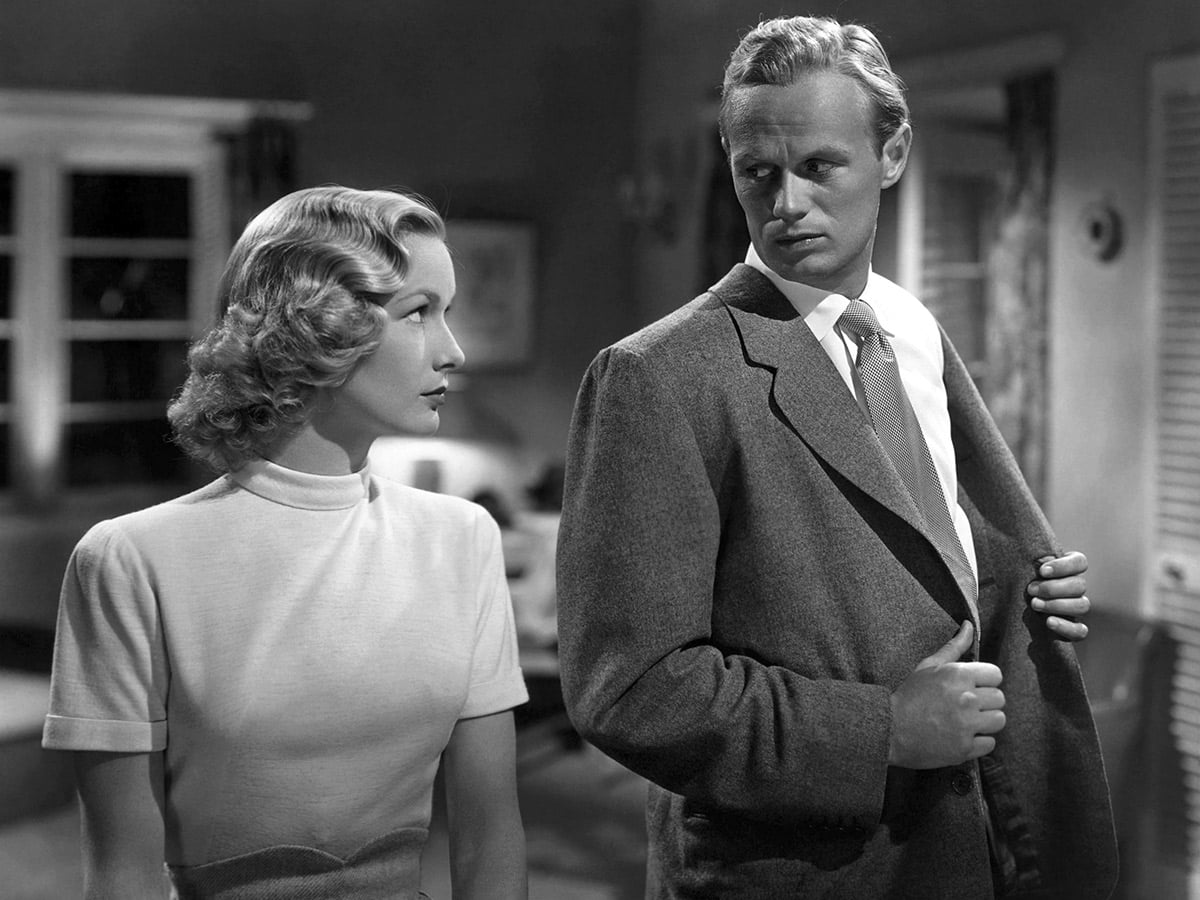
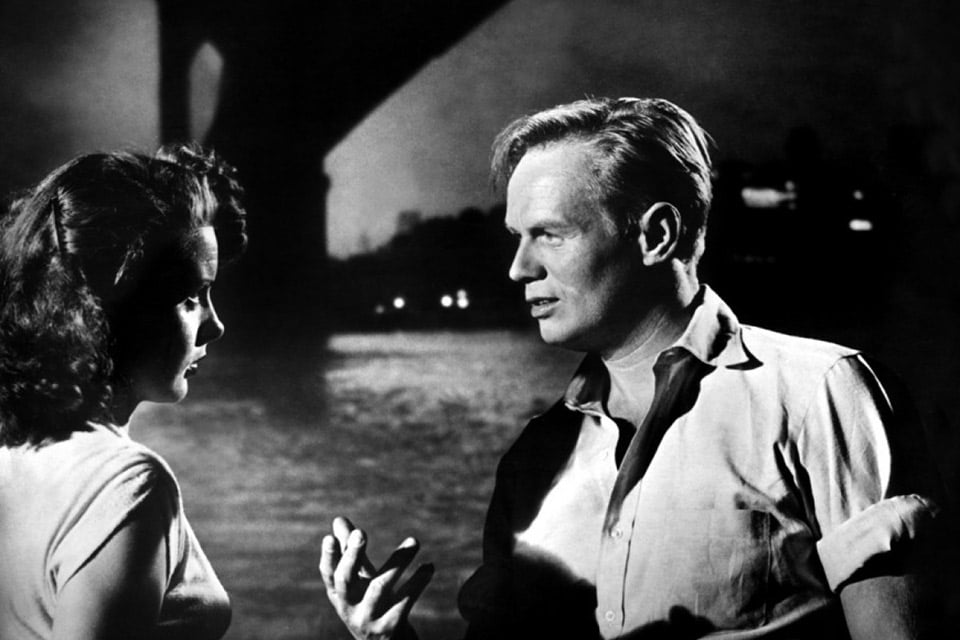
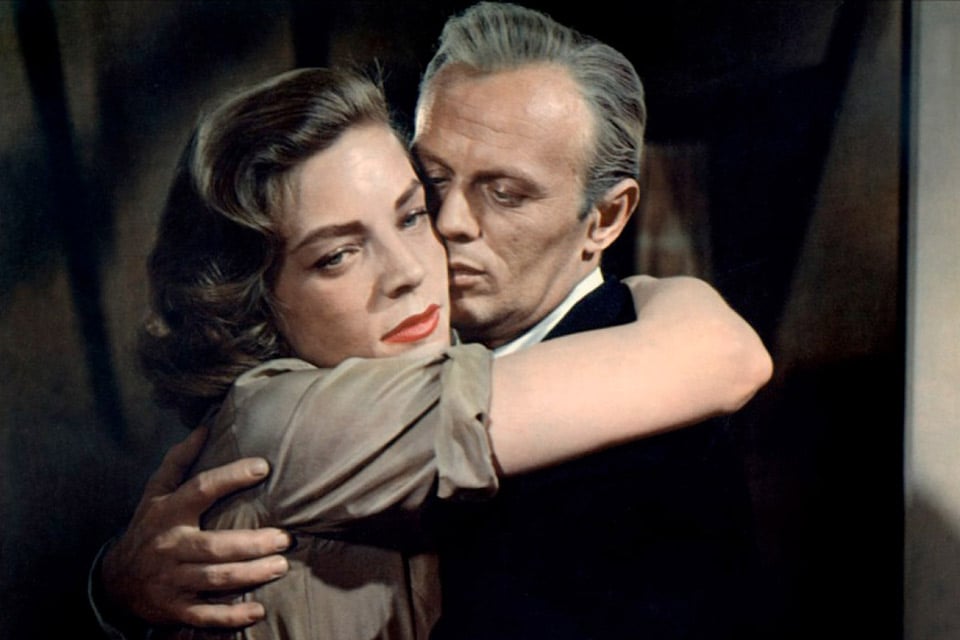
But that’s true of Widmark, too. From the beginning, he worked from tension, his characters’ minds compulsively angling, ruminating, trying to get a fix on some brain-twisting problem. In the gallery of postwar malcontents—Mitchum, Lancaster, Peck, Cotten, Douglas, Ryan, Andrews—Widmark was the least stylized and dreamy, the most earthbound. He was extraordinarily beautiful—when he was young, his large-boned face looked as if it had been sculpted out of marble—but he was also convincingly ordinary, suggesting any number of everyday figures: a face you might spot on the seedy side of town, or a repairman, or maybe your lawyer or your psychiatrist. And unlike the stocky Tracy, Widmark was at home on the range, despite an inauspicious start on horseback in Yellow Sky. “We were in Death Valley in July. It was 120, 130. Jesus, it was awful. I had to do a little scene with the horses, and I was new with horses at the time. I got my foot in the stirrup and it slipped. [Director William] Wellman said, ‘That’s it—you’re not doin’ it again.’ In the picture, you see me stick my foot in, and then there’s a cut, and I’m already on the horse.”
Widmark had a quiet genius, developing a convincing psychological mechanism for each character. At the heart of many Widmark performances is a disappointed child within—not a bad intuition about American manhood. His Jefty in Road House is an astonishing piece of work. Widmark’s smooth features and blond hair always suggested an overgrown boy, as did his head, which seemed a little too big for his body. When he’s trying to lay claim to Ida Lupino’s Lily, he’s as awkward and overeager as a 12-year-old—he lurches into her private space, an unsuccessfully suave smile creases the corner of his mouth, and you can practically feel the clamminess of his hands as he touches her shoulder. Like Tracy, Widmark was less a graceful mover than an ingenious one, and he had a way of angling his upper body into clean visual lines, using it as a weapon of insolence (Pickup on South Street, Night and the City, Madigan), arrogance (The Bedford Incident, Coma), or as a bulwark against a neurotic onslaught (The Cobweb). But besides that drawling voice, his greatest asset was his face, made for close study. The opening of Pickup on South Street is a wonder, an alternation of close-ups between Widmark’s pickpocket and Jean Peters’ unwitting communist moll, in which he builds a careful, subtle gradation of sexual intensity beneath an appearance of nonchalance, all the while keeping his concentration so that he can lift her billfold out of her pocketbook. Later, as he’s being questioned by a cop, Widmark uses his arching eyebrows to devastatingly sarcastic effect, an arrogant smile beaming in mock humility.
In his later, beefier years, after his face had gotten a good baking in the California sun, Widmark put the smile/arched brow combo to even more devastating use, whether poignantly reaching out to his bored wife in Madigan or imperiously putting off a visiting doctor in The Bedford Incident. It all adds up to a multi-faceted portrait of the postwar American male, across a 40-year time span.