The Spirit of the Place
This article appeared in the September 30, 2025 edition of The Film Comment Letter, our free weekly newsletter featuring original film criticism and writing. Sign up for the Letter here.
Dry Leaf (Alexandre Koberidze, 2025)
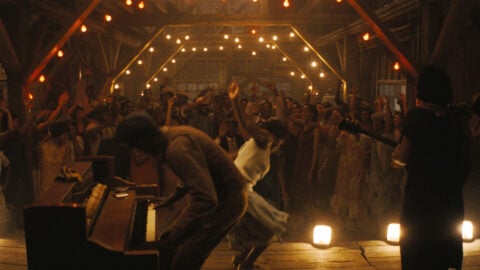
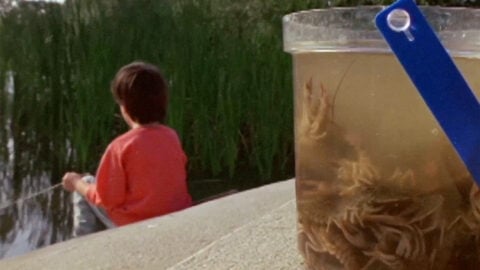
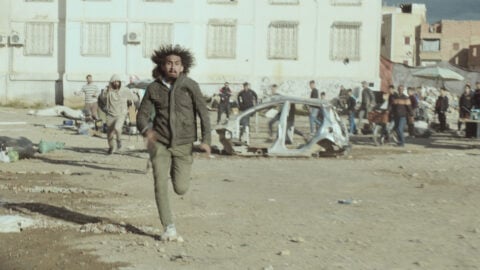
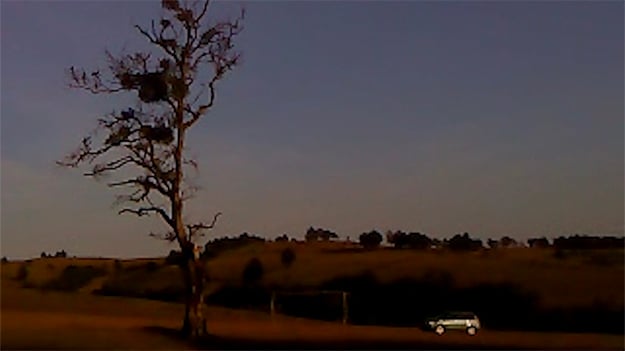
A film can resemble a window through which we look into a world. But some films present us with surfaces so textured and tactile that they have the physicality of a terrain. This is the case with three new films made using older, artfully imperfect formats, all playing in the 63rd New York Film Festival. Rhayne Vermette’s Levers was shot on broken Bolex cameras, according to the filmmaker, and begins, after a brief prelude of scratched leader, with a close-up of metal spikes being hammered into the rough surface of a stone. Even more eccentrically, Alexandre Koberidze’s Dry Leaf was shot on an old Sony Ericsson phone, which produces blurry, pixelated images that pulse slightly: a low-res digital equivalent of impressionist paintings made from thick dabs of color. Filmed on grainy 16mm stock with hyper-saturated hues, Rose of Nevada, directed by Mark Jenkin, opens with a montage of nearly abstract shots of rust, lichen, peeling tree bark, and dancing water. Sharply distinct in their styles and effects, all of these films sensuously evoke places that are haunted by loss, absence, or decline. Each is built around a mystery, threaded with tantalizing clues and constant reminders of what we can’t see or know.
In Rose of Nevada, the place is a village on the Cornish coast, emptied out and impoverished by the disappearance of the fish that were once its livelihood. The town’s economic depression is linked to a 30-year-old tragedy involving the titular fishing boat, a stubby, rust-stained trawler that may be a kind of ghost ship. In early scenes, the mood is so portentous that the film almost verges on a parody of horror, all thudding chords and ominous warnings—but the supernatural twist, when it came, was nothing I expected.
After Nick (George MacKay), a young family man desperate for money to mend his home’s rotting roof, signs on to crew the Rose of Nevada, much of the film is devoted to a visceral depiction of the grueling routine of hauling in, sorting, gutting, and packing fish. The film is shot mostly in tight close-ups, rarely opening out to a landscape or view of the town; the intimate, jostling camerawork and heightened sounds trap us in the sensory experiences of the characters. (Jenkin is also the film’s cinematographer and editor.) At times, it is hard to distinguish Nick’s feverish dreams from reality, but his ordeal is less a matter of spectral terrors—as in Jenkin’s 2022 film Enys Men—than of all-too-real emotions and dilemmas: grief, separation, loss of identity, and sacrifice. These themes are spelled out most eloquently in images, often with throbs of red: a bouquet of carnations on the edge of a cliff, their petals lambent; a mailbox into which Nick entrusts a love message, hoping it can travel through time; the boat itself, as crimson as the blood of the fish caught in its nets. The film offers an unsettling answer to a timely question: what would it take to bring back the good old days?
Levers, the second feature by Canadian filmmaker Rhayne Vermette, is a cryptic nocturne. It opens with a bizarre event: following a mysterious bang, the sun disappears for 24 hours. In Ste. Anne, Manitoba, the outdoors is all darkness and whipping snow; interiors are lit by the silvery static of old television sets. A strange monolith appears. A civil servant (Andrina Turenne) pursues an investigation, viewing security-camera footage and reading through files relating to the commissioning of a monument. The sculptor of the monument, an elderly woman (Val Vint), grieves someone’s death. Nuns perform a sinister ceremony, collecting the tears of an Indigenous woman and bottling them as holy water. A man leads a procession to a graveyard, holding up an infinity symbol, which (I learned) is also the symbol of the Métis Nation, to which Vermette belongs.
The film’s lush, resonant soundscape is punctuated by a whole series of bangs: the blast of a canon at the unveiling ceremony for the never-seen monument, set off by men in 18th-century uniforms; a gunshot fired by a homeowner to scare away a bear; the thud of a car hitting another bear on a road at night. Each sound echoes a history of violence against nature and Indigenous communities. The enigmatic vignettes are introduced by hand-drawn cards alluding to the tarot deck. The film’s poetic symbology—moon, mirror, stone, river—is embedded in a laconic depiction of everyday life, as specific in its locality and culture as Jenkin’s in Rose of Nevada. Here, the cause of the uncanny events and mourning rituals is not named, but the film’s runic images stay etched in the mind, perhaps all the more so for being unexplained.
The mystery in Dry Leaf is simple and presented in a matter-of-fact way. Irakli (played by the director’s father, David Koberidze) goes on a road trip in search of his adult daughter, Lisa, who took off after leaving a letter with no information about where she was going. Aware that she was working on a project photographing football fields in the Georgian countryside, he visits one after another in hopes of tracking her down. No one has seen her, and nothing much happens over the course of the movie’s three hours. This is a film of absences. We never see the photograph of Lisa that Irakli shows to people, and his companion on the journey, Levan, is invisible, a fact that is simply stated without explanation. The camera surveys one vacant, overgrown field after another, focusing again and again on goalposts: lopsided rectangles of weathered wood that look like empty picture frames.
Yet Dry Leaf is not a sad film at all. It is bathed in dappled golden light and steeped in a warm, tender regard for what is there: wild flowers, pine trees in the mist, autumn crocuses trembling in the wind. A bowl of apples, a handful of apricots on a picnic table. Yellow leaves on the ground, springs of clear water, children sleeping on the grass. And above all, animals: cats and dogs, white and black cows, a horse and a foal, a donkey, a sweet calf to which Irakli feeds berries from his hand. The mood is meditative, becalmed, though the music (by the director’s brother Giorgi Koberidze) has sprightly passages that might accompany a silent comedy. Sometimes the images become entirely abstract, as in a long, sublime sequence that observes the car being washed, water and suds swirling over the windows and engulfing the screen. At another point, the camera zooms in on a patch of sunlit leaves until the pixelation becomes so extreme that there is nothing but a shapeless bloom of light—a transcendent effect of subpar technology. Kobiridze’s approach is audaciously modest, if that makes sense: a rebuke to the excessive sharpness and sterility of high-definition video and the maximalism of so much contemporary cinema. In the film’s boundless love for the ordinary, imperfect world, there is tremendous solace.
Imogen Sara Smith is the author of In Lonely Places: Film Noir Beyond the City and Buster Keaton: The Persistence of Comedy. She has written for The Criterion Collection and elsewhere, and wrote the Phantom Light column for Film Comment.