Tender Pains
This article appeared in the November 14, 2025 edition of The Film Comment Letter, our free weekly newsletter featuring original film criticism and writing. Sign up for the Letter here.
A Body to Live In (Angelo Madsen, 2025)
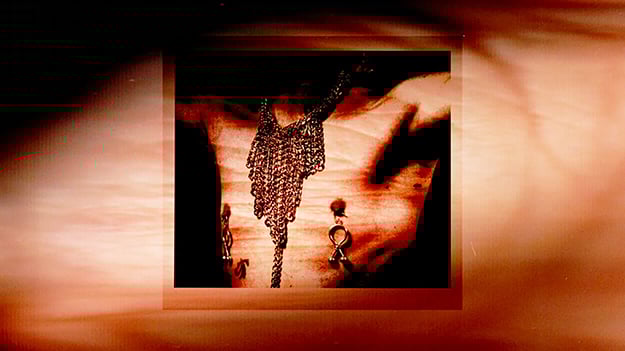
Toward the end of Angelo Madsen’s documentary about the late body-modification legend Fakir Musafar, A Body to Live In (2025), Musafar and his wife, dominatrix Cléo DuBois, perform a suspension ritual on Fakir’s lover William “Grin” Grindatti. Grin, who is covered in numerous piercings and tattoos, and towers over both of their petite frames, is surprisingly anxious about the act. Nonetheless, he goes through with it. Fakir glides a needle through the flesh on Grin’s back like a hot knife slicing through butter. He then inserts into Grin’s skin hooks that attach to a rack via a steel clip, and slowly pulls him into the air. Fakir holds his hands and guides him through his breathing to calm him. Tears begin to well up in Grin’s eyes. Nothing is said. The room is affectively charged. Cléo is soon crying as Fakir motions for her to bring Grin back down. I realize that I am, too.
Perhaps one of the most damaging outcomes of today’s hyper-mediated culture is that people are increasingly primed to view cinema (especially works that emphasize sex and violence) through a purely ocular lens—therefore unlinking it from its affective register. Countering this tendency, contemporary explorations of sadomasochism or the politics of desire made by members of kink subcultures, like A Body to Live In and Tiona Nekkia McClodden’s video installations, invite audiences to experience bodily violence through a more tender and attentive lens. McClodden’s work depicts her submission to sadist actions while making explicit references to how state and systemic violence both inform and vastly differ from her self-crafted scenes of subjugation. But neither artist pursues an investigative approach; instead, both enact what scholar Avgi Saketopoulou describes as “exigent sadism,” in which violence is presented with a certain degree of opacity. This type of sadism does not provide answers, but holds space for whatever emerges from the pursuit of seeing the pain through.
Though Musafar, who passed away in 2018, spent his life trying to locate the origin of his and his followers’ actions—their raison d’être for pursuing pain—Madsen steers away from providing any one definitive explanation. A Body to Live In is culled from DuBois’s personal archive of photographs, home movies, letters, taped televisual appearances, and more, and it documents many different replies to the why of it all, with some participants in S/M from Musafar’s community invoking the pursuit of agency, wholeness, and healing through self-administered pain. These accounts, of participants who took to S/M to grapple with the violence inflicted on their personhood, are moving in their emotional clarity—like DuBois’s stated desire to recuperate control over her body after being raped in her youth.
But more interesting are those who fail to arrive at answers or reasonings for their proclivity for sadomasochism, and Madsen maintains and centers their sense of opacity. Musafar is one such subject. We are not given any linear or chronological account of his life, for example, or a sense of how he crafted the persona of Fakir Musafar, a name he formally adopted in the 1970s. We glimpse his beginnings as a nonnormative boy in South Dakota in the 1940s through the pictures he took of his early ritual performances for the camera. As we see his adolescent black-and-white self-portraits, in which he’s dressed in corsets with clothespins all over his body, Musafar recalls in voiceover his initiation into the practice of restriction: left alone at home one weekend when he was a teenager, he fasted, cinched his waist with belts, and danced around until he almost passed out, occasionally documenting the performance with his camera. Throughout the film, we see similar photos of Musafar, DuBois, and their friends engaged in S/M acts. These high-contrast images hold the frame and our gaze for what feels like an infinite amount of time but is only mere seconds. The stillness of these pictures unnerves us, as they are only occasionally accompanied by anecdotes, with minimal context as to how these painful acts, like DuBois suspended in the air by her breasts, came to be. This formal approach is Madsen’s own sadism in action, forcing us to sit with so many images and narratives that lack resolution.
A Body to Live In brought to my mind McClodden’s 90-minute video installation The Brad Johnson Tape (2017), in which the filmmaker reads 10 poems by the late gay Black American poet while performing an S/M scene for each, playing with and against the lush queer erotics of Johnson’s writing. The final section of the video, set to Johnson’s “On Subjugation” (1988), sees McClodden suspended upside down from her feet in a custom-built rig. The video is shot on lo-fi VHS, which means that we cannot see her facial expressions very clearly, but we can hear her exasperated sighs and breaths as the inversion overwhelms her body and she struggles to finish the poem. With only the video camera, set to auto-zoom, operating as witness, McClodden’s act is reminiscent of Musafar’s self-portraits from his youth: both artists use the camera as a kind of body double that allows them to turn their will to subjugate others toward themselves.
“On Subjugation” is Johnson’s critique of how institutions ensnare marginalized people and make them foot soldiers for its imperial violence—what Saketopoulou, drawing from Georges Bataille’s work on fascism and sadism, terms “destructive sadism.” Johnson writes, “AM WRITING WITH AN IRON GLOVE, CAN’T YOU TELL? RESTRICTIVE MEASURES HAVE BEEN TAKEN TO ENSURE THE STIFLING OF ALL EXPRESSION. YOU NEED FEAR NO EFFUSIVE BURGEONINGS OF UNIMPEDED AND DIARRHETIC RAMBLINGS FROM LOVE. IRON GLOVES FOR AN IRON STATE!” The poem was likely influenced by Johnson’s time in the Navy, and it makes the apt argument that the state creates conditions wherein racialized and queer people subjugate themselves in service to it. This is the project of respectability politics: it situates marginalized bodies as “problems” so that they enact a form of self-censure in an attempt to become exemplary citizens. It is, in other words, a type of S/M over Black life.
The turn to S/M is a way out from those respectable restraints, as McClodden says: “Engaging within BDSM can allow one to experience violence that may feel imminent before it happens . . . I realized years ago that I could satisfy these urges with my own hand, through S/M, as a Black queer woman. I was interested in consensual pain as a form of tenderizing, or softness, or something that is of the interior self.” For individuals who have experienced destructive sadism in their lives (either at the hands of the state or in interpersonal contexts), S/M offers sites to transform embodied fear into something else that allows them to move past the moment of violence. The reality is that we are all capable of harming others, and we often do so with little or no harmful intent—just simple carelessness. Witnessing someone hold space and perform aftercare for someone they are physically harming troubles our senses and our binary understanding of perpetrators and sufferers. Seeing tender embraces of violence allows us to grasp what breaches of this dynamic look like. It is conflict held with care.
Such works are often described using the neoliberal platitudes of reclaiming, recovery, or healing that obscure the more unknown affective registers of our experiences of both the body and cinema. These directors render time as something felt rather than measured or controlled. By resisting the claim of healing that desires to “complete” the body or restore it, Madsen and McClodden make us complicit voyeurs in their desire to see what becomes of themselves, as filmmakers, and their audiences when acts of exigent sadism are pursued. The final moments of McClodden’s “On Subjugation” segment show her panting and heaving as she struggles to finish the poem before the tape runs out; she is approaching a state of jouissance both physically and aesthetically by completing the poem in time. Likewise, in A Body to Live In, Musafar and DuBois bond with Grindatti by sharing with him the temporal state of pain they’re inflicting on him. This, to me, is what a cinema of devotion feels like—a cinema that, by inviting us to share time tenderly and caringly with others enduring pain, allows us to touch the unknown within ourselves.
Ayanna Dozier (PhD) is a Brooklyn-based artist-writer working in performance, film, printmaking, and photography. She is the author of Janet Jackson’s The Velvet Rope (2020), and is currently preparing a manuscript titled Troubling Erotics: Race, Risk, and Perversion in Women’s Film and Video. She is a professor of film studies at the University of Massachusetts, Amher