Street Level
This article appeared in the January 23, 2026 edition of The Film Comment Letter, our free weekly newsletter featuring original film criticism and writing. Sign up for the Letter here.
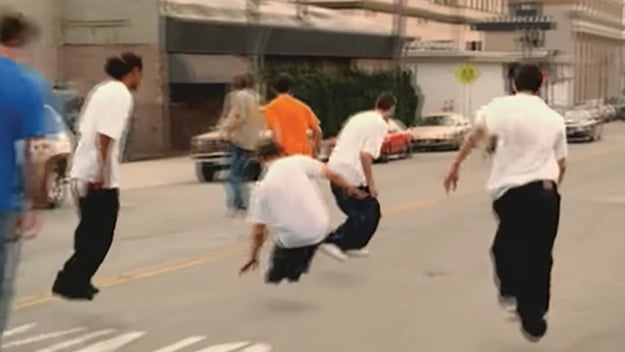
Yeah Right! (Spike Jonze, 2003)
There is a famous skit in Spike Jonze’s 2003 skate video, Yeah Right!, featuring Owen Wilson in the middle of his run as Hollywood’s golden boy. Sitting in an open hatchback wearing a black jacket and a “Girl” hat—a nod to Jonze’s skateboard company—Wilson playfully nags skaters Mike Carroll, Rick Howard, and Eric Koston about the tricks they performed earlier in the video. Ty Evans’s camera—outfitted with a fish-eye lens whose capacity to capture wide angles adds a warped intimacy to the scene—bounces between the characters, as Carroll puts Wilson on the spot about his tricks. The actor begins listing his many skating feats: “Hollywood High, what did I do? . . . Don’t forget Sylmar! Front salad, back salad, front blunt. Basically, I’ve got two minutes of footy.” He gets up (“Carroll, will you crack my back?”), sheds his jacket, and yells “No warm-up! First try, bitch!” as he drops the board and starts pushing. He approaches a rail, leaps up, and hits a bluntside. Wilson fist bumps the cameraman: “Yeah right!”
On the level of form, this interlude has a practical effect: it injects levity into an otherwise intense hour-long athletic spectacle. But Jonze also uses the skit to disorient the viewer, inviting them to question what they just saw. Was Wilson’s inventory of trick names scripted? Did the actor actually slide down the pole and (somewhat) stomp the trick? (The sketchy landing only adds an element of realism to the otherwise surreal occurrence.) Maybe he is actually… good at skating? Only the most hawk-eyed viewer would notice that, during a quick camera pivot, Wilson is replaced by a stunt double: Koston in a blond wig.
Yeah Right! represents the best of the skate video, a form that has never really gotten its critical due in its 60-year existence. Jonze’s classic arrived at the height of what many skaters describe as the Golden Age of skate videos, which included gems such as Alien Workshop’s Photosynthesis (2000) and Mind Field (2009); Emerica’s This is Skateboarding (2003), The DC Video (2003), and Baker 3 (2005), and Vicious Cycle (2005); and Lakai’s Fully Flared (2007). Jonze, who became a critical darling with Being John Malkovich in 1999, had come into his own as a filmmaker through the world of skateboarding: he made Rubbish Heap for World Industries in 1989, Video Days for Blind Skateboards in 1991, and the surreal cult classic Mouse for Girl Skateboards in 1996. Yeah Right! was different: it was technically rigorous, though still spiritually DIY. It was committed to the traditions of skate video aesthetics—the handheld feel (popularized by skating’s most famous camera, the Sony VX1000), the grittiness, the underground vibe—but resistant to formulas. Most of all, it presented skaters doing real tricks in ways that were formally imaginative: in the opening scene, Jonze used ultra slow motion, a first for skate videos at the time, and later, in the “invisible board” skit, he created the illusion that skaters were riding on air.
Right from its very beginnings, the beauty and tension of the skate film came from the ground up. Noel Black’s boy-meets-girl short Skaterdater (1965), the first film ever made about skating, turned Southern California’s pristine suburban life upside down with two choices: placing the camera at ankle-level to shoot the skaters, and showing them riding on their bare feet, skidding and moving about on the asphalt. The cleanliness of the skaters’ “prep” attire contrasts with the filth they accumulate with each kick. The film, which was nominated for Best Short Subject (Live Action) at the 1966 Academy Awards and won both the Best Short Film Grand Prix and Technical Grand Prize at the 1966 Cannes Film Festival, brought viewers down to the street level. A camera was affixed to an outrigger platform connected to a bicycle, viscerally communicating the feeling of freedom and risk afforded by a skateboard.
Skaterdater’s crafty use of camera angles has influenced the way in which skating is understood in the broader culture. In the 1970s, the Z-Boys, a group of teen surfers-turned-skaters from Dogtown, in Southern California, became associated with a hardcore aesthetic that matched the grit of the stretch between Venice Beach and the Santa Monica Pier. In photos, many of which were taken by Craig Stecyk, the kids look badass with their exaggerated leans and boisterous personalities. Stecyk often positioned himself downhill, looking up at the Z-Boys carving toward him. In a now-iconic 1975 shot, Stecyk captures Jay Adams yoking his board around a cone in a deep squat on Bicknell Hill in Santa Monica, his hand scraping the ground like a motorcycle racer’s knee on a curve. In another photo, Stecyk positions himself on the side of an empty pool as Adams, holding his board with one hand and tapping his back trucks along the pool’s edge, looks directly into the camera, giving it the finger.
In 1984, Stacy Peralta, the standout skater from that group, directed and co-produced The Bones Brigade Video Show, which featured legends like Lance Mountain, Tony Hawk, Steve Caballero, and Rodney Mullen. Whereas the Z-Boys look like punk superstars in Stecyk’s photos, the Video Show told a different skate story: it presented the sport as an everyman’s pursuit. Mountain leisurely skates around Los Angeles, often on sidewalks, occasionally planting on walls, kicking and pushing on his board without a lot of technically over-the-top maneuvers. He is just coasting, and the camera observes him with equal chill, often from stationary positions and straight-ahead, eye-level angles.
The Bones Brigade was a team representing Powell-Peralta, a skateboard company started by Peralta and George Powell (with Stecyk as creative director), so pandering to a more general audience made business sense. Powell-Peralta’s later efforts—Future Primitive (1985), The Search for Animal Chin (1987), and Ban This (1989), among others—continued to promote skating as a lifestyle, and they also offered, through fly-on-the-wall depictions of the skaters’ rituals, rites, and kinship, a window into a seemingly closed subculture. The Bones Brigade, for instance, were shown traveling together, pushing each other to experiment, and expressing awe at one another’s trick arsenal.
The idea of community is paramount in the most well-known documentaries about skating: Dogtown and Z-Boys (2001); Bones Brigade: An Autobiography (2012); and All the Streets Are Silent: The Convergence of Hip Hop and Skateboarding 1987-1997 (2021). In narrative films like Larry Clark’s Kids (1995) and Jonah Hill’s mid90s (2018), skating is a refuge for misfits and punks trying to make connections outside of broken homes. But the communal third spaces—skate and surf shops—where these young (almost always) men congregated also reinforce the ways in which late-capitalist notions of identity defined skate culture. The history of skate videos is also a history of advertising investments made by skate brands. Empire Skate, a documentary that aired last year as part of ESPN’s 30 for 30 series, shows how the kids who created New York street skating culture also helped Supreme appropriate it into a global commodity. The brand engineered its image using real skaters, who lent it street cred. In return, Supreme provided resources—a hangout spot, clothes, jobs.
These videos were commercials that resembled high art. Thomas Campbell’s A Love Supreme, a promo video he filmed for the Supreme store in 1995, is shot in black and white, with John Coltrane’s classic album A Love Supreme as the soundtrack. The film is less concerned with skating as an athletic endeavor and more interested in its setting—in this case, New York City. Campbell interweaves shots of skaters moving in and out of traffic with shots of businessmen walking through revolving doors, silhouettes of people kissing, pedestrian overpass stairs, panhandlers, shoes being lobbed over light poles, pay phones, the subway, park foliage, out-of-focus headlights. The video contributes to the lore of Supreme’s origin story, as recounted in Empire Skate and All the Streets Are Silent, which was about aligning skating and visual art—the brand’s logo appropriates the aesthetic of Barbara Kruger, and the shop was designed to look like an art gallery.
Skate culture has been shaped not only by brand endorsements and cool tricks, but also by the consistent criminalization of the sport. In the ’70s, at the height of the Southern California drought, the Z-Boys would trespass into private backyards to skate in dry, unused pools. In the ’90s, street skaters found exciting alternative uses and misuses of city infrastructure, repurposing loading docks, freeway offramps, benches, and concrete walls as makeshift skate parks. These creative uses of public and private infrastructure made them the frequent targets of police violence and harassment. The need to evade the wrath of cops and property owners helped refine skate video aesthetics. If you need to film someone getting a trick off in a spot where you’re not supposed to be, you need to film everything, get in and out quickly, and evaluate what you have after the fact. That’s one reason why, historically, so many skate videos have a verité sensibility.
Music lends a richness of texture to the onscreen tricks as well. Freestyles from the likes of Method Man, Ghostface Killah, Busta Rhymes, and Fat Joe (lifted from radio’s The Stretch Armstrong and Bobbito Show) add rawness to footage of skaters like Harold Hunter and Danny Supa ripping in the streets of New York in Zoo York – Mixtape (1998). It’s one thing to see Zered Bassett in Vicious Cycle ride up the wall of an office building but another to see it with Jay-Z rapping “When the streets is watching/Blocks keep clocking/Waiting for you to break, make your first mistake/Can’t ignore it” on the soundtrack. A killer score is not just about song choice, it’s also about timing: a perfectly synced chord change hitting just as a skater stomps a landing or eats shit, mixing with the sounds of skating itself—the cling and drag of metal trucks hitting a rail, the rhythmic growl of wheels picking up speed on a sidewalk, the pop of the wood when a skater pushes off the ground on an ollie (or nollie), the eruption of cheers after someone narrowly avoids catastrophe.
One of my favorite moments from a skate film comes from Jeff Stevens’s segment in the first A Happy Medium (2008) by Buster O’Shea. Stevens seems bent on touching every bannister, every support beam, every curb with his board. He booger slides. He primo slides, grinding on a loading dock only to half-flip his board on its edge and coast a little more, standing on the sides of his wheels before jumping 180 out of it. The video is shot in Phoenix, Arizona. Many of the shots are at night—it’s too hot during the day to skate. This brings the presence of the cameraman into the shots via shadows more than we’re used to in most tapes. Happy Medium depicts what I might call drought-resistant skating—in lieu of city benches and construction ramps, the skaters leap over cactuses and succulents, roll over poorly-landscaped front yards, and skid down barren aqueducts. The landscape is completely washed out.
It’s a tall order for art to approach lived experience. But, since Skaterdater, that’s exactly what all skate videos try to do in one way or another. The Golden Age might be over, but in the last few decades, other skate videos—Girl/Chocolate’s Pretty Sweet (2012), Supreme’s “cherry” (2014), HUF’s Forever (2023), Dickies’s Honeymoon (2024)—have kept this spirit alive. They speak to something essential about the form: that the best videos help you see skating like a skater. They offer another way of looking.
Ian F. Blair is a writer and editor based in New York City.