Parallel Time
This article appeared in the October 3, 2025 edition of The Film Comment Letter, our free weekly newsletter featuring original film criticism and writing. Sign up for the Letter here.
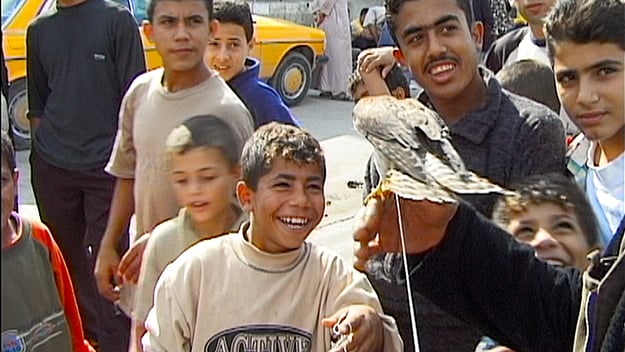
With Hasan in Gaza (Kamal Aljafari, 2025)
“Our time does not proceed on the axis of past and present and future,” wrote the Palestinian political prisoner and novelist Walid Daqqa, nearly 20 years into what would become a life sentence. Daqqa poignantly contrasted the “parallel time” of prison, stretching out indefinitely though never moving forward, with the chronological time outside; yet he understood well that for Palestinians, prison does not end at the cell doors. Later, reflecting on his young daughter’s intuitive understanding of his condition, Daqqa would define prison as a “place without a door.” It’s a phrase that distills much about Palestinian existence under Israeli occupation, particularly, though not only, for those holding onto life in the besieged rubble of Gaza today.
Kamal Aljafari’s With Hasan in Gaza, screening in the Currents section of NYFF63, returns us, bucking chronological time, to a Gaza still standing and accessible to the Palestinian filmmaker in 2001—during the Second Intifada but prior to Israel’s blockade. Aljafari’s quiet and haunting film is made from MiniDV tapes he shot back then—before he had made his first short, 2003’s Visit Iraq—and recently rediscovered. It documents the filmmaker’s search for a friend from Gaza with whom he shared a prison cell as a teenager. Composed entirely of this “found” footage, With Hasan is minimally framed, in the present, by captions relaying his prison memories and a soundtrack that alternates sparse, eerie synth work with brilliantly selected Palestinian and Arab songs, whose lyrics recast the images in light of Gaza’s destruction.
Much of With Hasan’s pathos lies in our anachronistic encounter with Gaza’s once-vibrant streets and souks, where smiling children play and fresh vegetables abound. But the rubble, subjugation, and poverty wrought by Israeli occupation are here too; With Hasan cannot escape from Daqqa’s prison, which is both its subject and the prism through which we see Gaza. Aljafari’s first images are of the Israeli military infrastructure through which he passes to enter Gaza; zooming in on an unattended checkpoint, it is as if he seizes the role of the watcher only to exorcise the surveillant gaze. From here on, Aljafari gives us an intimate record of two days and two nights in Gaza, with his friend and guide Hasan Elboubou and himself serving as our companions.
Rarely in cinema is Gaza granted the care of close, tender observation that seeks to know the place from the perspective of a neighbor and friend rather than a journalist or emergency worker. (Important exceptions include Abdel Salam Shehada’s wistful 2008 documentary To My Father and Michel Khleifi’s wondrous 1995 drama Tale of the Three Jewels, the first narrative feature shot entirely in Gaza.) With Hasan is poignant not only because it depicts Gaza before its annihilation, but because Aljafari explores its lifeworlds with a loving curiosity that has nothing to do with saving it or speaking on its behalf. His camera is tactile and active; we feel we are running our hands along the walls of narrow alleyways, idling in a café watching men play cards, or sitting in the passenger seat of a car and gazing out its window.
Everyone Aljafari encounters commands him to point the camera here or there, whether it is children shouting “film me!” or adults imploring him to document Israeli violence. In this respect alone, With Hasan is like many a documentary set during the Second Intifada, with their inescapable imagery of checkpoints, rubble, and shouting passersby—but Aljafari quietly lets his gaze wander. Hasan also holds the camera at times, showing Aljafari in conversation with various individuals: a father who spent eight years in Israeli prisons and says he’s at the beach making up for lost time with his children; a farmer standing atop the debris of homes destroyed by the Israeli army, who worries about being filmed because he has an “electronic worker card.” A neighbor of his reassures him that no one will see the film, and unwittingly makes him a prophetic synecdoche for Gaza: “We’re preparing a documentary that will be shown many years from now. You wouldn’t be recognizable in it.”
The ghostly traces of Gaza’s people also become the unanticipated subject of Sepideh Farsi’s NYFF63 Spotlight selection Put Your Soul on Your Hand and Walk, a documentary about Palestinian photojournalist and poet Fatma Hassouna, who was killed earlier this year at the age of 25. Blocked from entering Gaza, the exiled Iranian filmmaker struck up a friendship with Hassouna after hearing of her through a displaced Palestinian in Cairo, and finding in her a kindred spirit also “conditioned by walls and wars.” The film is structured as a chronological diary of the two women’s video calls between April 2024 and April 2025, interrupted by connectivity failures and bombings, and interspersed with news clips. We see Hassouna on the screen of a mounted cell phone, filmed by Farsi; her unguarded smile, love of Gaza, and evident joy in connecting with the filmmaker are devastating counterpoints to the scenes of destruction she shows us.
“If I must die, I want a resonant death,” Hassouna wrote, before she met the same fate as poet and professor Refaat Alareer, whose now-famous words (as translated by Batool Abu Akleen) she echoes. Farsi has admirably amplified her life, creativity, and steadfast hope in Put Your Soul, which features several sequences that vividly pair Hassouna’s photographs with her poems, songs, and commentary. The filmmaker also compellingly resists any urge to speak with her subject as a victim or naïf; instead, the secular, Paris- and Athens-based Iranian dissident frequently allows differences to emerge between herself and a woman her daughter’s age, who never had a chance to leave Gaza and who believes that God has a reason for everything, including Gaza’s suffering (Farsi openly, politely, disagrees). But there is tragically little time for this relationship to develop. In their final conversation, Farsi informs Hassouna that the film has been accepted to Cannes; the two discuss flying out Hassouna, who insists she will return to Gaza, her home. That night, captions inform us, Hassouna was killed in her apartment by an Israeli air strike, together with several family members, joining more than 200 Palestinian journalists killed since October 2023.
Basma al-Sharif’s 21-minute experimental short Morning Circle, featured in the NYFF’s Currents program, takes place not in Gaza but amid the reverberations of genocides past and ongoing, in Berlin. (The director was raised in Gaza, the U.S., and France, and now lives in Germany.) Her film is about parenting as an immigrant in a country that sets a dehumanizing standard of assimilation as the cost of its hospitality—or rather, about the dignity to be found in refusing that price. Set during a single morning, its loose narrative is structured around a tense exchange between Herr Abrahamyan (Panos Aprahamian) and an off-screen German bureaucrat who interrogates him, apparently within his own apartment, about his “attachment to our way of life here.” Abrahamyan attests, among other things, that he speaks Arabic but is not Muslim; his Armenian-Arab identity summons a plurality of displacements and attachments opaque to systems of population management. But al-Sharif is not concerned with exposing how the bureaucrat’s questions (“Would you like to go back?”) rest on impossible binaries; Abrahamyan balks at them, coolly smokes his cigarette, and walks away to wake his young son Adnan (Mohammad Ali).
The German’s questions echo across much of the film, trailing Abrahamyan and Adnan as they enter Adnan’s musikkindergarten. But so too do sonic rejoinders and glimpses of distant homelands. Abrahamyan clips his son’s fingernails as we hear them listening to Arabic-language news from Gaza; a countershot shows the TV screen, but rather than images of death and destruction, we see the Mediterranean coast. Punctuating the pensive tone of the film is an electronic underground anthem by Cairo’s Maurice Louca, “Salute the Parrot,” whose zany chorus and shaabi beats bubble up in the quiet of the family apartment before erupting in the film’s final dance sequence at the school. It’s an exuberant ending, the camera whirling with the kindergarten children as they dance, filtered through psychedelic colors and overlayed with images of Gaza’s Palestinians returning to their homes (during January’s ceasefire).
The film may strike some as flippant (oh Germany, always on the wrong side) or absurdist (wake up and salute the parrot?), but, as a diasporic Palestinian-Lebanese father, I found it deeply moving. The recurrent techniques employed by al-Sharif—echoes, superimpositions, irruptions—here evoke Edward Said’s celebration of the exile’s contrapuntal vision, their “awareness of simultaneous dimensions.” Scenes of Abrahamyan caring for Adnan, meanwhile, remind us of what it is to build family amid a genocide that has killed, injured, or orphaned countless thousands upon thousands of children (and for which casualty counts of “women and children,” however well-intended, are an affront to the tenderness of Palestinian men). Here is one kaleidoscopic view of what it means for Gaza to resonate within us, wherever we live.
I think of a photo by Hassouna, of a concrete wall blasted open; sunlight streams in from the hole, and through it, we see two cars parked under a horizon of sea and sky. Is it an image of ruination or possibility? If prison is a place without a door, these three films, distinct as they are, pry open apertures into a parallel time and space, from which we must make sense of Gaza’s horizon as intimately tied to our own.
Kareem Estefan is an assistant professor of film and screen studies at the University of Cambridge.