Locarno 2025: Past Perfect
This article appeared in the August 22, 2025 edition of The Film Comment Letter, our free weekly newsletter featuring original film criticism and writing. Sign up for the Letter here.
Blue Heron (Sophy Romvari, 2025)
When you’re at the Locarno Film Festival and you mention that your mother grew up in these parts, and still owns your grandmother’s small, inconvenient, mosquitoey house up in the hills, people look incredulous. It’s like you’ve just confessed that you were raised by a family of woodland elves, or that you live in Summerisle or Brigadoon. Unlike at festivals located in big cities such as Berlin or Toronto, or in famous tourist hot spots such as Venice or Cannes, few international attendees will have visited—or even contemplated the existence of—this pretty, crushingly expensive town in the south of Switzerland, barring a couple of sweltering weeks in August. Fewer still will have spent their childhood summers in the region, and it’s probably only me who, scurrying sweatily from screening to screening, finds her mind full of madeleine-memories of getting panicky-lost among the sunbathing bodies at the lido, or of having a wobbly milk tooth on the Piazza Grande, or of the annual treat that was each vacation’s first Rivella (a sparkling Swiss soft drink made from milk whey that is a lot more delicious than it sounds).
Apologies for my indulgently memoir-ish opening paragraph—it’s a register I try to avoid. But my peculiar history with Locarno is relevant here because quite a few highlights of this year’s selection were also contending not just with memory, but with the past nosing so insistently into the present that it alters the very shape of the memorializing act. As such, not to acknowledge the influence of my lifelong relationship with this place on my experience of the last couple of weeks would be conduct unbecoming a piece about filmmakers who are unafraid to let the intrusively imperfect nature of recollection and recreation reshape their films from the inside out, and sometimes from the outside in.
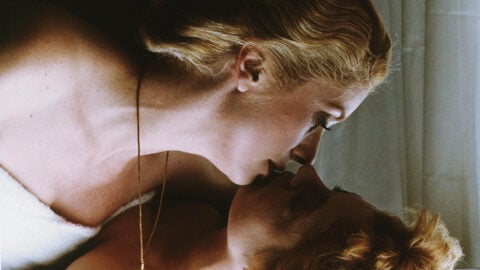
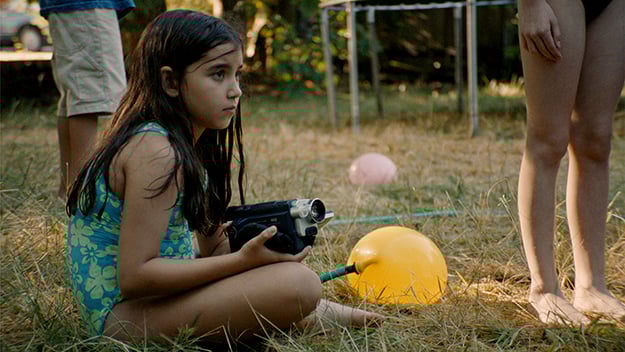
Take, for example, Sophy Romvari’s delicately devastating Blue Heron, which played in the Cineasti del Presente competition for emerging directors. Many of Romvari’s celebrated short films have lived in the overlap between fiction and nonfiction, but that instinct is taken to a piercingly perceptive new level in her feature debut. Initially, its evocative soundscape of spritzing garden hoses and zoinging trampoline springs, plus the glancing, sunflared cinematography, makes the film play as a reminiscence of a pivotal summer holiday, albeit one unusually sensitive to the inaccuracies of our childhood perceptions. But, as if the writer-director is becoming impatient with the way her 8-year-old on-screen avatar, Sasha (Eylul Guven), inevitably turns her gaze away from things the adult Romvari is desperate to look at, soon the film’s reality starts to warp.
This happens especially around Sasha’s tragically troubled teenage brother Jeremy (Edik Beddoes), as he seems to appear and disappear from the periphery of certain scenes, and to become the subject of every partially overheard, low-voiced conversation between the kids’ anguished parents. When this gentle futzing with narrative fabric also proves inadequate for the catharsis Romvari seeks, she effects a more dramatic intervention, allowing the grown-up Sasha (Amy Zimmer), now a filmmaker addressing her brother’s early death in her work, to show up at the house during that fateful long-ago summer as a care worker. This is an enormously rich gambit, but its layered, time-collapsing complexity belies the moving emotional simplicity it summons. It’s especially pure, and especially heartbreaking in the one moment of interaction between kid-Sasha and adult-Sasha, in which forgiveness seems to flow in both directions along the axis of a single glance: you were just a child.
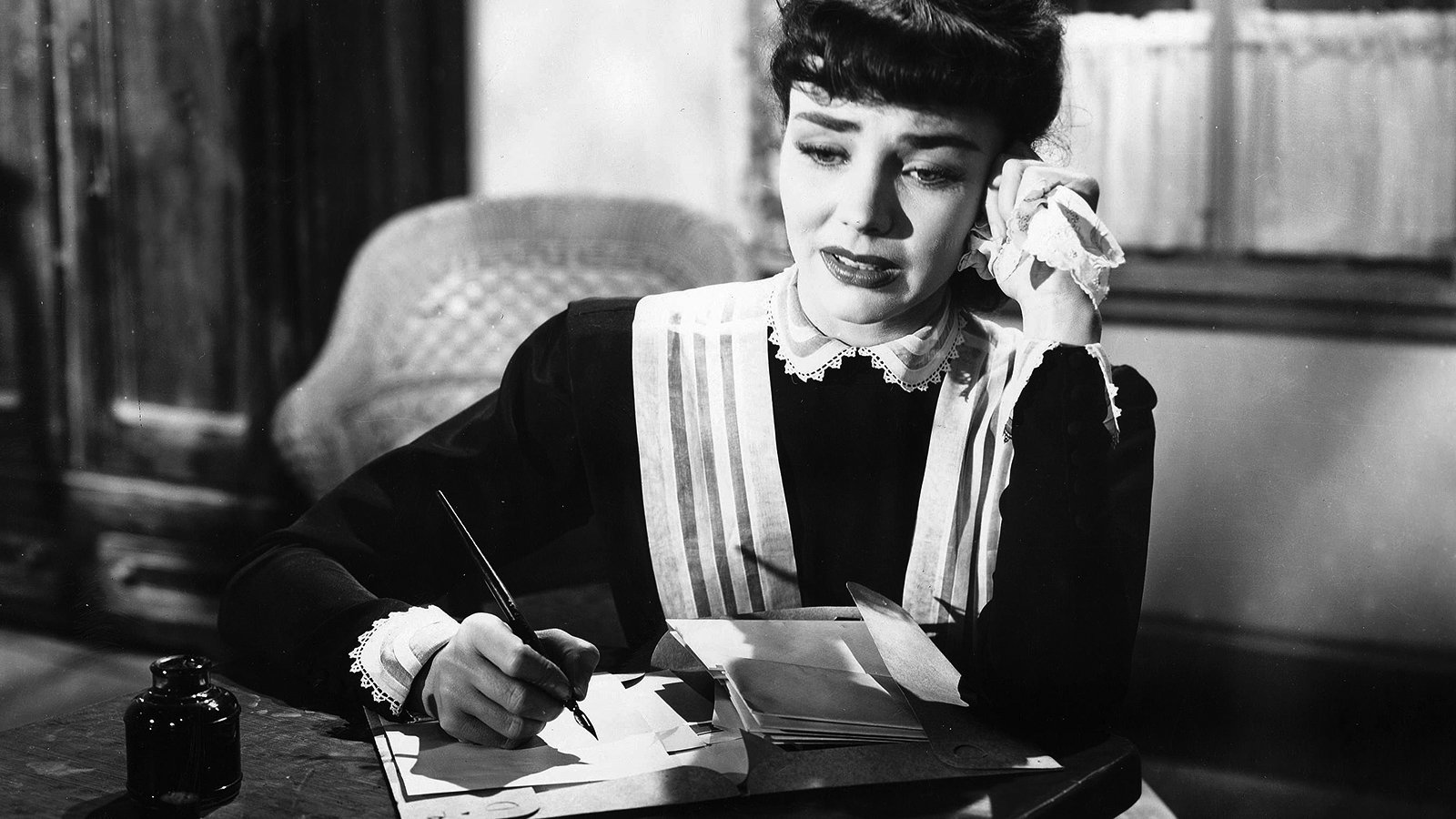
In a much more classical though no less haunted vein, Croatian filmmaker Hana Jušić takes a giant leap up from her feature debut Quit Staring at My Plate with her follow-up, the period drama God Will Not Help, which played in the main competition. Set in the early 20th century, it traces the sudden upheaval that ensues when black-clad, Spanish-speaking Teresa (Manuela Martelli) arrives at a remote homestead in the Croatian mountains claiming to be the widow of the brother who left to find his fortune in Chile. With no real way to prove or disprove her self-declared identity, Teresa becomes a reflection of the desires and fears of the other characters, even as she suffers nightmarish flashbacks to a past she is trying to escape.
But also, in focusing on this émigré woman and her determination to earn her place in the world despite the cultural, linguistic, jingoistic, and sexist barriers between her and her hostile, occasionally predatory in-laws, the whole film feels like an act of willful remembrance of exactly the type of person history often forgets. In Martelli’s superbly compact, sly portrayal marked by her uncannily defiant gaze (she shared one of the festival’s Best Performance prizes with her co-star Ana Marija Veselčić), Jušić’s film gets its modern edge. At times it’s like Teresa has more in common with the charismatic grifters and ambitious imposters who fascinate us today than with her patriarchal, superstitious contemporaries.
However, for taking potshots at the patriarchy and also for interrogating cultural history through the lens of grasping, uncouth, A.I.-raddled modernity, one must not overlook Radu Jude’s outlandish Dracula. Indeed one really cannot overlook Dracula, given its length, its provocative vulgarity, and its deliberately garish unwieldiness. An almost three-hour burp in the face of good taste, subtlety, and those laboring under the delusion that, after his terrific but comparatively sedate Kontinental ’25, Jude was getting respectable, Dracula is a discordant riff on a classic text that is astonishingly stupid, stupefyingly brilliant, and quite often flat-out irritating.
For our purposes, because you could parse this epic, 14-part movie for a week, it serves as a handy illustration of form following content. When you’re talking about the sheer dumbfuck idiocy of so much of modern life, what business do you have being tidy and polite? Jude employs the framing device of a likably motormouthed filmmaker (Adonis Tanța) who is engaged in repeated attempts to get an A.I. chatbot to fix the screenplay for his version of Dracula, many of which we see play out. This scrappy structure provides the pretext for gathering wildly off-topic but typically spicy digressions about art, history, commerce, politics, capital, and labor all under the same cape, so to speak. And it also allows for the inclusion of lengthy montages of profane, often gynecological, eye-gougingly ugly A.I. illustrations, which somehow manage to make actress Ilinca Manolache’s Andrew Tate–filtered TikToks in Do Not Expect Too Much from the End of the World (2023) look quaint by comparison. Jude’s take is hardly the last word in Dracula adaptations. But with Bram Stoker and Count Orlok and Vlad the Impaler and indeed everything that’s ever been part of our shared cultural, social, and historical memory being ground down and fed into the A.I. slop mill, it might just be an omen of the next word in Dracula adaptations. And that should chill your blood.
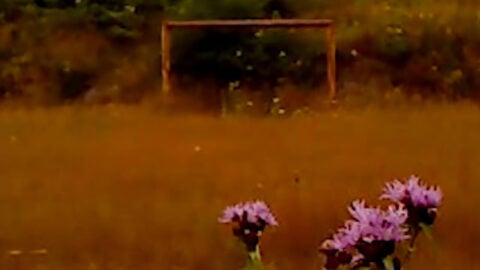
It’s far more pleasant to contemplate a wholly different, though by no means less experimental, riff on another national legend, namely Georgia’s abiding love affair with football. Alexandre Koberidze’s Dry Leaf (my favorite new film of the whole Locarno selection) is another three-hour movie, but its intimate, fuzzy pleasures could not be further from Jude’s hi-res, sharp-edged provocations. Shooting on a defunct camera phone so that, when projected, the image is made up of blotchy pixels a hand’s-breadth wide, Koberidze follows up his gorgeous fairy tale What Do We See When We Look at the Sky? (2021) with a sweetly nostalgic road movie, amply decorated with trees, cats, dogs, donkeys, hens, overgrown countryside football pitches, ripe apricots, and digital compression artifacts. Yet the distraction of the low-resolution photography lasts only a minute or two, and soon it’s the nature of the image that provides so much of the storytelling. The skimpy plotline involves a man (played by Koberidze’s father, David) going on a trip with an invisible companion in search of a daughter who is not so much missing as preferring not to be found. But the glimmeringly diffuse, pixelated imagery means every new scene is a game of hide and seek, and every new frame comes encoded with little mysteries born of the way digital images degrade, which reminded me of the way our memories do.
Yet Dry Leaf isn’t just some sophistic intellectual exercise in seeing and not seeing, nor simply a recalibration of the aesthetic judgements of “ugly” and “beautiful” in the cinema. There’s a remarkable warmth here that verges on sentimentality but is pulled back from the brink by the lovely ordinariness of what is being celebrated: a chat with some local kids waiting to play on a sloping, soon-to-be-demolished pitch; a drop-in visit to a relative; a quick stop to feed a stray dog or pat the muzzle of a forlorn-looking donkey (is there any other kind?). Koberidze’s sincere investment in these moments, and the softness of their presentation, imbues them with a near-magical grace, for all their essential mundanity. And the mushy indistinctness of the images gives them a kind of heroic authenticity; as yet, there is no Instagram filter that will make your snaps look like they were shot on a Sony Ericsson phone that was discontinued in 2011. Of course, there is no real way to capture incidents and feelings exactly as they happened, after the moment has passed. But using old technology in this way might be the closest you can come to that kind of time travel, the kind I helplessly engage in each year I come back to Locarno—and this year, because of these films, more than most.
Jessica Kiang is a freelance film critic and a member of the Berlinale selection committee.