Day by Day
This article appeared in the November 14, 2025 edition of The Film Comment Letter, our free weekly newsletter featuring original film criticism and writing. Sign up for the Letter here.
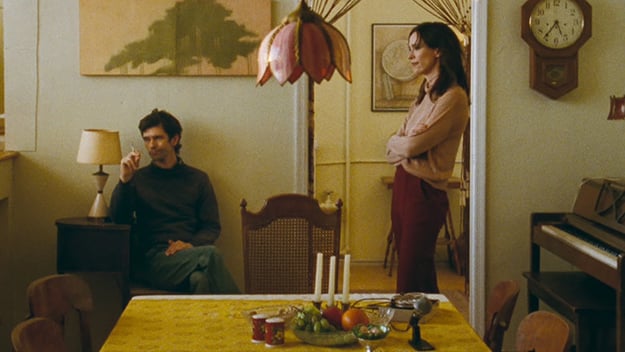
Peter Hujar’s Day (Ira Sachs, 2025)
Here are two or three things I know about Peter Hujar: he was a photographer, active primarily in the 1970s and ’80s, whose work often featured stark black-and-white portraits of artists and writers in New York. He was a gay man. He died, at just 53 years of age, in 1987 due to AIDS-related pneumonia. To what extent do facts like these compose an accurate portrait of a life? And can any portrait ever truthfully depict an irretrievable past? These questions animate Ira Sachs’s new film, Peter Hujar’s Day, a not-quite-biopic that brings Hujar onto the screen not by focusing on the broad strokes of his life, but by approaching them aslant through a single day. The stuff of life, the film suggests, is not just what appears in the factual record, but the banalities that fill a person’s minutes and days.
These details are drawn from the structural conceit of the film, which directly adapts just one single conversation Hujar and his friend, writer Linda Rosenkrantz, had on a December day in 1974. As part of a never-to-be-realized book project, Rosenkrantz had set up a tape recorder and asked the photographer to recount in precise detail everything he had done the previous day. The interview was a continuation of Rosenkrantz’s ongoing investment in interrogating the everyday—her 1968 book Talk had transformed verbatim real conversations with her friends into a novel. The everyday, she imagined, was something everyone assumed they understood yet never actually thought very deeply about.
Though the original recording was lost, a print transcript of the conversation was recently discovered in Hujar’s archives and published as a book in 2021. Sachs lifts the dialogue word for word into his screenplay (with minor cuts), casts Ben Whishaw as Hujar and Rebecca Hall as Rosenkrantz, and stages their encounter in the writer’s lush, sun-filled Upper Manhattan apartment. The result is something like a chamber drama, consisting almost entirely of two people talking—mostly about the banalities of daily life, like whether Hujar wore clothes during his nap and what the person in front of him in line at the take-out place ordered. The effect of this approach is not to narrow our sense of what makes up a life, but rather to expand it.
Sachs resists the impulse to cut away to images of the day Hujar describes, holding fast to the scene of the conversation, the moment directly inscribed onto the tape. Repeated shots of the tape recorder underline this narrative strategy: every word uttered by Whishaw and Hall is taken straight from the transcript. Yet basing a work of art in reality is no guarantee of truth, something Hujar knew better than anyone—he remarked once that “a photograph is a complete fiction.” Offsetting its use of the verbatim source, the film goes out of its way to reference its own construction, opening with a shot of a slate and including, in one moment, a boom mic flashing into frame. The actors abruptly change locations and outfits, as the film jump-cuts from the kitchen to the bedroom to the roof, even as their sentences continue unbroken across the edits. A few times, the film takes flight into imagined tableaus, as if breaking into song: interludes set to Mozart in which Hall and Whishaw pose theatrically and stare directly into the camera. Even as the film draws us in with the truth-claim of its narrative conceit, it keeps us at bay with these flourishes, reminding us of the incompleteness of its (and any) documentary record.
The recourse to fiction also gives the film a way of undercutting reality, circumventing the tragedy of Hujar’s death. If the specter of the AIDS epidemic loomed over the lives of gay men in the subsequent decade, linking them irrevocably to tragedy and death, Peter Hujar’s Day insists, instead, on the terms of life. There is no direct reference to death anywhere in this film, neither in the conversation nor in the contextual titles that appear at the beginning. Instead, the film’s carefully circumscribed everyday fashions a space of day-to-day living against the pervasive tendency, etched into the historical record, to render queer life as proximate to death.
Sachs also understands that the everyday is not outside of that record. There’s a mournful undercurrent to the film, one that rises increasingly to the surface as the day draws to a close. Darkness settles into the apartment, and Whishaw’s performance becomes heavy with wistfulness and lethargy. “I don’t feel good,” he laments about his smoking habit. In the film’s closing sequence, Sachs frames Whishaw and Hall exclusively in separate shots, creating a sudden distance between the two that’s jarring in a work that has so often presented their bodies close together. One moment of portraiture at the end of the sequence has Hujar looking straight at the camera, staring blankly, his face illuminated by the soft lamp beside him—before the light abruptly shuts off, leaving his features partially shrouded. It’s hard not to read this gesture as something like turning the lights out, a way to acknowledge death without ever explicitly rendering it on screen. A delicate visual elegy, then—a curtain drawn.
But the film does not end with this shot. Instead, in the remaining light, we see Rosenkrantz stop the tape, before Sachs cuts back to Hujar, his face suddenly emerging from the darkness. In this interstitial space after the archival recording trails off, Hujar lets out a long, fatigued sigh before suddenly craning his head upward, as if responding to a signal from beyond the frame. Maybe Whishaw is looking at the film being made around him, or maybe it’s Hujar looking around, finally done retelling his day. In either case, something outside of both the film and its source juts in and interrupts its situation. All of a sudden (have they been talking all this time?), the night is already past—dawn peeks out from the background. Gesturing toward what’s outside the frame, the film affirms possibility: somewhere out there, for Peter Hujar, another day might follow.
Daniel Zheng is a writer and critic based in New York