Karlovy Vary 2025: Nothing Feels Normal
This article appeared in the July 18, 2025 edition of The Film Comment Letter, our free weekly newsletter featuring original film criticism and writing. Sign up for the Letter here.
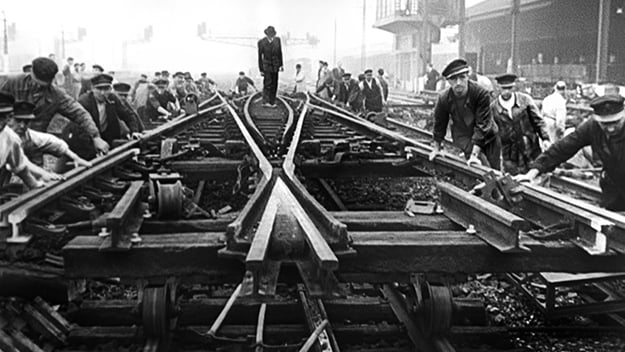
Trains (Maciej Drygas, 2024)
My 59th Karlovy Vary International Film Festival began with Maciej Drygas’s searing archival epic Trains (2024), in the Horizons program, which highlights notable premieres from the year’s fest circuit. Drygas’s film, along with titles from other veteran Eastern European directors like Sergei Loznitsa, resonated deeply in Karlovy Vary as a reminder of the region’s turbulent history. Trains draws from 46 different archives across the globe to paint a collective portrait of life and death in the 20th century. The invention of railroads, which enabled time and space travel, is paralleled poignantly with cinema’s own transportive powers, but at its heart Trains is a somber reflection on the implacable march of modern history as technology-aided slaughter. The film’s temporal compression—it spans the late 1800s to the mid-1940s in 81 minutes—heightens the sensation that no sooner than soldiers return home after the First World War and cities are restored, the Second World War breaks out. In each war’s aftermath, trains bring back broken bodies, corpses, and starving orphans: the bitter outcome of Europe’s spiral of aggression.
The film’s grim message about political conflicts that simmer, unresolved, only to break out again reverberated across the lineup. Pavel Juráček’s New Wave pastiche Every Young Man (1966) follows a group of young men in communist-era military training. In this lighthearted comedy, dogma breeds a new class not of enlightened Soviet men but of hapless bunglers and perennial slackers. The youngsters break the tedium of duty by fantasizing about sex, playing with pets, and joking around in the army kitchen. Low morale and antimilitarist sentiment affect soldiers and civilians alike—one noisy wartime simulation ends with a villager screaming, “Stop, you idiots!” Juráček made the film shortly before the “small normalization,” a period marked by purges and renewed censorship following the ’68 Soviet invasion of Czechoslovakia and the resulting societal retreat from political engagement. In this latter aspect, the movie resonated poignantly with the new films at KVIFF, in which young protagonists wish to engage politically but retreat anxiously into their private lives, raising questions about the tenuous line between conformity and complicity on the one hand and self-care on the other.
In Paula Ďurinová’s experimental documentary Action Item (2025), playing in the Proxima competition for emerging filmmakers, a young woman narrates her experience of joining protests in Berlin (it’s ambiguous what the protests are against, but shots of protesters wearing black-and-white keffiyehs suggest they’re pro-Palestinian demonstrations, violently suppressed by the police). One day, she realizes she’s been riding her bike with a broken ankle. Her delayed reaction to the acute physical pain spurs her to reexamine the extent to which her day-to-day existence has been marked by anxiety so great that has resulted in psychosomatic numbness. The film’s fragmented visual language, collaging first-person voiceover with coolly objective shots of Berlin’s urban landscape, gives expression to the character’s disorientation as she’s caught between myriad emergencies, from economic instability to the crackdown on activists. Later scenes depict the young woman reading her diary entries about burnout with a group of friends who then share similar experiences and eventually go on a kind of mindfulness retreat.
Matas (Šarūnas Zenkevičius), a Lithuanian tour guide in Gabrielė Urbonaitė’s witty contemporary drama Renovation (2025), also doesn’t notice his broken foot while navigating a whirlwind romantic and domestic life with a young poet, Ilona (Žygimantė Elena Jakštaitė). Ilona is anxious about marriage and motherhood, and her parents’ expectations of careerist success. Meanwhile, Matas is pressured by his father to take a survival course, which he finds absurdly militaristic, but he fears that his masculinity is at stake. His repressed pain is but one sign that his private “small normalization”—an attempt to fit in and to get by—masks a deeper angst. The couple’s intimate scenes are bracketed by news from the war in Ukraine. Meanwhile Ilona befriends one of the Ukrainian refugees working on her building, whom the neighbors mistrust. (There’s even a fascist “Z” graffitied on the entrance of the apartment complex). The film’s title acquires a darkly ironic meaning: just as the hasty renovation of Ilona’s building is an aesthetic bandage pasted over deeper structural problems, so too do old political conflicts fester under the facade of relative stability.
In the festival’s main Crystal Globe Competition, Ondřej Provaznik’s Broken Voices (2025) also delves into a young person’s conflicted inner world. In the film, teenage sisters Karolina (Kateřina Falbrová) and Lucie (Maya Kintera) have a crush on their choir director, Vit Macha (Juraj Loj). Stern yet charismatic, Macha plays an insidious father figure to young singers competing for spots on an international tour to the United States. When Karolina suddenly becomes his “favorite,” Lucie—a victim of abuse—finds herself unable, or possibly unwilling, to protect her younger sibling. Based on the real-life 2008 case of the Bambini di Praga choir conductor who was accused of abusing dozens of girls, Broken Voices reconstructs the musty décor of ’90s Czechia as it was emerging from its communist past, making the allure of the West all the more irresistible for youth—yet also a mirage. In one evocative scene, Karolina offers to buy a bowtie for Macha before a crucial event at the Czech Embassy in New York, only to lose the accessory in the city’s garbage-strewn streets and traffic jams.
The most memorable specter at this year’s KVIFF came from the history of cinema itself. In the festival’s non-competitive Imagina program, dedicated to films employing “an unconventional approach to narration and style,” Bill Morrison’s hypnotic Ghost of the Past (2025) reinterprets the surviving fragments of Édouard Chimant’s silent feature Survivre (1924) with archival footage set to a pulsating jazz score by Bill Frisell. Not much of the film’s plot can be discerned, though the scenes featured by Morrison depict characters smoking opium in a den. As always in the Chicago-based director’s films, the main event is not the narrative action but rather the degradation of the film stock itself—its stains, burns, and tears. Watching the smokers’ faces pulse and dissolve, liquifying as if burned by acid, I couldn’t help but think of the maimed visages of the World War I veterans in Drygas’s Trains, young men fitted with masks to cover the gaping orifices in their torn flesh, a facial “renovation” of sorts that only exacerbates the enduring tragedy of the wounds underneath.
Ela Bittencourt is a writer who contributes essays on film and art to such international publications as Artforum and Frieze magazine. She’s currently living in Berlin.