Interview: Bi Gan on Resurrection
This article appeared in the October 3, 2025 edition of The Film Comment Letter, our free weekly newsletter featuring original film criticism and writing. Sign up for the Letter here.

Resurrection (Bi Gan, 2025)
The cinema of Bi Gan exults in the medium’s essential properties: its capacity to traverse as well as transfigure space and time. Resurrection, the Chinese director’s long-awaited third feature and the winner of a Special Jury Prize at this year’s Cannes Film Festival, takes this metaphysical impulse to grandiose extremes, encompassing the 20th century and the many lives of cinema contained therein.
The film takes place in a world where dreaming no longer exists, except among a cohort of rebel illusionists known as the Fantasmers. One of them, played by pop idol Jackson Yee, is mutated into a Frankenstein’s monster of cinema after a whirring projector is installed in his torso, and serves as our shape-shifting guide through a drifting odyssey that alights on various eras and cinematic modes. Like Kaili Blues (2015) and Long Day’s Journey Into Night (2018), the movie culminates with Bi’s trademark high-wire act: an elaborately choreographed extended take, unfolding in this instance on the brink of doomsday, as night turns to morning.
Resurrection was added to the Competition less than a week before the festival got under way. Bringing to mind the fabled days of Wong Kar-wai arriving in Cannes with prints allegedly still wet from the lab, Bi was likewise deep into postproduction at the festival’s midpoint, when an unfinished version was screened for distributors. (It was acquired for the U.S. by Janus Films.) On the eve of the world premiere at Cannes, I met with Bi to discuss the making of his most extravagant film to date.
Resurrection has its New York premiere on Sunday, Oct 5 at NYFF.
I gather it was a mad rush to finish the film.
The shooting took much longer than we expected.
When did you finish and how long was the shoot?
We finished around the 10th of April, and the shoot started more than a year ago. The original plan was to finish by May of last year, but we had to pause twice and ended up shooting until last month.
It’s quite a high-concept film—actually there are many concepts, but was the main impulse to engage with the entire lifespan of cinema?
After Long Day’s Journey Into Night, I wanted to make something about the 20th century, but it’s such a long period of time that I decided to use chapters. So from the beginning, I knew the structure, and that I wanted to explore the question of what the human mind is, and also use the same actor in all the chapters. I thought that the way to move through time was not with a human character or a historical figure, but with the figure of what I call a cinema monster.
As with your previous films, the Chinese and English titles are different.
I don’t really have deep thoughts on this; it’s kind of a game for me. With the English title, Resurrection, I want people to appreciate again the beauty of cinema. There’s a religious connotation too, and I want this resurrection to bring comfort to the audience. For the Chinese title, I actually wanted to use the same word, but Resurrection in Chinese is associated with the Tolstoy novel [of that name]. So I chose a Chinese name [Kuang ye shi dai] which means “Savage Age,” referring to the 20th century.
This movement through the cinema century is ultimately circular: we end where we begin, inside a theater.
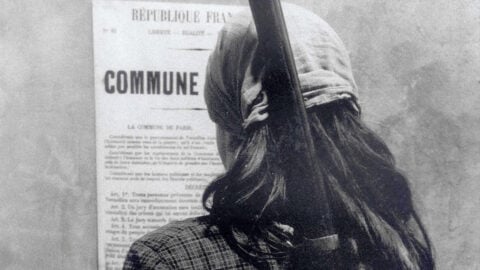
The beginning of the story, the silent-film chapter, corresponds with the birth of cinema. The last chapter, I actually conceived as sci-fi. But while shooting, I lost interest in this sci-fi ending, so I thought we could end by moving back to where we started. We tested black and white, and it was very beautiful, but it had a very retro feeling, so we went with color. I wanted it to be new, modern. It’s a tribute, not just a duplicate of a silent film.
There are echoes of early cinema in your short film A Short Story (2022). Have you always been interested in early and silent cinema?
Actually, I’m not very familiar with it, but I use it out of necessity. I like Buster Keaton. That’s why there’s a cat with a hat in A Short Story. And I like Chaplin.
I’ve heard you say that you like to make simple films, but each one of your features has represented a step up in budget, scale, and complexity.
In the conception [stage], this was a simple movie. It became more difficult and complicated as we were making it. A Short Story was commissioned by a pet company, and was supposed to be done within a few days, but I took four months. They wanted a three-minute advertisement and I made a 15-minute film. For Resurrection, several different ideas are intertwined together, and I think I needed a more complicated structure for the ending to make sense. But I do want to make a simple movie next time.
Long Day’s Journey became infamous for its marketing campaign in China, where it was sold as a romantic New Year’s Eve date movie—which met with some backlash. Is there a plan for how Resurrection will be positioned there, since it’s a bigger film?
Yes, the marketing strategy for Long Day’s Journey Into Night made it slightly controversial. With Resurrection, we are making it very clear from the beginning that it’s an art-house film. There are famous actors in it, but they participated without any commercial consideration. They spent a lot of time preparing for their characters, and it’s a very sincere movie. At the end of Resurrection, I had this very simple, pure desire to offer comfort to the audience. Over the last few years, the world has changed in many ways, and I want to offer some comfort to those who are suffering through these changes.
Can you say a bit about casting? Your lead, Jackson Yee, is a huge star in China, and Shu Qi is associated with a filmmaker, Hou Hsiao-hsien, whom I know is important to you.
I’m a fan of Shu Qi, and knowing that this is a character who will see through all illusions, I thought about her immediately.
Watching her here, you realize she would have been a great silent movie star.
When I told her she had to act in a silent movie, she said she didn’t know what to do. But she’s a great actress and we trusted each other.
Did you ask her to watch any silent movies?
Yes, Buster Keaton. As for Jackson, this is a character who journeys through time, and I knew I had to make the right choice. The first time I met him, I found he was as introverted as me, and I had the sense right away that an introverted person would do a good job in this role, to take us through the whole century as experienced by the same character. We had many discussions: about literature, about singers we like, about cinema aesthetics. Jackson is a very young actor, and he has to play very different characters throughout, and someone much older in the chapter about smell. He spent a lot of time doing makeup, many hours sometimes, but he always showed up in his best condition.
The long take has become a signature of yours. Would you say it is used to different effect in each of your films?
I was not planning to use a long take in this movie. But it’s like an alcoholic who says they’re going to quit drinking. When things become difficult, you fall back on what you know. When we started on the doomsday chapter, we didn’t have many resources left, so I decided to go back to my familiar way of shooting with long takes.
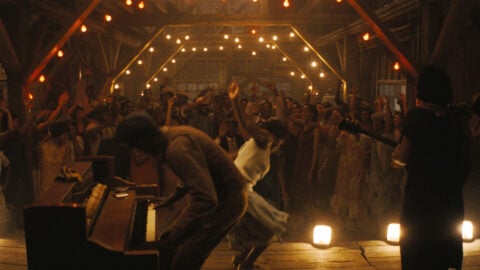
In Kaili Blues, what I wanted was to convey the perception of time, not in a scientific way, but as normal people perceive it. For Long Day’s Journey, I used the long take to portray memory, which has a spatial aspect to it—going downward into memory. For this chapter about doomsday in Resurrection, I wanted to film from night through to the next morning. But we didn’t have the resources, so we used the time-lapse technique. For Kaili Blues and Long Day’s Journey, I had more time to build up the atmosphere in the long takes. Here it’s only 30 minutes long, so I tried other devices, like moving into a character’s point of view, and color coding.
Your films have always depicted dream states, and Resurrection is set in a world where people have lost the ability to dream, and the absence of dreams is associated with longevity. I’m curious how you arrived at this premise.
These days, we read about A.I. in the news, we hear about entrepreneurs who are going to send people to other planets, or we are told we will exist in one big computer one day. But in the end, we still believe that it’s good to be in this body. We may have aspirations of living longer, living better, but living in this body with its defects, with sickness—that’s the essential meaning of being human. When I was filming Resurrection, a close family member passed away. Before he died, I was sitting next to him, and I realized he had lost consciousness. He was mumbling things I didn’t understand, and he had a totally different perception of time. This experience had a huge impact on me, and it’s a universal one.
I had many lines in the script about dreams, but I didn’t use them in the end. I imagined the very beginning of human civilization, without electricity and lights. There was day and there was night, and to compensate for the loss of vision at night, humans started dreaming. This now-useless ability follows us to the present day, but we’re becoming numb to it, and we’re even trying to control what we dream about. We want to control our illusions, our brains. What I want to say is that it’s okay not to control everything—it’s okay not to control our dreams.
Your film brings to mind a perennial question about cinema: is it dying or is it being resurrected? Or is that the same thing?
These days, we’re also trying to control what happens in movies. We have a tendency to calculate what the public likes, and we try to cater to them. But everybody has their own experience, and their own subconscious. What do we want subconsciously? That’s what we neglect today in the cinema world.
Dennis Lim is the artistic director of the New York Film Festival and the author of Tale of Cinema (2022) and David Lynch: The Man from Another Place (2015).