Book Review: Ross Lipman’s The Archival Impermanence Project
This article appeared in the November 21, 2025 edition of The Film Comment Letter, our free weekly newsletter featuring original film criticism and writing. Sign up for the Letter here.
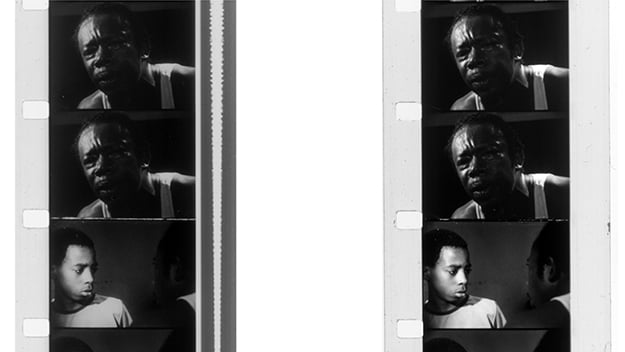
Killer of Sheep (Charles Burnett, 1978), 16mm print tests. Left: release print from old distribution negative. Right: test print from original camera negative. Courtesy Milestone Films.
The fraught choices and painstaking human labor of film restoration remains a mystery to many viewers, even as new archival releases play an increasingly central role in the life cycle of independent films. Restorationist Ross Lipman’s new essay collection, The Archival Impermanence Project (Sticking Place Books, 2025), aims to pull back the curtain, exploring in detail the decision-making and technical processes behind many of his landmark projects. Along the way, Lipman provides a much-needed meta-analysis of the film-preservation discipline in 2025, outlining a series of questions about the nature of archives, the ephemerality of cultural objects, and the history of cinematic technology.
Lipman was the senior film restorationist at the UCLA Film & Television Archive for 17 years before founding his own restoration and production company, Corpus Fluxus. He has played a crucial role in the rediscovery of American independent classics like The Exiles (Kent Mackenzie, 1961), Wanda (Barbara Loden, 1970), and Killer of Sheep (Charles Burnett, 1978). The Archival Impermanence Project compiles writing from throughout Lipman’s career. Far from a technical manual, however, the book is buoyed throughout by Lipman’s quirky voice, humorous anecdotes, and insider trivia.
The book is broken up into three sections: “Poetics” outlines a theoretical approach to restoration, “Case Studies” describes a series of workflows for individual films Lipman has worked on, and “Histories” includes articles that arose out of the extensive research Lipman conducts as part of the restoration process. Lipman’s key theses are articulated in his 2009 essay “The Gray Zone,” in which he maps a rough “travel guide” to the restoration process. What arises in “the zone” (an allusion to both Ansel Adams and Fred Archer’s system for photographic exposure and Tarkovsky’s dystopian sci-fi Stalker) are the myriad questions related to a restoration’s supposed authenticity.
These questions are especially pertinent for independent films, where filmmakers rarely retain the level of control over lab procedures that is a given for directors of studio productions. Using a contact printer, lab technicians manipulate qualities like contrast and saturation when striking a new print from a negative—this process is known as “timing” or “grading.” With different cueing methods, it is possible to exercise control over these qualities at the level of individual frames, though it is more common for lighting (and thus contrast and saturation) to vary from shot to shot or scene to scene. But independent productions are rarely allotted the time and money required to regrade an entire project if this process has not been completed to their exact specifications, so as Lipman puts it, “emulating an old release print is preserving the work not of the filmmaker but whoever worked the night shift at Deluxe Labs on a given night in 1975.”
Further complicating notions of authenticity, film archives and museums typically differentiate among archival conservation, preservation, and restoration. Conservation (attentive storage) and preservation (duplication in stable formats) do not fundamentally alter the appearance of a film. Restoration, on the other hand, implies a wholesale reconstruction of a film’s contents, “combining picture and sound elements from different sources in order to restore a work that has been significantly altered back to its original form.”
Viewers might conceive of the restorationist’s task as an objective, scientific endeavor to re-create a film exactly as it originally looked. For Lipman, however, true restoration is a subjective, interpretative art that must be guided by an understanding of the filmmaker’s original vision. In Lipman’s philosophy of film restoration, individual films are actually just abstract aesthetic ideas. When the director makes a film, they give this idea an embodied form as a self-contained work (e.g., an original release print on 35mm). Later, the restorationist helps to realize a new version in an appropriate physical format, drawing from the best surviving elements (e.g., the internegative scanned to 35mm and 4K DCP). In this sense, there is actually no permanently fixed version of any film—just its various iterations in different cuts, print generations, and formats. Because the restorationist inherently maintains a high degree of control over lab procedures like timing, the restored version may ultimately hew closer to the filmmaker’s original intentions than the filmmaker’s original product. As to what all this means for a restoration’s authenticity, the jury is still out.
Thus, in thinking about how to achieve the ideal restoration, Lipman offers a simple-sounding maxim with far-ranging and sometimes contradictory implications: “the final text on any work is the work itself.” Sometimes a living filmmaker can offer helpful consultation throughout the restoration process. More often than not, however, the restorationist must look for obscure clues that indicate how a work was originally meant to look (in inscrutable handwriting on film cans, in the margins of scripts, in diary entries or journals, or within the highlights and shadows of the negative themselves). Strict rules about source elements, aspect ratios, grain, and contrast curves won’t help; just because two films are shot on Eastman Color Negative 5254/7254 100T stock doesn’t mean the contact printer can maintain the same filter settings for timing.
Authenticity is again challenged when Lipman arrives at exhibition, since even two screenings of the same film can be radically different visual and sensory experiences—as anyone who has experienced an unpleasantly long reel break knows all too well. This is a pressing concern amid the “explosion of contexts in which moving images are received.” At one end of the spectrum, viewers now mostly watch movies at home, streamed on personal devices. At the other end, audiences are also more likely than ever to encounter film and video in museums, as traditional art institutions expand their purview to include “time-based media.” The eponymous essay from the book, subtitled “Performing Cinema in the Age of the Death of Everything” (written during the pandemic), relocates a film’s existence in the ephemeral “moment of presentation.”
It is in this context that Lipman deliberates on format, drawing on what art historian Rosalind Krauss terms the “post-medium condition.” For film, Lipman explains, this means “the wholesale de-physicalization of moving images.” The formal instruments of cameras, projectors, and the negatives and prints themselves have historically had outsize influence on films’ content and structure, which were literally ingrained in the medium. This is rapidly changing with the digital decoupling of form and content. Lipman is hardly a purist when it comes to analog formats, emphasizing how digital cleanup tools have their proper place in the restoration process (discussing Cassavetes’s 1968 film Faces, he differentiates between authentic “camera gate hairs,” imprinted on the negative, and distracting “printer gate hairs,” introduced by inattention at the lab). But he still insists that wherever possible, restorations should maintain a film’s original format, seeking out rare stocks or emulating discontinued ones, because “it’s ontologically impossible to replicate one medium in another.” This is not nostalgia for celluloid; it is a phenomenological reality.
Lipman’s impassioned call for nuance—not to prioritize celluloid’s physicality for its own sake, not to label any one restoration as “definitive”—is a welcome counterbalance to the flurry of “new restorations.” The contemporary cinemagoer needs to be able to comprehend and discern what all this archival terminology means. The Archival Impermanence Project is an important contribution to the relatively young genre of books about film restoration, which includes Paul Read and Mark-Paul Meyer’s technical manual Restoration of Motion Picture Film (2000) and Giovanna Fossati’s theoretical monograph From Grain to Pixel (2009). Though the book will appeal most to filmmakers and archival professionals, Lipman’s concerns take on new and broader urgency amid accelerating digitization, which renders the physical properties of light and color as “binary abstractions,” sequences of 1s and 0s—ever more impermanent than plastic celluloid. If films are ideas given physical form, what does it mean for the art of cinema when the entire cycle of production, exhibition, and restoration happens in the digital realm? This fascinating anthology makes clear that it is the process of film restoration, in its constant consideration of authenticity, materiality, and artistic vision, that is uniquely positioned to address the paradox of archival impermanence.
Lily Grossbard is a student in UCLA’s Master of Library & Information Science program, where she specializes in media archival studies.