Two’s a Crowd: The Invite
Olivia Wilde’s latest explores the perils of heterosexual coupling with wit and sincerity
Olivia Wilde’s latest explores the perils of heterosexual coupling with wit and sincerity
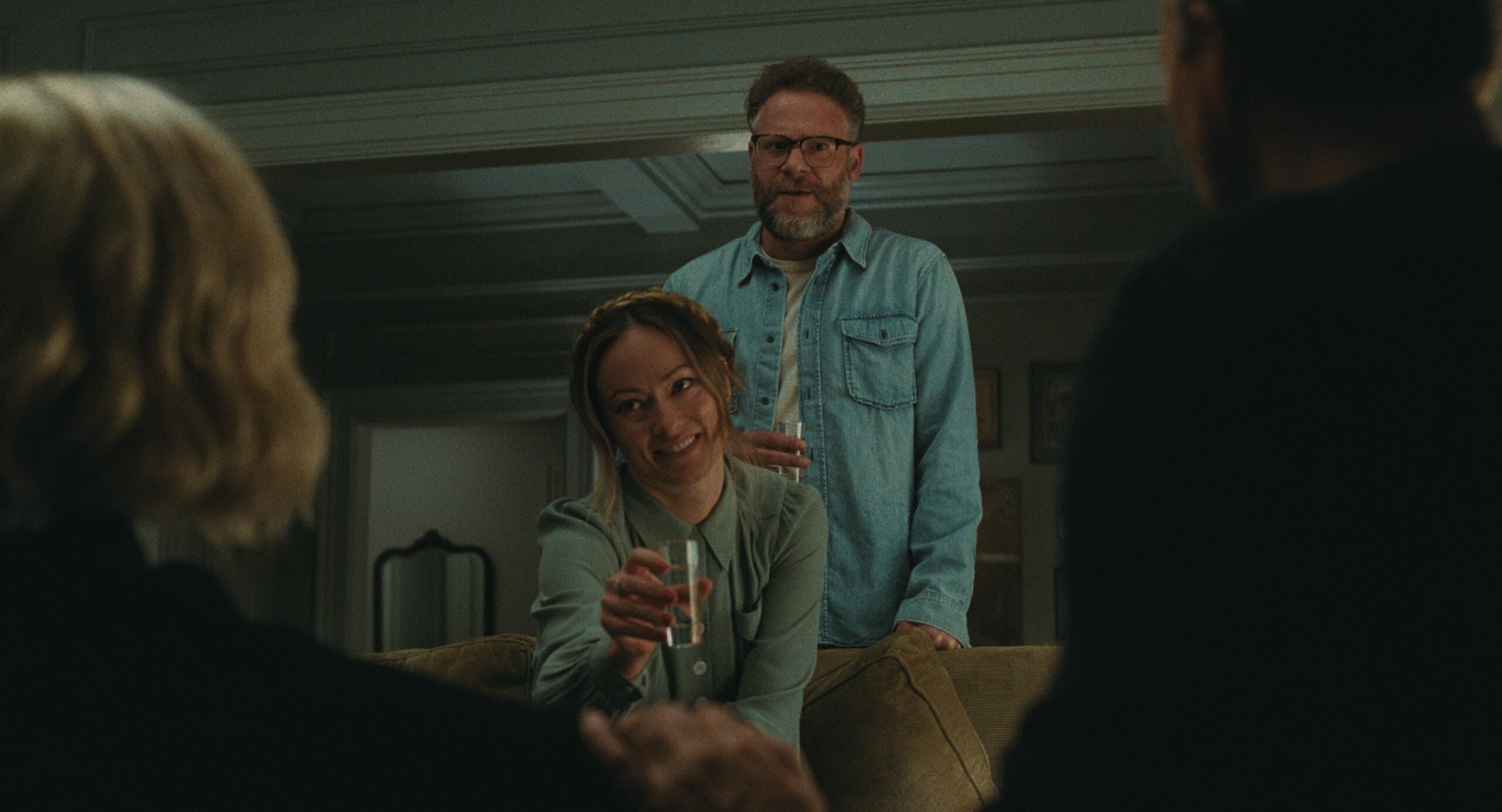
Picture this: it’s a beautiful day in San Francisco. Your palatial apartment, which you own despite being a millennial “artist,” is newly renovated. Your kid is away at a sleepover. Your back hurts, but everything is going OK—until you walk in the door, and the untended resentment bubbling below the surface of your marriage threatens to boil over.
This is the modern condition plaguing failed-musician Joe (a curmudgeonly Seth Rogen) and his lustful wife Angela (Olivia Wilde), an art-school graduate–turned–stay-at-home mom, when their upstairs neighbors arrive at their home for dinner. Angela swears she told Joe about the plans months ago; he’d rather reschedule. They argue over the misunderstanding until it evolves into full-blown character assassinations, the frenetic score matching the heat of their altercation.
“We love a contentious environment,” says Hawk (Edward Norton), a retired firefighter, as he arrives with his Spanish girlfriend Piña (a bleached-blonde Penelope Cruz), homemade flan in hand. Things remain strained between the two couples until an aged anniversary wine, a Xanax, and a few joints begin to loosen the conversation, and truths come tumbling out. Piña and Hawk have been throwing raucous sex parties upstairs. Joe and Angela have been together long enough that sex is nearly nonexistent. And what could be worse for a set of aging, self-loathing creatives than the timeworn tradition of comparison?
A movie that takes on zeitgeisty, think-pieced-to-death themes like bi-curiosity, “radical honesty,” and polyamory (cue: we saw you from across the bar and really dig your vibe) might sound grating—particularly coming from director Wilde, whose last outing, 2022’s Don’t Worry Darling, a revenge thriller about 1950s housewives, was muddled at best. But aided by screenwriters Will McCormack and Rashida Jones, Wilde redeems herself with The Invite, which explores the perils of heterosexual coupling with both wit and sincerity. Joe and Angela and Hawk and Piña—like Bob and Carol and Ted and Alice before them—“have it all.” Except, of course, contentment.
The Invite is one of many remakes of Spanish director Cesc Gay’s play-turned-film The People Upstairs (2020); its themes are universal enough that there are Italian, Swiss, French, and South Korean iterations as well. By the end of Wilde’s version, the original Spanish title, Sentimental, feels unexpectedly appropriate, as Piña, a psychotherapist and sexologist, eventually brings Joe and Angela to their knees—though not in the literal way the film’s overlathered one-liners foreshadowing an orgy might lead you to believe.
The warm, endearing Piña, whose character is based on the popular self-help author and podcaster (and consultant on the film) Esther Perel, intuitively coaxes Angela and Joe into realizing that the problems they have chalked up to sex are, unsurprisingly, about something else entirely, and only the prospect of losing their bourgeois idyll can make them appreciate that. The camera, which peers through windows, and the film’s emotionally capacious performances suggest that while we might be prone to mock the superfluous ways people these days try to open up their relationships, exposing ourselves is not always embarrassing. In fact, it might just unmoor us in ways we don’t expect.
Alana Pockros is an associate editor at The Nation.
This story is part of the Summer 2026 issue of Film Comment.
By clicking Sign up, you agree to our site’s Terms of Service and consent to our Privacy Policy.
Get full access to Film Comment with a paid subscription. Already signed up? Log in.
Thank you for signing up for The Film Comment Letter.
Check your email to set up your account and get access to select articles, or become a paid subscriber for full access.