Total Control: Michaela Coel
The multi-hyphenate star of The Christophers and Mother Mary reflects on what it’s like to do it all
The multi-hyphenate star of The Christophers and Mother Mary reflects on what it’s like to do it all
It was June 2020, three months into the COVID-19 lockdown—the moment when you realized that this isolation could go on for a very long time if the disease didn’t claim you first—that Michaela Coel showed up on my TV screen. HBO was streaming I May Destroy You, the BBC series that Coel created, wrote, co-directed, co-produced, and starred in. It is still streaming on HBO Max, and a recent viewing proved that it is just as existentially liberating in a differently dire time.
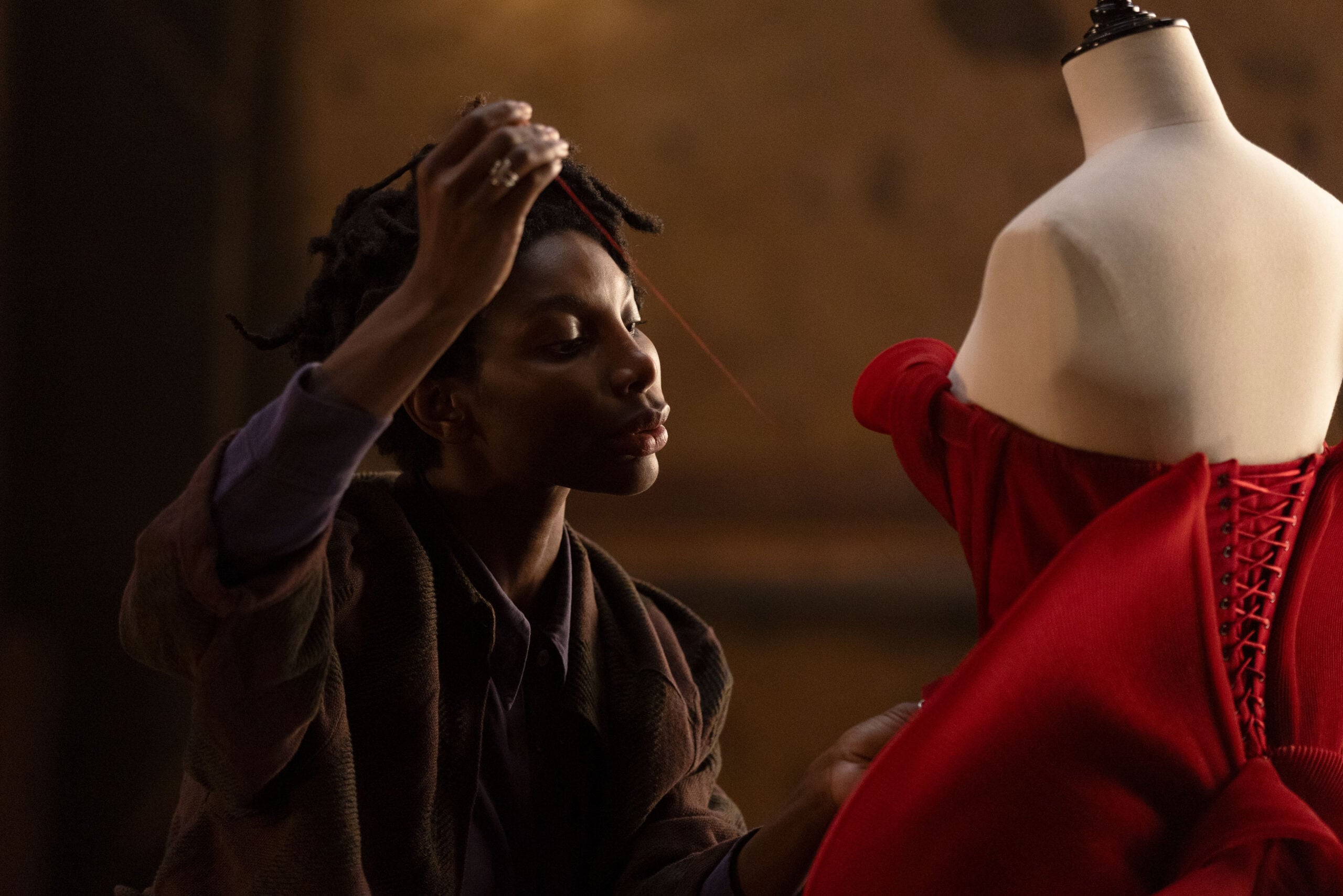
Coel was in New York for the opening of two movies, both more or less two-handers in which she partners with celebrated actors—and is more than a match for each. In Steven Soderbergh’s heady The Christophers, she plays a painter with a side gig as an art forger, who forms a bond with the elderly artist meant to be her mark. Played by the formidable Ian McKellan, he is a man of many words, but it is her eyes that speak volumes. In David Lowery’s risible horror-thriller Mother Mary, the burden of speech is carried by Coel. As her voice soars and plummets, we hang on her every utterance, however nonsensical. Her character is a costume designer who a decade ago made clothes for a pop superstar played by Anne Hathaway, before they parted ways acrimoniously. The suggestion is that once upon a time, their relationship went deeper than image formation. But now they are merely dutiful daughters of design, and no floor-rolling exorcisms and diaphanous red chiffon floating upwards convinced me otherwise.
Still, I watch everything Coel does for screens of all sizes and read everything she writes. This profile is based on a 20-minute in-person interview I was able to conduct during the New York press days for The Christophers, two Q&As I did with her at the film’s opening-weekend screenings, and her 2021 book, Misfits: A Personal Manifesto. The pull quote on its back cover reads: “A misfit is one who looks at life differently. Many, however, are made into misfits because life looks at them differently…”
The younger of two daughters born to parents who emigrated from Ghana, Coel was born in London’s East End and raised as a Pentecostal Christian, although she is no longer that kind of believer. The Bible, particularly the psalms, inspired her to write poetry. “I started off as a poet. I was writing poems and turning up in pubs and bars, asking if I could say a poem I’d written. That was 2006. I was 18. And then somebody saw me do a poem and said, ‘You should act.’ I didn’t have anything else to do, so I just said yes. His name is Ché Walker—he’s a director. He taught me for free and then he said, ‘Go to drama school.’ I got into Guildhall School of Music and Drama, but I think I didn’t really know that I wanted to act until I had written the play Chewing Gum Dreams and witnessed how much it resonated with my classmates, and how much they appreciated me sharing my story. Somehow, acting and writing have always been the same thing for me.”
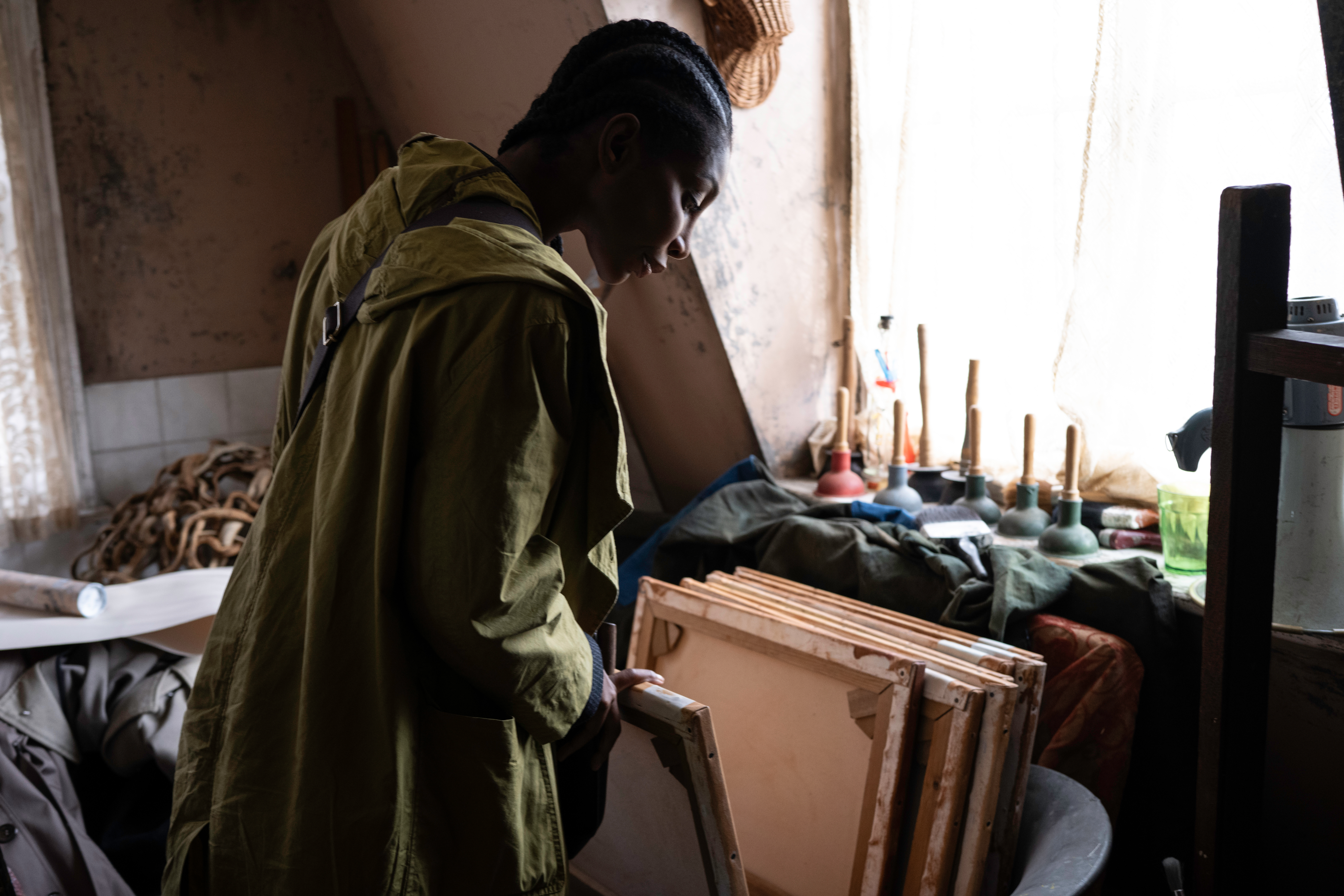
Coel was the first Black woman accepted by Guildhall in five years. Her tuition was paid with a Laurence Olivier Award stipend, which suggests that her talent was obvious from the start. She says that she loved learning the craft of acting, but she understood that the school was training students for shows like Downton Abbey, in which she never would be cast. In her last year, she was finally assigned a leading role—the play was Lysistrata—but it was scheduled not for Guildhall’s main stage on Silk Street, where agents and producers came to size up new talent, but across the river in South London, where no one from the industry ventured. Coel decided to use a similar out-of-the-way location, the basement of the Silk Street theater, to turn her play, Chewing Gum Dreams, into a monologue and to enact all 11 characters herself.
A broad and rude comedy about a 14-year-old girl who is obsessed with sex and desperately wants to break from her Evangelical upbringing, it went on to play on about half a dozen small stages including at the National Theatre, where Coel spent a year until a producer at Channel 4 asked her to turn the play into a TV series and act in it as well. Chewing Gum—which starred Coel as an older, 24-year-old version of the play’s protagonist—ran for two seasons, was a critical and popular success, and earned Coel some big awards for TV writing and performance.
“Somehow, acting and writing have always been the same thing for me.”
–Michaela Coel
It also taught her how profoundly racism and misogyny were structured into the industry, and therefore how precarious her own position in it was and continues to be. When I asked her why a professionally inexperienced writer, director, and actor was hired to develop a TV series in which she would star, she said that being Black was an advantage. It was a moment when British TV needed diversity. But that didn’t mean that any of it was easy. Misfits is an extension of Coel’s 2018 MacTaggart Lecture, a kind of TED Talk that she gave to 4,000 TV professionals. It recounts the process of making Chewing Gum. One evening, while she was working on the second season of the series, she left the production offices to take a break and was raped by a stranger at a bar. That assault becomes the inciting event in I May Destroy You. As Coel writes in Misfits, “Like any other experience I’ve found traumatic, it’s been therapeutic to write about it, and actively twist a narrative of pain into one of hope, and even humor. And be able to share it with you, as part of a fictional drama on television, because I think transparency helps.”
I May Destroy You transformed Coel into an international star and creative force. The series is about power, consent, friendship, writing, procrastination, and rape, and how this mess might be resolved. It is funny and scary, crude and subtle about bodies (and bodily fluids). What I find truly subversive about Coel’s performance as Arabella Essiedu (a partly autobiographical character) is that she doesn’t comply with any gender codes. She asked me what I meant by that, and I tried to explain by telling her that when I was an actor, a director objected when I behaved in a way that he said only a man would behave in.
“I was outside of all that,” Coel answered. “I never had a man in my house growing up. I didn’t see my mum doing any of that—we were very free. Sometimes I was just on the couch naked, just watching TV, hanging out with my mum. And sometimes when I went to a friend’s home for dinner and there was a father at the table, I’d think, God, this is weird—you’ve got to add some kind of performance. I think it’s worked in my favor, even at drama school. I was never thought of as the feminine character, and when I did have to do some kind of trope of femininity, it was very strange—it was never convincing. So many of the roles in plays ask you to do that, and I never felt comfortable with it. So it’s nice. Maybe part of my fulfillment in writing is making these women who are free. I think that if a woman can be encouraged to have some kind of freedom by watching my work, then I’m happy.”

In The Christophers, Coel’s character, Lori Butler, is wary and guarded, which Coel explains is very different from Arabella in I May Destroy You or Tracey Gordon in Chewing Gum. “Tracey and Arabella have friends, they have people they can off-load their thoughts to, which enables audiences to get a view of what’s going on in their brain. Lori, even though she lives with people, is a very isolated character who deals with her pain, her anger, her bitterness internally. So it’s a different game.”
Steven Soderbergh and writer Ed Solomon’s process of working with Coel and McKellan was very different from anything Coel had experienced before. (In addition to her own two series, she has appeared in more than half a dozen films and several other TV shows.) Before the shoot, the two actors went through every line of the script with Solomon.
“We unpacked the script because it’s part of Ian’s process—a bit like how you would approach Shakespeare: you want to understand and scrutinize every part of it. I had never done anything like that before. To sit there in front of Ian, and first, just to witness his process… He won’t say a single word unless he’s sure he knows what it means. And he encouraged me to do the same, to question: what does this part and that part mean? Sometimes Ed would just scrap a page if we realized we didn’t really understand the point of it. Ian would say we saved Steven a couple of minutes in the edit just by cutting things that weren’t necessary. It was fascinating. It taught me that it’s okay to question and question and question, and that actually gives me confidence, but it also gives the writer more confidence, because they can go back to the drawing board and make it even better.”
Of the actual shoot, Coel said it was the simplest she had ever been part of. “I was told in advance that you pretty much get one or two takes—there’s no three or four or five, and no praise, no performance notes, really. And that switched off the anxiety department in my brain and encouraged me not to overthink anything, not to worry about how it was coming across, and to trust the moment. Also, Steven knows where he’s going to be at each point in the scene, so you don’t need to get through the whole thing. He’ll say, ‘I’m not going to be there for the rest of that, so you don’t have to finish the monologue or the scene.’ It allows you to have a detachment from the ego that I think complicates how we work. We finished most days at 2 p.m., when we were supposed to wrap at 6 p.m. He’s in complete control; he knows where it’s going, he knows what it’s doing. In a way, a little like how Lori Butler is an assistant to [McKellan’s character] Julian Sklar, I felt like an assistant to Steven. He wants to make a thing, he’s got his sleeves rolled up and he’s making it, and you’re just helping him—a little like how Lori hands the feathers to Julian as he throws them on the canvas. Steven has a vision—Steven and Ed, maybe. And it was so nice to just feel like you’re serving someone’s very clear vision. I think that’s what I meant by simple.”
Coel and Soderbergh are both multi-hyphenates. For 25 years, Soderbergh has been the cinematographer and camera operator as well as the director of his projects. But he does not often write the scripts for his films. In the case of The Christophers, he told Solomon that he was interested in making a film about an older artist whose best work is long behind him, and that there could be some kind of scam or crime involved. That was all. Coel, on the other hand, doesn’t separate writing from acting and directing, but she leaves the shooting and editing to others. For her TV series—including the upcoming First Day on Earth, which is currently in production in both Ghana and London—she is creator, writer, director, executive producer, and star. Nevertheless, she says that her experience on The Christophers has been massively influential on her.
“I remember actively knowing that I was taking a lot from Steven. Don’t overthink, and trust your actors. With I May Destroy You, there would be a lot of takes, and maybe I was pursuing things in a way that was very locked in my mind. But now I’m able to sit back and see what the actors are doing. I think I’m more open and more trusting of so many people who are operating at a very high level to make this thing come into being. I realize I don’t have to micromanage. I don’t have to do anything beyond my job, because they know what they’re doing. So I feel quite relaxed in the way that Steven was always very relaxed.”
Amy Taubin lives in New York City, where she writes about movies and art.
This story is part of the Summer 2026 issue of Film Comment.
By clicking Sign up, you agree to our site’s Terms of Service and consent to our Privacy Policy.
Get full access to Film Comment with a paid subscription. Already signed up? Log in.
Thank you for signing up for The Film Comment Letter.
Check your email to set up your account and get access to select articles, or become a paid subscriber for full access.