The Kids Aren’t Alright
The debut feature by music-video director Stillz creates an urban phantasmagoria out the lives of disaffected Colombian youths
The debut feature by music-video director Stillz creates an urban phantasmagoria out the lives of disaffected Colombian youths
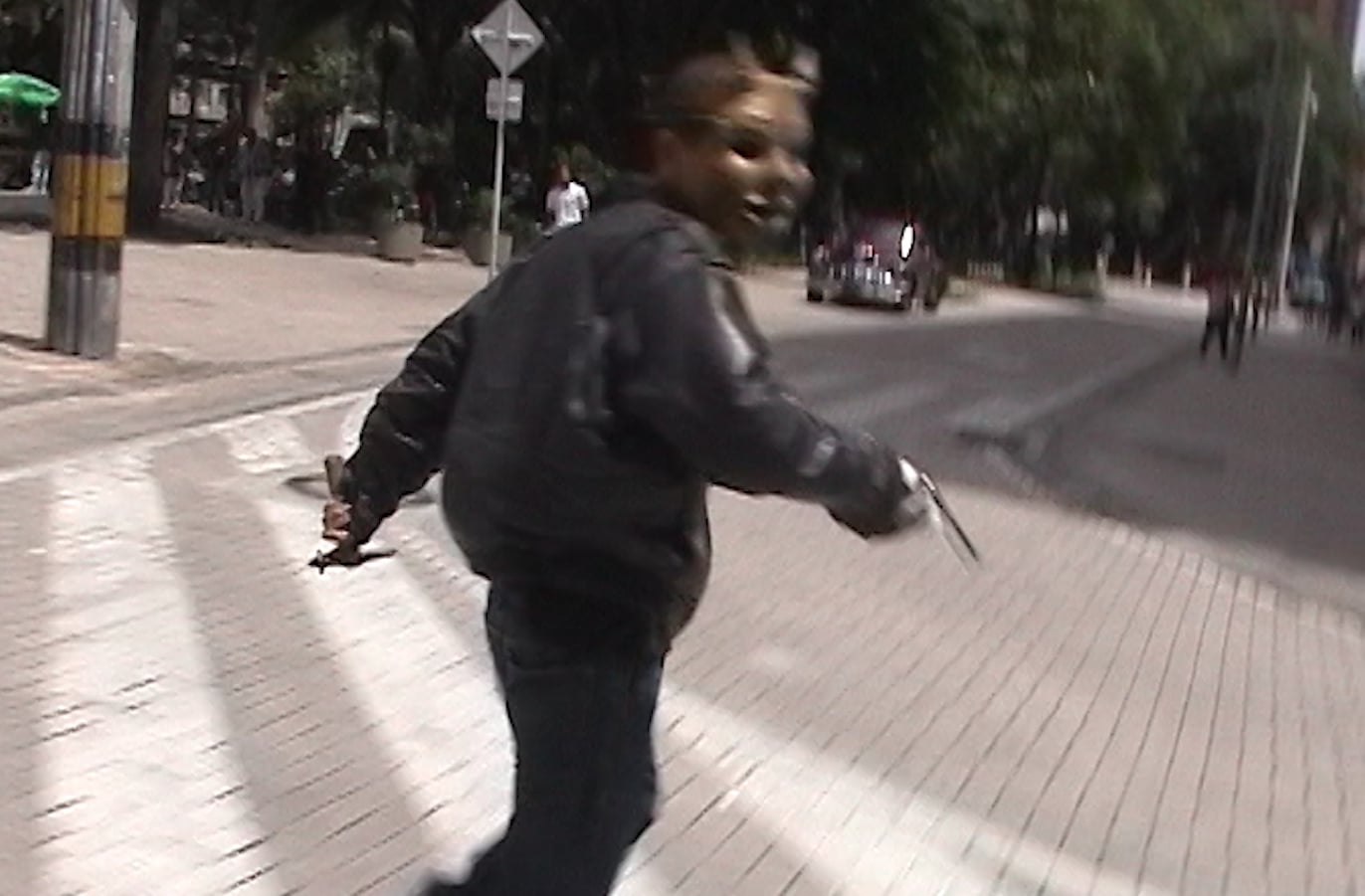
For his first feature film after a career of music-video collaborations with artists like Bad Bunny and Rosalía, the elusive and often masked filmmaker known as Stillz (real name: Matías Vásquez) turns his restless camera to the disaffected youths of a working-class neighborhood—or rather, he wants the camera to take the place of their eyes. Barrio Triste examines adolescent ennui and the quotidian brutalities of poverty in the titular neighborhood through a neorealist yet also strangely extraterrestrial lens. The style is intimate and handheld, like the cine-diary of someone who has never before wielded the power of creating images; at the same time, there is something alien about the film’s gaze, as if these images were captured not by a local participant, but by a distant observer.
Barrio Triste, which was produced through Harmony Korine’s new studio EDGLRD, grew from Stillz’s fascination with kidnappings and narco-violence in Colombia. Set in the 1980s, the film opens with an impeccably dressed newscaster reporting on recent sightings of strange lights in the night sky, when a ragtag group of postadolescent boys suddenly interrupts the live transmission. They steal the television camera in a vertiginous sequence punctuated by the cacophonous, metallic pangs of a score by Arca, the Venezuelan musician and record producer known for her experimental pop and reggaeton soundscapes. The stolen handheld Betacam becomes the audience’s eye as the characters go on a frenetic, Grand Theft Auto–esque joyride through the city—all while a serial killer recalls his homicidal exploits with chilling nonchalance over the car radio. When a robbery at a jewelry store in the city center ends with the murder of a shop attendant, the crew makes a heart-pounding escape to the hillside comuna (a term akin to favela used to designate marginalized neighborhoods in Medellín).
All of this unfolds in just the first 10 minutes of the movie, but it proves to be a false harbinger of what is to come. Reflecting its title, Barrio Triste (Spanish for “sad neighborhood,” and a real place in Medellín) is predominantly melancholic, more a meandering meditation on the existential malaise of the economically dispossessed than a narrative action-thriller. Following the breathless opening sequence, the film is mostly composed of wandering shots, sometimes interrupted by interviews with the youths at the center of the film (all nonprofessional actors) in a nondescript location that suggests they have been arrested in a not-so-distant future. One of them likens his existence to a bottle adrift at sea—a poignant, if somewhat trite, metaphor for the aimless intensity that animates the characters’ daily rhythms, and thus, the film’s movements. But the interviews reveal something more fundamental about these fictional rebels and their cause: they resent not just the grinding squalor and violence they endure from day to day, but the seeming insignificance of their lives.
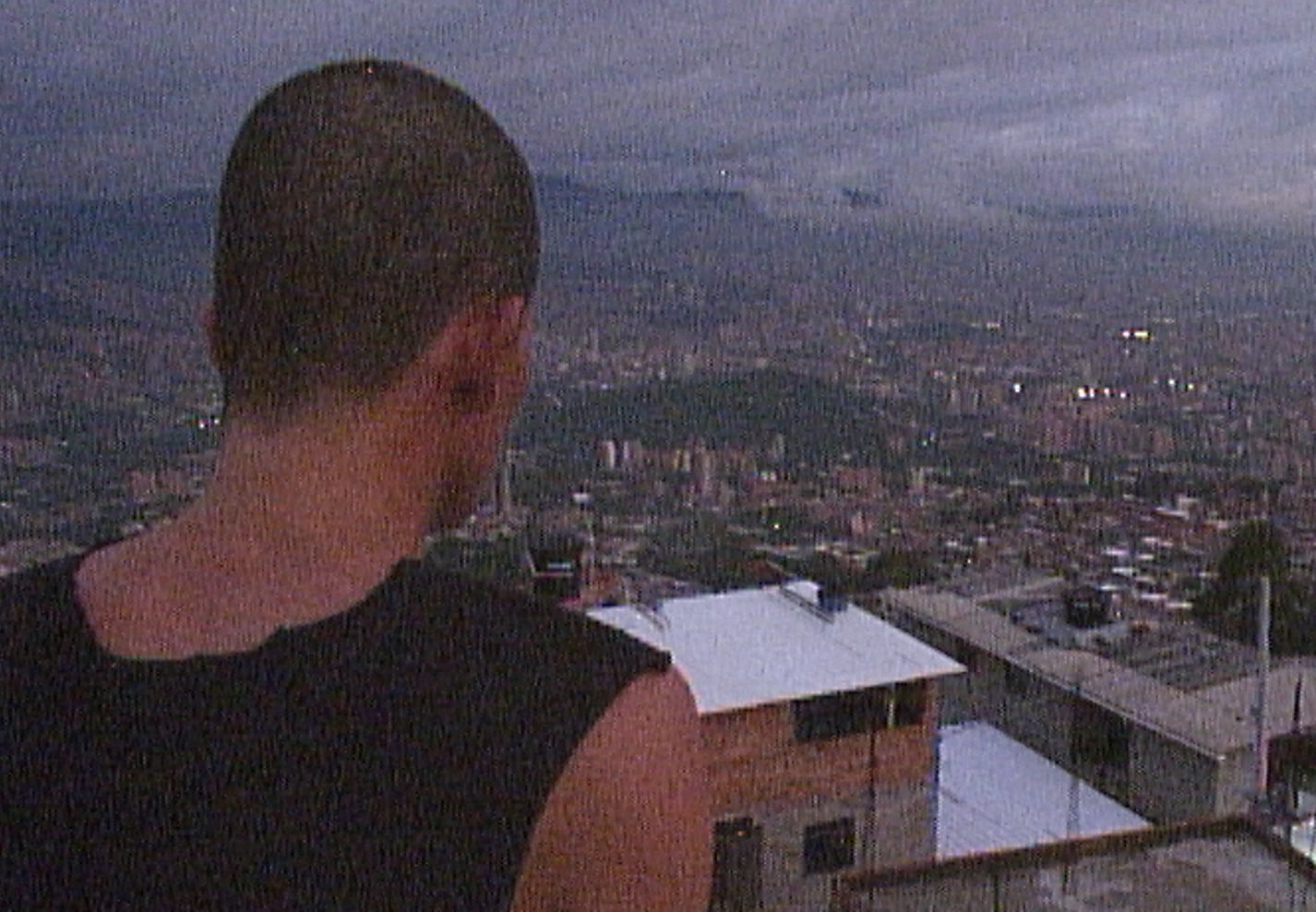
Pixelated skies, grainy city vistas, abstracted sidewalk views—the film favors alluringly impressionistic visual textures over discernable figures or narratives. The hypnotic pull of this urban phantasmagoria sustains things—as long as one surrenders to Stillz’s (sometimes nausea-inducing) roving motions and trancelike logic. Slowly drifting through crumbling red-brick homes and unpaved roads, the camera eventually leads us to a pair of otherworldly entities, one seemingly divine and the other menacing and shadowy. Have they come to save our young protagonists? And is the solution to these young adults’ social, economic, and spiritual problems only found in the afterworld or in a faraway universe?
Stillz is far from the first filmmaker to explore the plight of disillusioned, unruly youth in Latin America. From Luis Buñuel’s Los olvidados (1950) to Héctor Babenco’s Pixote (1980), juvenile delinquency and violence have long served as subjects of the region’s cinema; Colombian auteur Víctor Gaviria’s Rodrigo D: No Future (1990) and The Rose Seller (1998) are also set in the comunas of Medellín. But the film that feels most in dialogue with Barrio Triste is Luis Ospina and Carlos Mayolo’s caustic mockumentary Vampires of Poverty (1977), a scathing critique of First World directors and journalists who descend upon impoverished communities to document their misery with perverse pleasure—peddling pornomiseria, or “misery porn.” In one scene from that film, a fictional filmmaker working for a German TV station, played by co-director Mayolo, pays a handful of kids to jump naked into a public fountain to retrieve the coins he tossed in, a disturbing spectacle that is interrupted by a lone adult voice in the crowd that condemns the documentarian’s vampirism. While Stillz’s film fictionalizes the precarious, gloomy lives of young Colombian men, hoping to show how they are capable of producing striking images, Vampires of Poverty narrativizes this process of a filmmaker transforming precarity and gloom into spectacle. Together, they point to an ethical dilemma faced by films that enter unfamiliar territory: is it right to create art out of someone else’s privation?
Barrio Triste is built on a borrowed gaze. While the fictional frame of the film would have you believe that its young protagonists are producing these beautifully grainy images, in reality the camera was operated by Stillz himself, bringing his years of professional cinematographic experience to bear on creating the artfully unartful footage. The fictional premise of the film asks whether the tools of expression can confer agency upon the dispossessed by giving them the ability to create images, but its ornate and controlled cinematography, which moves more like a first-person video game than like a real human, reveals an underlying distanced perspective. Barrio Triste never quite inhabits the subjectivity it attempts to channel, but it does leverage the alienating effect of its camera to defamiliarize a doomed world and present it anew.
An ambient nihilism pervades Barrio Triste; it seeps into its listless camera movements and its inhabitants’ pessimistic worldview, in which nothing ever matters because everything will always be the same—until the alien arrives. Bearing the gift of beauty, this glimmering figure offers the young men a moment of respite, the aesthetic experience as a north star. The sublime—depicted in ceremonial fires, rites of worship, and atavistic graffiti art—faces off against their sordid lives, but its victory is short-lived. Barrio Triste acknowledges that even if beauty cannot grant real power to these dispossessed youths, it still offers a glimpse of the dignity and transcendence that their circumstances have denied them.
Juan Camilo Velásquez is a writer based in New York City and Montréal.
This story is part of the Summer 2026 issue of Film Comment.
By clicking Sign up, you agree to our site’s Terms of Service and consent to our Privacy Policy.
Get full access to Film Comment with a paid subscription. Already signed up? Log in.
Thank you for signing up for The Film Comment Letter.
Check your email to set up your account and get access to select articles, or become a paid subscriber for full access.