Lee Way: An Interview with Spike Lee
From the Sept-Oct 1986 Midsection, “Five Restless Voices,” Marlaine Glicksman talks to the filmmaker about She’s Gotta Have It.
From the Sept-Oct 1986 Midsection, “Five Restless Voices,” Marlaine Glicksman talks to the filmmaker about She’s Gotta Have It.
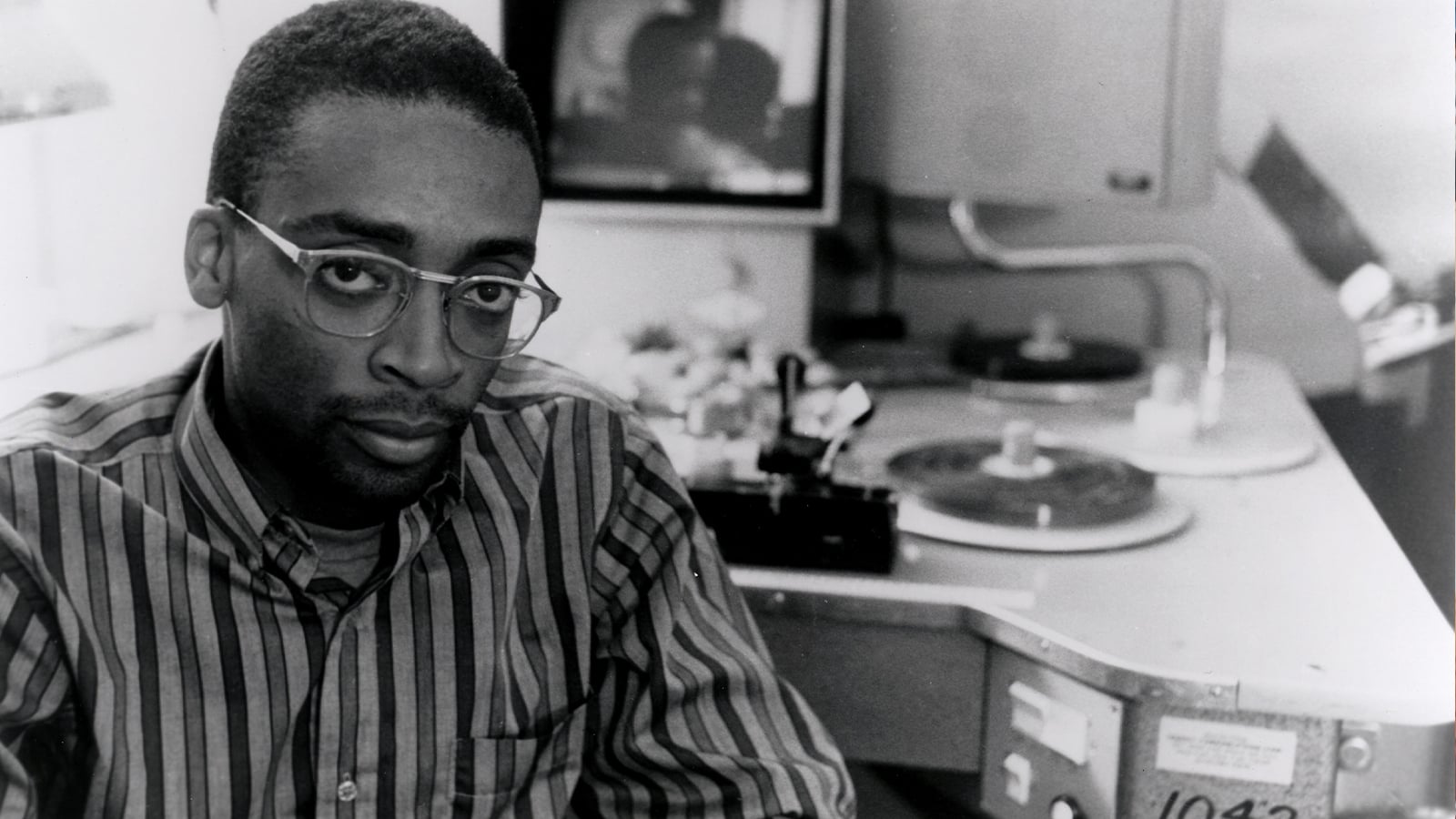
You so fine, I drink a tub of your bath water.” “You need a man like me…. What’s your number?” “I love you….” “Please baby, please baby, please baby, please.” “You know the minute you get fat, I’m leaving you.” So cajole, plead, woo, and threaten the men-the decent ones and the dogs-in 29-year-old filmmaker Spike Lee’s first feature film, She’s Gotta Have It. The focus of their attention is Nola Darling. Nola possesses what we have come to know as a man’s desire, but is cursed (in society’s eyes) with a woman’s body. “Some people would call me a freak,” she explains at the film’s beginning, meaning she’s a woman who likes to get down. The story unfolds through Nola’s eyes and through the multiple perspectives of 46 those men and women who long to see into and possess them. It is a comedic commentary on the frazzled rules of cat-and-mouse, with Nola as the mouse who scores.
Set entirely in Brooklyn, the film is, like the borough’s namesake bridge, laced with the tangles and crossed wires of love and its accompanying emotions, as well as a warm and generous sense of humor. Black and white and in the confession style of Akira Kurosawa’s Rashoman, She’s Gotta Have It was shot in 12 days with a New York State Council of the Arts grant of $18,000. Lee worked closely with Ernest Dickerson (“my ace cameraman”) as well as a cast and crew with whom he has worked on past films, some whom he has known since undergraduate days at Morehouse College, where he first began “dibbing and dabbing” in film.
Lee also involved almost his whole family in the production. (“If you have a talented family,” he says, “you should be shot if you don’t use them.”) This is the third film that his well-known jazz musician father, Bill Lee, has scored. His sister, Joie, plays Clorinda Bradford, Nola’s ex-roommate. And his brother, David, acted as still photographer on the shoot. His straightforward, grainy stills are interspersed throughout the film, contrasting their sense of vanishing time and place with the film’s sassy tone, as well as setting the scene for the story. Spike himself plays one of Nola’s three main men, the aptly named Mars Blackmon, the four-eyed, hiphopper B-boy who hilariously woos Nola and wars with her other suitors: Jamie Overstreet as Nola’s serious and stable suitor, who sees himself as Nola’s soulmate; Greer Childs as her self-possessed Buppie beau; and finally the seductive Opal Gilstrap as Nola’s lesbian admirer.
All of the characters in the film are black. Unlike Steven Spielberg’s The Color Purple, She’s Gotta Have It neither needs white context nor white audiences to-which-blacks-have-been-invited. This time, black women talk to black men, and whites are invited-to learn something about blacks, and also about themselves.
Nola shares her birthday with Malcolm X and paints a commemorative mural, pasted with headlines such as “Honor Student Shot by Cop.” Mars wears hi-top sneakers (even when making love to Nola) sports an extra-large 18-karat gold nameplate around his neck, and street-talks and jives, repeating himself incessantly. Greer is a GQ model who plays scrabble with a dictionary. Jamie is, well, always decent and stable, very predictable. When Nola invites all three to Thanksgiving dinner, the feathers fly. “Chain snatcher,” Greer sniffs at Mars. “Pseudo black man,” Mars retorts. When Jamie attempts to quiet the ruckus, Greer cuts, “What are you? Henry Kissinger?” In another scene, Nola and Mars share a nice moment after lovemaking and she greases his hair. The film’s final credits include the statement “This film contains no jerri curls and no drugs.” These characters are well-grounded in a largely black neighborhood and, unlike black characters in most other films, speak black dialect intelligently. The blacks in Lee’s film are real people. And as real people, they speak to us all.
Each lover offers a lover’s reason why he isn’t Nola Darling’s number one man. “To Nola,” says Jamie, “we’re all interchangeable.” Accuses Greer, “I think you are sick. I’m not saying you’re a nympho, slut, or whore, but I do think you are a sex addict.” When bike-conjoined Mars encounters Jamie on a park bench he opines, “Nola is about as dependable as a ripped diaphragm.” But soon the discussion veers off into sports-stopped dead by a female passerby-before the two return to their thoughts about Nola, providing yet another universal observation on the ways men and women navigate and collide. It is Mars who finally figures it out, that all three men comprise an integrated whole for Nola, that it was the men who were really at fault. “We let her create a three-headed, six-armed, six-legged, three-penis monster.” In the end, Nola ditches them all and, content to be alone in her bed, reveals the decisive verdict, “It’s about control. My body. My mind. Whose gonna own it, them or me?”
She’s Gotta Have It uniquely tackles an age-old controversial topic, the discrepancies that exist not only between the sexes but also in the judgments rendered by society. Ironically, the film’s willingness to investigate the hot spot where love meets sex landed it in hot water. The MPAA thrice gave the film an X rating. Since the film features a woman and her three lovers, naturally there are sex scenes. But there is no more to be seen than the breasts and butts that grace the lovemaking of white maintstream R-rated films.
Spike had to recut his film three times, plus cut in half an overhead shot of Greer and Nola in bed, to get down to the R rating dictated by his Island Pictures contract for its domestic release. “It’ll be shown the real way in Europe and on tape,” Spike said. Spike is no stranger to trouble. Outspoken, he was almost not asked back after his probational first year at NYU graduate film school when he submitted The Answer. The 20-minute short portrayed a young black screenwriter hired to do a rewrite on a $50 million remake of Birth of a Nation. Lee eventually graduated with a Student Academy Award for Joe’s Bed-Stuy Barbershop: Cut Heads, about a numbers-running barbershop in the Bedford-Stuyvesant section of Brooklyn. This film also earned him a screening in the New Directors/New Films festival at the Museum of Modern Art in 1983.
It is no surprise, then, that She’s Gotta Have It this year achieved a spot in the director’s fortnight at Cannes, as well as the Prix de Jeunesse. (“We got robbed of the Camera d’Or,” Lee says, “but I’m not complaining.”) Still, it is often the comments on the long line to the ladies room which serve final judgment on the success of a film, and in the case of this film, perhaps one of the most apropos places to listen. “I want three men, too,” said one line-stander. “Yeah but I want’em all at the same time,” said another. Perhaps Mars was wrong; perhaps it is Spike Lee who has created the monster. -M.G.
The MPAA originally gave She’s Gotta Have It an X rating.
The MPAA said it was filled with gratuitous sex, that it was—and this is an actual quote—‘saturated with sex.’ I edited the film three times and each time they said it was better. But it was still given an X rating. The film will be released unrated in New York, but I have to cut an R rated film for me to get money, because that is in my contract.
I don’t think it’s out-and-out racist, but the film portrays blacks outside stereotypical roles, and they don’t know what to do with blacks in films. They never have any love interests. Nick Nolte is the one who has a relationship in 48 Hours. And when it comes to black sexuality, they especially don’t know how to deal with it. They feel uncomfortable. There are films with more gratuitous sex and even violence. 9 1/2 Weeks got an R. And look at Body Double.
Why did you set and film She’s Gotta Have It in Brooklyn-because you’re from there?
I was born in Atlanta, Georgia, but I’ve lived in Brooklyn all my life. When you are doing independent filmmaking, you don’t have the means to go anywhere else. She’s Gotta Have It was really shot in a one-mile radius, the whole film, in the neighborhood where I lived. That’s the only way we could shoot a film in 12 days, only if locations are within a block from each other.
How did the film come about?
In the summer of 1984, I attempted to do a film called Messenger. We were in pre-production for eight weeks, but I had to pull the plug because it just never really came together with all the money and stuff. So out of that devastation and disaster, we came up with the idea, out of desperation, to do She’s Gotta Have It. I was determined do another film the next summer for as little money as possible. Small cast, small crew. I had a grant from NYSCA [the N.Y. State Council on the Arts] for $18, 000 for Messenger. NYSCA was kind enough to let me move that money to She’s Gotta Have It. I also got a grant from American Film Institute for $20,000, but those mother fuckers took the money back. They wouldn’t let me move the money. Print that too.
You had no private funding?
When we started out, there wasn’t. But the whole game plan was to raise the money stage by stage. The next stage was to get the film out of the lab. I had the confidence that if we could get it shot, cut, and show it to people, I would be able to raise enough money.
Was the $18,000 to shoot enough?
No. Monty Ross, the lead actor in Joe’s Bed-Stuy Barber Shop, who I went to school with at Morehouse, was production supervisor on this film. After we would shoot, everyday, Monty would come home, get on the phone, and call and write everybody we knew in the world asking them to please, please, please help us out, to please, please, please send money, their hundreds, fifties, whatever. So we raised the money at the same time we were remember a number of times while Monty, during the shoot, would leave the set and I would fill out the deposit slip and he would run to the bank and deposit the checks. So that’s the kind of duress we made this film under. But I’m not complaining. That’s the only way that this film could be done.
It’s wonderful that you had the confidence to go ahead and do the film.
Well, I’ve never lacked confidence [laughs]. It’s just money. And I’ve been fortunate that I’ve had people around me like Ernest Dickerson and Pam Jackson, who went to school with Monty and me. She was associate producer of the film.
You shot the film on a very small ratio.
It’s just my style. There’s really no need to take eight million takes of everything. We were well-rehearsed. And we try to just get it within the first or second take, move it on to the next shot.
Why did you decide to shoot the film in black and white?
Well, the images came to me in black and white. This had nothing to do with the budget. I just felt that the subject was a black and white movie.
You used color for the birthday scene.
Well, we wanted to make that scene, which is a present that Jamie is giving to Nola, a very imaginable scene, to make it different. A little homage to The Wizard of Oz… Jamie says to her, ‘Close your eyes and repeat after me; There’s no place like home, there’s no place like home.’ And she says, ‘There’s no place like home, there’s no place like home,’ and you cut to the close-up of her clicking her heels.
What is it like to act in your own film?
I never acted before. Well, halfway through writing this film, I decided, hey, I should play this role. It was hard. The first day, it was horrible because I was trying to direct and act, and Michael Hunter, who was the gaffer, says to me, ‘When you’re in front of the camera, let Ernest be the director; because I was still saying ‘Everybody ready, roll sound, action,’ all that, and then I’d try to go and act. You can’t do that. So when I was in front of the camera, Ernest assumed the reins of the director as far as getting the crew ready, the action, cut, that stuff.
Did you ever take acting lessons?
I’m really not an opponent of those acting schools. My sister has never acted before either and I think that she’s very natural. That stuff—Mars repeating everything-that wasn’t scripted.
Why do you feel a particular affinity toward the character of Mars?
There are a lot of them out there, especially in Brooklyn, a lot of young black youths, and they don’t have such a good reputation. Look at the Bernard Goetz situation. That’s why I had stuff like Greer calling him a “chain snatcher.” I knew I couldn’t attempt to clear their reputation, but I could portray them more positively.
Was it difficult for you to shoot and direct the sex scenes?
That is why I used Tracy as an actress. I could have had a known actress, but it was important that I use somebody who was comfortable with the love scenes, someone at ease, because her ease would make the audience more at ease.
The script was written remarkably from a woman’s point of view.
I’m a good listener. And I think I really try to be honest. And if you really try to go about the truth and honesty in your work, then you can hurdle my not being a woman. But you have to understand, I have not attempted to make a feminist film. For me, it is about a woman who has three lovers. My friends are always boasting and bragging about how many women they have. But when word gets back to them that one of the women in their stable is even thinking about seeing somebody else, they go berserk. That’s insane, that double standard. So I decided, let’s make a film about a woman who is actually living her life as a man.
How did “black” figure into it?
Another reason I did this film was because there are hardly any films about black people. When you do see films about black people, they’re either musicals or comedies. You know, ha-ha, chi-chi, and dancing. Eddie Murphy and Richard Pryor, don’t even kiss or have any romantic interests in their films.
They don’t have a home, no wife, no lovers. And I knew that black people would kill to go into the movie theater and see black people hugging and kissing and, you know, loving each other. There is so much catching up to do, I know I’m not going to have any problems, for the next three or four films, just dealing with stuff within a black genre. This film has shown a lot of people, especially at Cannes, that black people are just as diversified as any other race. People have been shocked by just how universal this film is, by how they had never seen black people portrayed like this before. I guess all their experiences have been with Hollywood films.
Is it harder for blacks to work in the industry?
It is harder for blacks in the industry. But we have to create our own jobs and make our own films. That is why it is important to find close working associates that have the same goals and aspirations that you do.
Is this film about blacks or men and women?
I think my love of women is reflected in the work. But I think this film should be the antidote to how the black male is perceived in The Color Purple. See, nobody is saying that black men haven’t done some terrible things, and what Jamie does to Nola at the end of the film is a horrible act. But Jamie is a full-bodied character, unlike Mister in The Color Purple and the rest of that film’s black men, who are just one-dimensional animals. I’m not going to blame it all entirely on Steven Spielberg, because if you read Alice Walker’s work, that’s the way she feels about black men. She really has problems with them. I think people should really analyze why The Color Purple was made.
Why?
Within recent years, the quickest way for a black playwright, novelist, or poet to get published has been to say that black men are shit. If you say that, then you are definitely going to get media, your book published, your play done—Ntozake Shange, Alice Walker.
Do you feel the same way about black male playwrights?
To me, Toni Morrison could write motherfuckin’ rings around Alice Walker. If you look at Toni Morrison’s body of work—Sula, The Bluest Eye, Tar Baby, Song of Solomon—Song of Solomon, I mean, I would like to do that one day. That’s going to make a great movie. But still, till today, not one of Toni Morrison’s works has been made into film. Why hasn’t she won a Pulitzer prize? That’s why they put Alice Walker out there. That’s why she won the Pulitzer Prize. That’s why Hollywood leaped the pond to seize this book and had it made. To me, it’s justifying everything they say about black people and black men in general: that we ain’t shit, that we’re animals. That’s why this film was made. Of all the black novels, it’s not just coincidence that this was the one that they chose. And then they turn around and get some Dutch guy to write the script and get Spielberg to direct it. He knows nothing about black people.
And Whoopi Goldberg—you’ve got to print this—I’ve seen her on Phil Donahue and she was getting all defensive about the flak that she’s getting about Color Purple, telling black men that if they can’t take a joke, fuck it, and shit like that, and then she’s going to try to defend The Color Purple by saying, what about Purple Rain? What about when Prince had women thrown in garbage cans? Hey, I didn’t like that shit either, but that doesn’t have a goddamn thing to do with Color Purple. And Whoopi Goldberg says that Steven Spielberg is the only director in the world who could have directed that film. Does she realize what she is saying? Is she saying that a white person is the only person who can define our existence? And now, even something more stupid, she’s running around with goddamn blue contact lenses in her eyes, telling everybody that she has blue eyes. And that’s sick… to me. And I hope people realize, that the media realizes, that she’s not a spokesperson for black people, especially when you’re running around with motherfucking blue contact lenses telling everybody that your eyes are blue. Tell her to read Toni Morrison’s book, The Bluest Eye.
It was a wonderful idea to have “the dogs” speak.
I’m just amazed at the things men tell women. And when you think about it, the only reason why they say that stuff is that it must work some of the time, because if it never worked, they wouldn’t keep on saying that dumb stuff.
And what do women say to men?
I don’t think they‘re as…. I don’t know about that. It might work. But it never happened with me! [Laughs]
Whose work are you influenced by? You quote Zora Neale Hurston in the beginning of your film.
I think it’s a very good book [Their Eyes Were Watching God], and she’s a person that all black female novelists quote. Alice Walker, Toni Morrison, all talk about the influence Zora Neale Hurston had on them. But for film, I like the work of Scorsese, Kurosawa, Coppola. I also like musicals, too, and my next film is going to be a musical.
She’s Gotta Have It was shot in the style of Rashomon. Was that scripted?
Yeah. I called it confessions with people facing the camera. It also was very economical. It doesn’t take a whole lot of time to light. And you just shoot. That really helped us to shoot in 12 days.
Were you very influenced by your dad? Does his music influence your work?
Yeah, his music, jazz…. We were raised in a very artistic family. So he was taking me to see him play at the Village Gate, at The Bitter End, at the Blue Note, when I was four, five years old. See him play with Odetta, Judy Collins, Leon Bibb, Peter, Paul, and Mary. I really strive to make music play an important part in all my films. This is the third film that my father has done the music for. And this is the first where the soundtrack is going to be released. [Island Records is releasing.]
What’s it like working with him?
It’s hard [laughs]. Because he’s a perfectionist and a nonconformist, and I love him because he’s my father, but he’s not the easiest person to work with.
At what stage do you start working with him? In the script?
Yes. I knew I wanted a theme for Nola played throughout the whole film and I had a lot that had to be recorded before we shot for play back, for the choreography, for the dance scene, and some other stuff. Then I went and shot it, cut it, and when I had a rough cut, that’s when we sat down and decided when we wanted music, the type of music, the color of the instrumentation, the length of it. Then he went away and came back and played an idea on the piano. Then we decided what piece was appropriate for each particular scene.
What is the balance of power; working with your father?
Well, I don’t want to sound like a dictator, but film is a director’s medium. I try to listen to everybody’s suggestions, but the final outcome ultimately is going to be my decision.
Do you feel like jazz has influenced your writing or editing ?
That’s a hard question. Well, I guess it has in the sense that I never try to restrict myself. I just let my imagination go very free. And I like to improvise. So you could say maybe like that.
Are you a perfectionist?
No. I haven’t been in a situation where I could afford to be a perfectionist.
What is your next project?
The next film is a musical called School Daze for Island Pictures. I hope to begin shooting in March on a $3 million budget, which feels good. It is set at a black college in the South, during homecoming, on the Spellman/Morehouse campuses. I intend to include a whole spectrum of black music, from funk to jazz.
You know, what we’re doing now, people are saying, ‘Spike, this is great, this is great, aren’t you excited? You look so blase.’ And I say, ‘Everything we’re doing now, Monty, Pam, and I talked about when we were in school eight or nine years ago. So this is what we’re supposed to be doing. It’s no shock.’
This story is part of the September-October 1986 issue of Film Comment.
By clicking Sign up, you agree to our site’s Terms of Service and consent to our Privacy Policy.
Get full access to Film Comment with a paid subscription. Already signed up? Log in.
Thank you for signing up for The Film Comment Letter.
Check your email to set up your account and get access to select articles, or become a paid subscriber for full access.