Film Comment Plays Itself
Introducing a new column that revisits and reconsiders the magazine’s archive
Introducing a new column that revisits and reconsiders the magazine’s archive
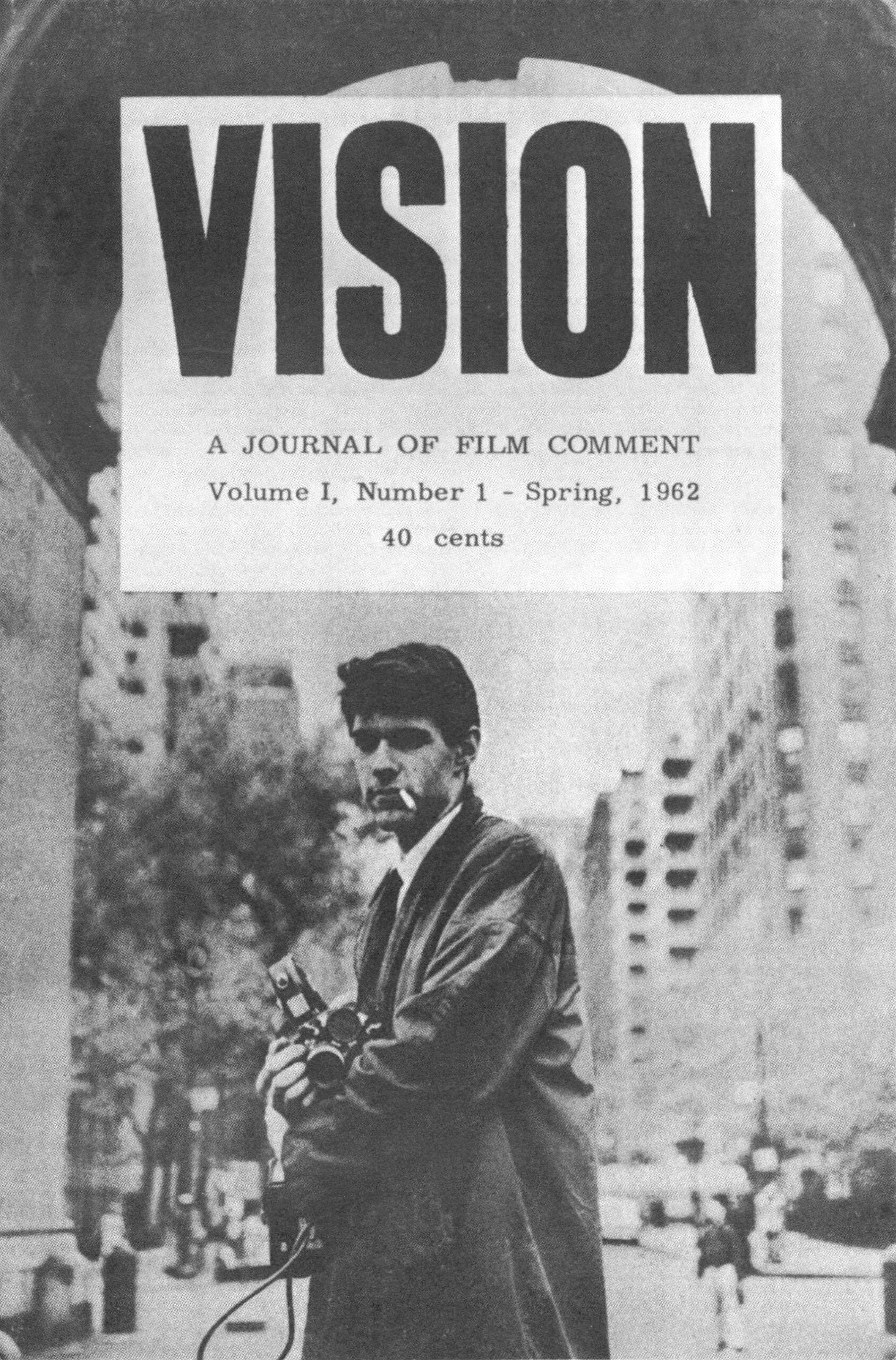
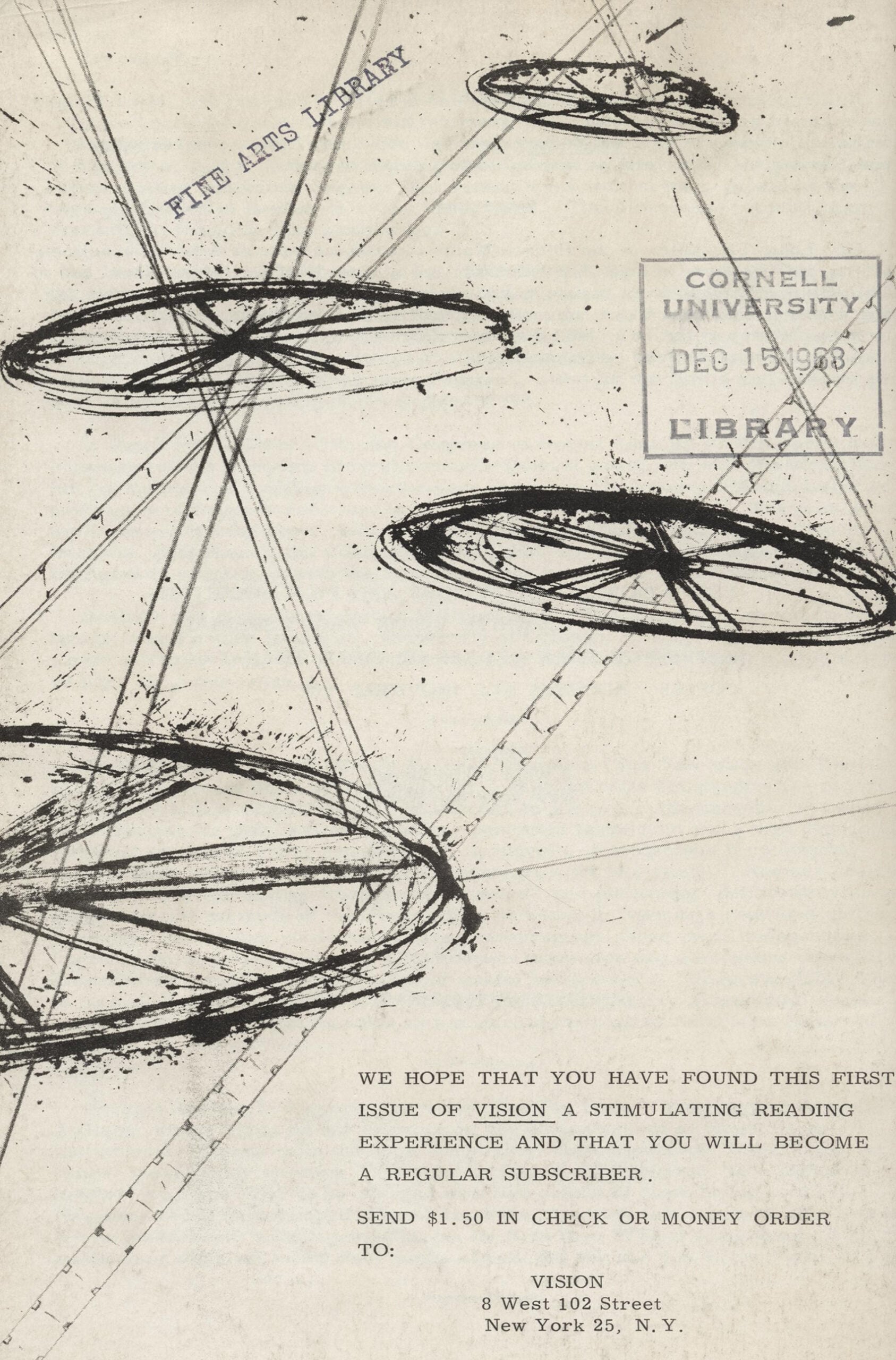
In the spring of 1962, a modest periodical bearing the title Vision: A Journal of Film Comment was published in New York. For the price of 40 cents, readers were treated to discussions of experimental film, reflections on the “emergence of the teen-ager as a self-conscious social force,” and a report on the happenings at Amos Vogel’s legendary film society Cinema 16 (which would fold the following year), among much else. The back cover bore an all-caps appeal: “WE HOPE THAT YOU HAVE FOUND THIS FIRST ISSUE OF VISION A STIMULATING READING EXPERIENCE AND THAT YOU WILL BECOME A REGULAR SUBSCRIBER.”
Vision would last one more issue that summer before rechristening itself as Film Comment in the fall—but a stimulating experience it remained. Over a span of nearly 60 years, the publication expanded and evolved, changing formats, publishers, editors, and emphases, securing along the way a reputation as the foremost North American magazine devoted to cinema.
And then it all came to an end. It was announced that the May-June 2020 issue of Film Comment would be its last. The cover featured an image from Roy Andersson’s About Endlessness (2019), and another all-caps message: CINEMA IN ISOLATION / ESSAYS FROM A FROZEN WORLD. In his final editor’s letter, Nicolas Rapold informed readers that “in light of the coronavirus crisis” the magazine had been placed “on a hiatus.” Readers were encouraged to consult the website for additional details. Rapold closed his remarks with an appeal of his own: “Let’s get together again soon.”
***
Soon enough we did. Several months later, under the co-editorship of Devika Girish and Clinton Krute, the publication reconstituted itself in the form of a weekly email newsletter. Though readers mourned the demise of the bimonthly print edition, the Film Comment community slowly regrouped. The newsletter matured, grew more ambitious, cultivated a new diversity of voices, and welcomed back seminal contributors. Key values of Film Comment—reports on the newest developments in global cinema, advocacy for emerging filmmakers, thoughtful criticism guided by an editorial ethos invested in what matters right now—remained, albeit at a scale necessarily delimited by format.
With the relaunch this spring of Film Comment as a quarterly “digital magazine,” that scale has been significantly expanded—not least by making the entire archive of the publication’s history available online. This brings us to the text at hand, the first in a regular column in which I’ll be exploring this archive from various angles. My guiding principle in the essays to come will be to place materials from the past in dialogue with something contemporary, to engage the archive as a living entity that speaks to our moment. As to what form this takes, I leave the question open. I have no program beyond the disinclination merely to celebrate or summarize. Every voice that emerges from an archive is inflected by its archivist; description is always a mode of commentary. Given the reflexivity of this project, I have selected as my first object a notable precedent of Film Comment regarding itself.
***
The November-December 2013 issue featured that year’s Inside Llewyn Davis on the cover, but the real story was an inside look at the magazine in recognition of its 50th anniversary. A special midsection included an interview with former Editor Richard Corliss by critic David Thomson; a ranking of the magazine’s 50 most frequently published contributors; a poll of the best and worst covers in the publication’s history; and a list of contributors to the “Guilty Pleasures” feature inaugurated in 1978 by Roger Ebert—whose selections included the Sasquatchsploitation opus Bigfoot (1970), Invasion of the Bee Girls (1973), and Wes Craven’s rape-revenge shocker The Last House on the Left (1972)—and succeeded by a dazzling cohort of fellow confessors including Martin Scorsese, Stephen King, John Waters, Mary Harron, Terence Davies, Catherine Breillat, Joan Rivers, Slavoj Žižek, and Jodie Foster, among many others. Running along the margins was a color-coded timeline specifying the cover story, themes, key films, and featured critics of each issue.
The essential document in this dossier was a comprehensive narrative of Film Comment’s history, undertaken with remarkable skill and confidence by a 20-year-old intern. At the time a Columbia undergrad studying philosophy, Max Nelson researched his 14-page essay, “E Pluribus Unum,” by checking out issues of the magazine from his university library and combing through countless pages, taking note of matters large and small: decade-spanning editorial dispositions; the ethos and prose style of diverse contributors; evolutions of format and design; the shifting relation of Film Comment to the politics, critical paradigms, and cinematic culture of its times—and, with a delicate touch and no small degree of courage, the various internecine conflicts, editorial evictions, and fraught relations to the publishers that would intermittently erupt over a half century, and more than once imperil the magazine’s existence.
Nelson organized his narrative through an account and analysis of its successive editors starting with Gordon Hitchens, who produced the first issue in his Manhattan apartment. In the American context, auteurism was the discourse du jour. Cinema studies began to infiltrate the academy. Yet Film Comment in the ’60s, Nelson observed, “tended to downplay formal questions” in favor of a sociological emphasis and what we would now label “industry studies.” As such, its early years failed to keep pace with the critical élan, polemical verve, and theoretical investigations proliferating in the pages of Jonas and Adolfas Mekas’s Film Culture, the scholarly Film Quarterly (in which Andrew Sarris and Pauline Kael beefed over auteurism), or the European touchstones Sight and Sound and Cahiers du cinéma.
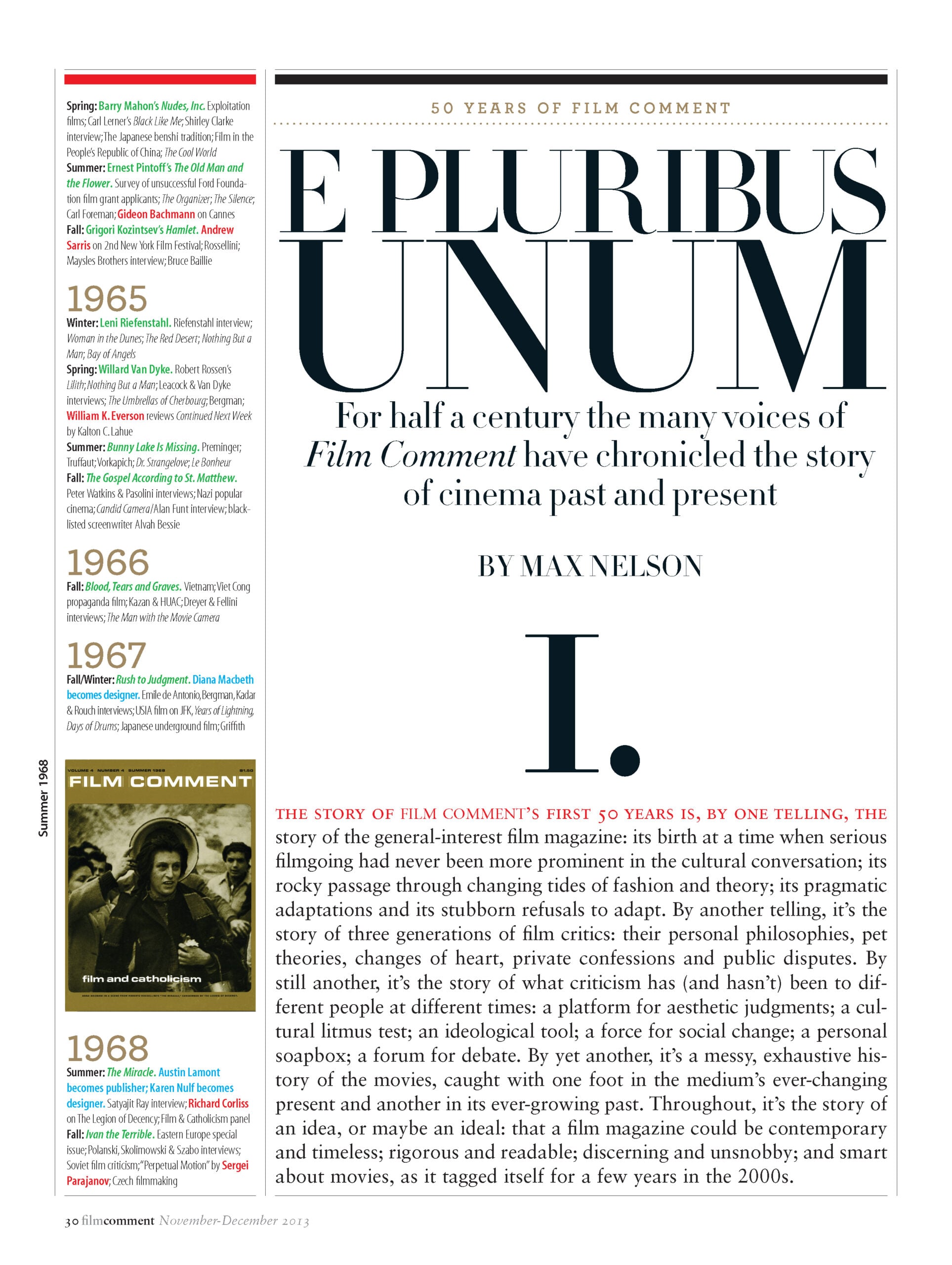
Pages from the “50 Years of Film Comment” section in the November-December 2013 issue.
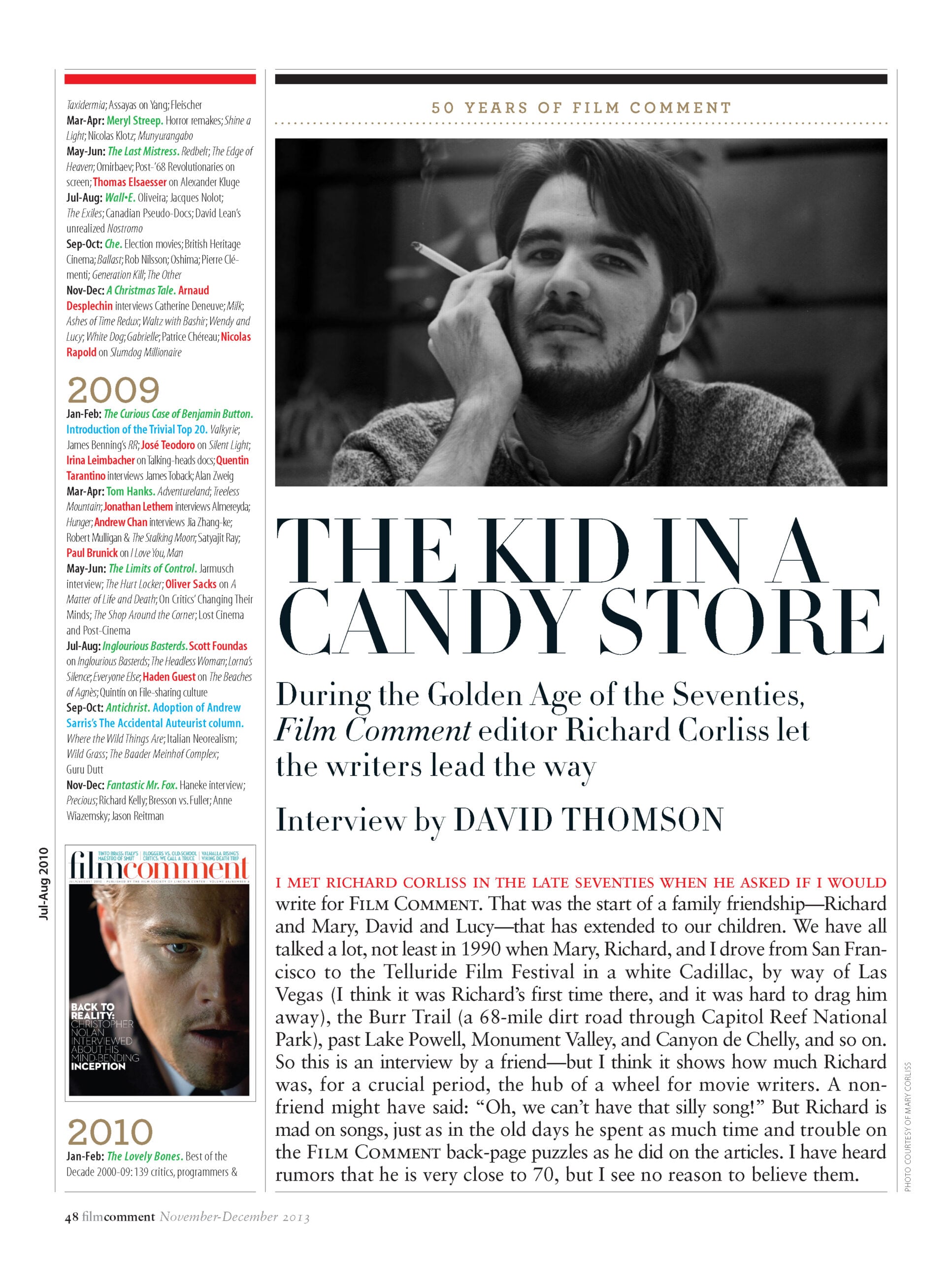
In the fall of 1970, Richard Corliss assumed the editorial reins. Only 26 years old but already a known figure on the critical scene, he featured in his first issue Sarris’s zesty “Notes on the Auteur Theory in 1970” (“Now let’s see where we were when we were so rudely interrupted by the shrill cackling of the unbelievers”) alongside extensive coverage of classical Hollywood, notably the Film Comment debut of Molly Haskell writing on Hitchcock’s Stage Fright (1950). Nelson characterized the Corliss agenda as “an Olympian next step . . . to reassess 50 years of American movies director by director, film by film, and shot by shot”—a decisive return to “the dustier territory of Old Hollywood.” At the same time, Corliss was dedicated to “autonomous, individual, freethinking critical voices,” soliciting work from Jonathan Rosenbaum, Amos Vogel, Raymond Durgnat, and Robin Wood—the latter two critics (as Nelson describes) given the latitude to exercise their idiosyncratic voices at length. The jewel in Film Comment’s ’70s crown was the publication of several late, extraordinary essays by the peerless Manny Farber and Patricia Patterson: termite deep-dives into Fassbinder, Taxi Driver (1976), and Jeanne Dielman, 23, quai du Commerce, 1080 Bruxelles (1975).
In 1980 Corliss was hired as the film critic for Time while remaining the nominal editor of Film Comment for nearly a decade. Yet the magazine’s perspective was assumed—and shifted once again—by Senior Editor Harlan Jacobson starting in 1982. In Jacobson’s hands, Nelson wrote, the “tone became lighter, its writing fresher and quippier, and its subject matter more timely.” Music videos and video games were discussed, identity politics entered the chat, David Thomson became a key contributor, and another Columbia student, Gavin Smith—an Oxford alum on a Fulbright for graduate studies—started interning for the magazine.
Nelson correlates Thomson’s stature in the ’80s to Robin Wood’s in the ’70s, deftly summarizing their respective voices: “where the latter’s prose feels carefully worked over, compressed for maximum clarity and precision, the former’s is nervous, pressurized, revved up, and spewed out—as if Thomson was desperate to pin down whatever association or impression had just occurred to him before another had the chance to displace it.” When it came to another displacement, Nelson maintains his poise in narrating Jacobson’s dismissal from the magazine. Precisely what happened remains unclear—accounts differ, parties involved declined to comment—but this would not be the last time the magazine was embroiled in what a source once described to me as “Game of Thrones–level intrigue.”
When the dust settled, incoming Editor Richard T. Jameson revived the emphasis on classical cinema even as new contributors joined the ranks: Godfrey Cheshire, a pioneering champion of Iranian cinema; Chuck Stephens, a savvy exegete of Asian excellence; and Howard Hampton, whose dense prose zigzagged with Farberesque intensity. Nelson credits this “influx of new blood” to Gavin Smith, the former intern who had risen to the rank of associate editor and would soon become one of the most transformational editors in the magazine’s history. It was Smith, too, who onboarded Kent Jones after discovering their mutual admiration for the emerging French cinéaste Olivier Assayas. Jones quickly became a mainstay of the magazine, serving in various editorial roles until assuming directorship of the New York Film Festival, then stepping away to focus on his own career as a filmmaker.
Following another institutional paroxysm, Smith was appointed editor of the magazine in the spring of 2000. A U.K. émigré with eclectic taste and a prickly personality that masked deep reservoirs of kindness and loyalty, it was Smith who took a chance on young Max Nelson and another fledgling critic—myself. Long something of a boys’ club (Jonathan Romney, Graham Fuller, and Paul Arthur were heavily featured; Guy Maddin and Alex Cox started regular columns), Film Comment in the 21st century became a regular perch for Amy Taubin, a critic at the Village Voice and eminence of the downtown scene—not only the star of a Warhol Screen Test but also a cast member in Michael Snow’s epochal Wavelength (1967).
Under Smith’s tenure the magazine undertook a much-needed redesign, expanded its internationalism, reckoned with the digital turn, and tightened its editorial parameters. If, as Nelson gently lamented in 2013, the magazine’s “present structure seems a little too restrictive” compared to more indulgent eras, it also remained an irreplaceable venue for long-form criticism and vital updates from the front lines of global cinema. Can it be that it was all so simple then? As the second decade of the 21st century approached, a paradigm shift began to assert itself. The financial crisis of 2007-’08 decimated the ranks of print critics; it is no exaggeration to say that nearly the entire profession was wiped out. The hopelessly passé era of film critics with health care and copy editors gave way to an efflorescence of unpaid bloggers and social media, hot takes and live-tweeting from Cannes. Excellent writing and skilled reviewers emerged from this tumult—as did the conditions that set the stage for the advent of the Letterboxd influencer.
“The principal challenge” of this milieu, wrote Nelson, “has been that of adapting to a critical landscape where two months count as an eternity and relevance seems measured by minutes of attention.” Noting the introduction of more robust online material overseen by Violet Lucca and Nicolas Rapold (then the digital editor and senior editor under Smith, respectively), the historian concludes his tale with cautious optimism in Film Comment’s devotion to “the art of film criticism, sustained by the faith—occasionally misplaced, but more often than not wonderfully confirmed—that some movie reviews are worth holding on to, rereading, and savoring.” There is a great deal more to the story since the publication of “E Pluribus Unum”: Rapold’s editorship following the departure of Smith in 2015, the dismantling and reconstitution of Film Comment during the pandemic, the ongoing efforts of Girish and Krute to steward the magazine through turbulent times. From the vantage of 2013, none of this could be foreseen. For the purposes of this column, it is a tale for another day, to be told by someone else. Keep an eye on future interns. One testament of the archive is their capacity to astound.
Nathan Lee is an assistant professor of film at Hollins University and a longtime contributor to Film Comment.
This story is part of the Summer 2026 issue of Film Comment.
By clicking Sign up, you agree to our site’s Terms of Service and consent to our Privacy Policy.
Get full access to Film Comment with a paid subscription. Already signed up? Log in.
Thank you for signing up for The Film Comment Letter.
Check your email to set up your account and get access to select articles, or become a paid subscriber for full access.