Of Mice and Men: The Films of Don Bluth
The animator’s dark, nuanced body of work functioned as a counterweight to Disney's brightly-lit dominance of the 1980s and ’90s
The animator’s dark, nuanced body of work functioned as a counterweight to Disney's brightly-lit dominance of the 1980s and ’90s
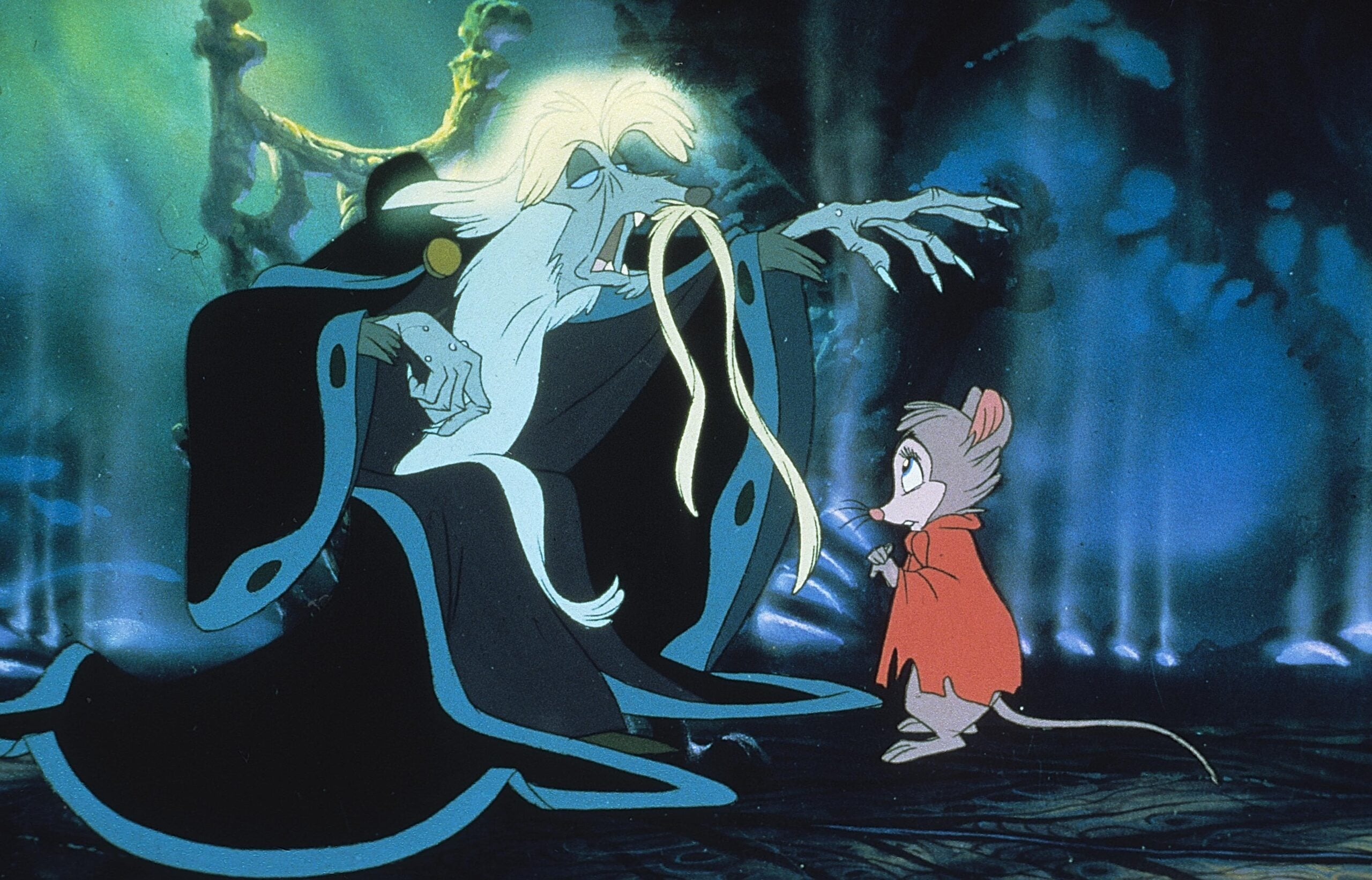
In 1979, star Disney animator Don Bluth exited the work-in-progress The Fox and the Hound (1981) and rebelled against the hegemony of the Mouse by starting his own indie studio, Don Bluth Productions. The films that followed were landmarks of ’80s children’s cinema that folded real-world darkness inside adventures featuring cute animals and comic relief: his 1982 debut The Secret of NIMH (“National Institute of Mental Health”) relates the grim struggle of a community of escaped lab rats; An American Tail explores the disillusionment of a family of mouse immigrants; All Dogs Go to Heaven talks about murder, revenge, and forgiveness in the guise of a canine ghost story. To many of Bluth’s devotees, he represented an anti-Disney ethos. But, as is often the case, the truth is more complicated.
Two recent portraits of Bluth’s life and career—his 2022 memoir, Somewhere Out There: My Animated Life, which touches on his Mormon faith, and a 2025 feature documentary Don Bluth: Somewhere Out There, directed by Chad N. Walker and Dave LaMattina—provide a glimpse into the conservative yet rebellious maverick’s craft and his deep love-hate relationship with his former employer, the mega-studio Disney.
Bluth fell in love as a child with Snow White and the Seven Dwarfs (1937), writing in his memoir that the film “reached off the screen and into a secret part of my soul, attached itself, and reeled me in.” Far from just a childhood inspiration, Walt Disney became a lifelong obsession for Bluth—in the documentary, Disney’s name is said more often than Bluth’s. In animation, Osamu Tezuka had a godlike status in Japan and was adored by Hayao Miyazaki, but the latter eventually grew out of his fandom and even went on to criticize Tezuka’s limited animation techniques publicly. For Bluth, however, Disney was much more than a sentimental touchstone or commercial icon. Bluth saw his biological dad as a villainous macho figure and Disney as a heroic father embodying an ideal of masculinity. He writes in his memoir about the first time he saw a photo of Disney, “I’d known the name of my hero long before I ever saw a picture of him and had worried that he would look, well, like me—a ‘sissy.’ Instead, his air of confidence, debonair moustache, and crooked smile reminded me of my dad and my jock brothers. He was an artist, and he looked manly.”
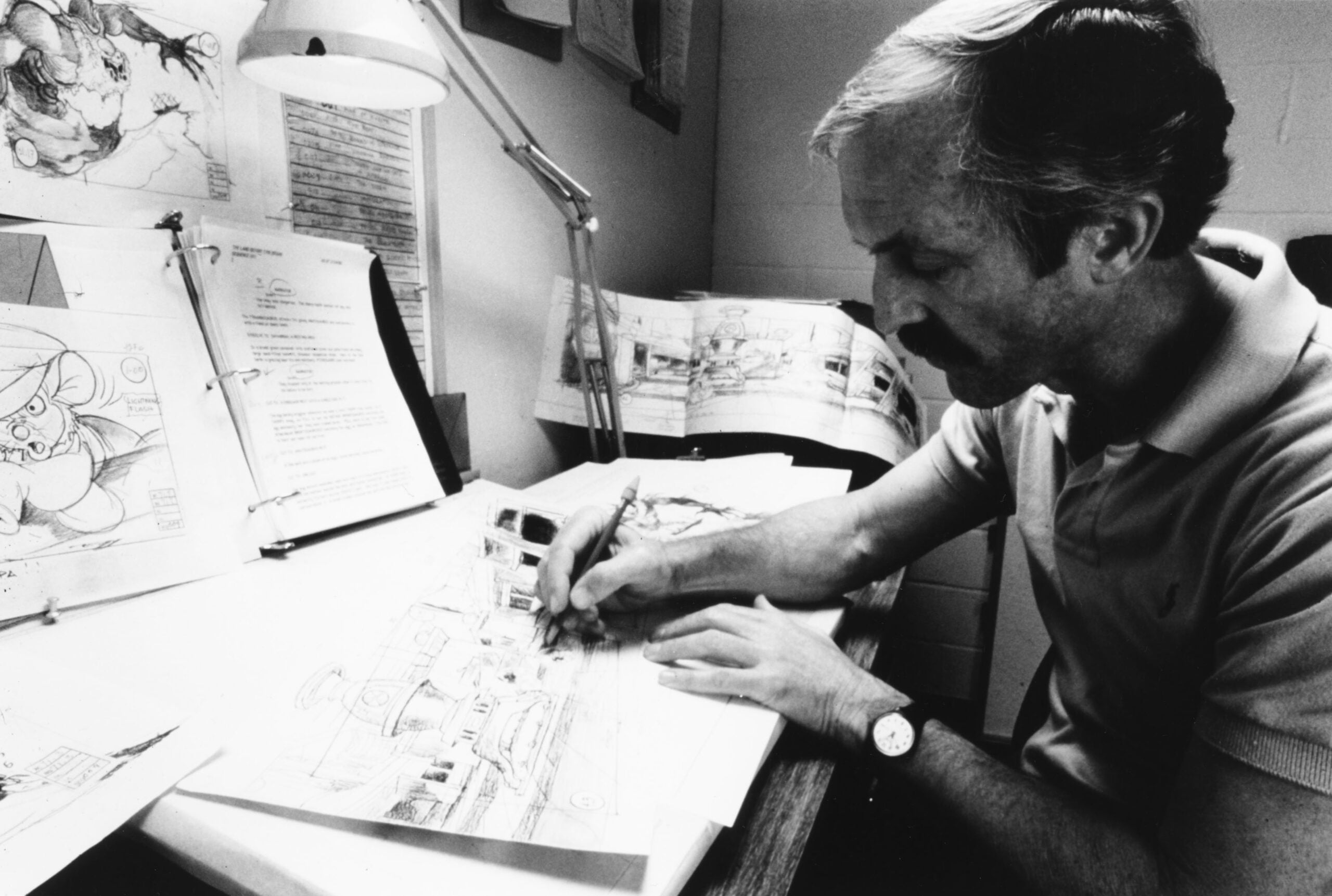
Bluth met Disney in person as a teenager in 1955 when he began working at the studio, then briefly left the company to conduct his Mormon mission in Argentina—“I’ve seen Disney but I’ve not seen God.” His memoir emphasizes his faith as his guiding spiritual light—perhaps an inspiration for the communities of outsiders that are so often central to his movies. But he spent most of his physical life at the drawing table, never marrying or having children. After completing his mission, Bluth returned to the studio in 1971, five years after Disney’s death in 1966, and went on to work there, most notably on 1977’s The Rescuers, for another eight years.
In an interview with the Los Angeles Times in 2022, Bluth said, “Someone asked me one time, ‘Why did you leave Walt Disney Studios?’ And I said, ‘Because Walt left Walt Disney Studios.’” After Walt’s death, Bluth felt the craft—and therefore the magic—of the classic films he cherished was suffering due to new cost-cutting measures. He also felt that the company’s identity was under an existential threat, as a new wave of animators, many of them graduates of CalArts, aspired to venture beyond traditional, hand-drawn animation. These young artists would go on to become an all-star cast. As Bluth writes in the memoir, “John Lasseter was already experimenting on his own time with computer animation. Brad Bird was pushing for more contemporary stories, while Tim Burton favored the darker tales colored with bits of horror. They were labeling the classical Disney style of drawing as ‘old-fashioned’ . . . At thirty-six, I was viewed by the CalArts rebels in the bullpen as part of that old guard, and a roadblock to their future plans.” Bluth rebelled against the studio because it had been overtaken by rebels. He wanted, à la Jean Cocteau, a “return to order.”
In the documentary, Bluth says that he wanted “to serve the same purpose—serve the same art” as Disney. Apparently he did so by serving up a nightmare version of The Rescuers. Released in 1982, his debut independent feature, The Secret of NIMH, was based on a book his former employer had passed on adapting and follows Mrs. Brisby, a field mouse, through a relentless series of misfortunes: her child’s illness, multiple threats to her home, and the death of her husband after he was experimented on at the NIMH. Alongside Martin Rosen’s brutal The Plague Dogs, released the same year, NIMH will forever be a touchstone of the edgy animation of the 1980s. Bluth does not appear to have seen his own work in this way, however. There’s a dissonance between the lightness of his persona (the cover of his book features him smiling, Mr. Rogers–like, surrounded by cute animated characters) and the darkness of many of his signature creations. He viewed himself as a good Mormon boy. He cited his failure to tithe for three years as the reason for NIMH’s box-office underperformance.
The Secret of NIMH established Bluth as an artistic force to reckon with. Though the film was not immediately financially successful, Bluth was soon offered animation tasks for the 1983 video game Dragon’s Lair, which used LaserDisc technology to create an arcade game that looked like hand-drawn TV animation. While its irksome controls made it a frustrating play, its novelty and the bright, goofy Sleeping Beauty–meets–Tex Avery animation won people over. It cost around $1.5 million to make and grossed $32 million in sales. To this day, it is highly regarded by arcade-game aficionados and animation heads.
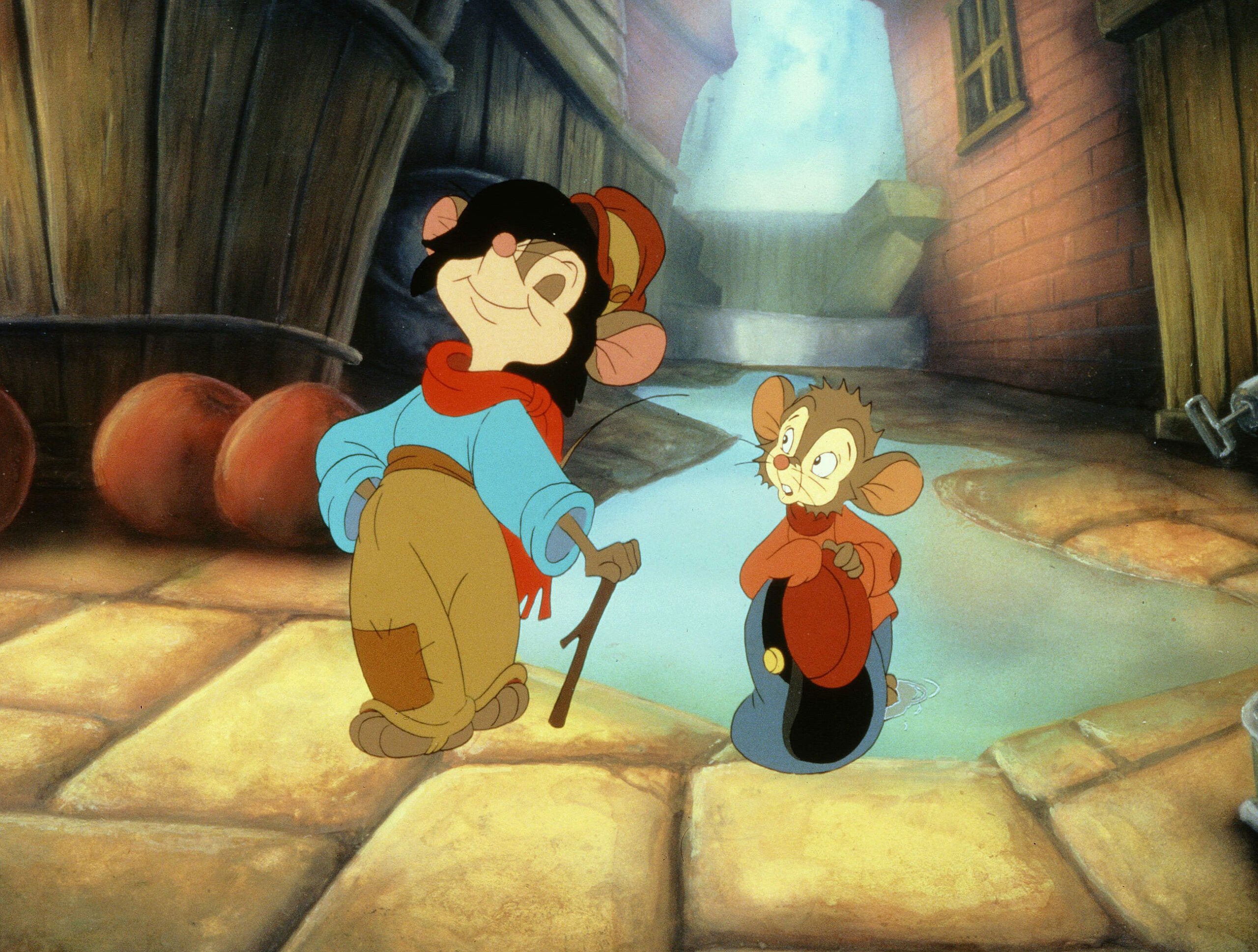
The Secret of NIMH and Bluth’s 1986 Steven Spielberg–produced blockbuster An American Tail (whose theme song provides the title for both the autobiography and the new doc) were both similar enough to the commercial aesthetics of Disney to appeal to kids, yet different enough to seem experimental—even radical—to them. While the Jewish immigration allegory An American Tail wasn’t nearly as gritty or adult as Art Spiegelman’s brilliant graphic novel Maus (whose first volume was also released in 1986), the bickering family and realistic world (“Tragic, gloomy . . . It has been written by people who want to prepare kids for the worst,” wrote Roger Ebert in his two-star review) was still shocking and eye-opening compared to films of the Mouse House. This may be why Bluth is so fondly remembered even now. For me, encountering Bluth’s movies as an 8-year-old was akin to discovering the French New Wave; they showed me that movies and arcade games didn’t have to look or feel like what I had previously seen.
The documentary excavates pencil tests from 1988’s The Land Before Time, and here we can really see Bluth’s artistry in a raw state. The baby dinosaurs appear out of ghostly graphite, like a William Kentridge creation; the apatosaurus’s long neck swoops and curls. This “old-school” entirely hand-drawn animation, which Bluth learned as a young man at Disney and then spent the rest of his life championing, comes off here like a beautiful beast fighting extinction. All Dogs Go to Heaven begins with a slow, moody zoom into a dark tunnel as two dogs break out of a pound. Burt Reynolds and Dom DeLuise voice two criminal dogs stealing from an orphan girl’s prospective parents, while Vic Tayback provides vocals for a raspy, cigar-puffing bulldog crimelord. Single frames from All Dogs might be mistaken for a grungy Ralph Bakshi film or a grotesque Red Grooms painting. The whole movie feels menacing—it’s as “anti-Disney” as Bluth ever got.
What’s remarkable is how much Walt Disney Studios cared to fight back. They timed releases (and rereleases) to be in direct competition with Bluth productions. In the 2021 documentary Claydream, Will Vinton, creator of Claymation characters like the California Raisins and director of 1985’s The Adventures of Mark Twain, also cites Walt Disney as his role model, which is surprising since Vinton’s stop-motion work seems more aligned with the underground comix of Robert Crumb than the sweet forest creatures of Walt Disney. But the Disney company never viewed Vinton, or any other filmmaker, as being as big of a threat as Bluth. The beef seemed to be personal. The Disney company couldn’t absorb and assimilate him the way they did other former employees. In fact, when Bluth declined chairman of animation and family scion Roy E. Disney’s offer to return to the fold in 1989, Roy promised to “crush” him.
And crush him they did. Disney bounced back from their mid-’80s commercial malaise with the resounding success of The Little Mermaid, released wide the same day in 1989 as All Dogs Go to Heaven. Their string of ’90s hits must have felt like a pummeling to Bluth. The transformation scene in Beauty and the Beast (1991) surpassed Bluth in its religiosity. The operatic depth of The Hunchback of Notre Dame (1996) rivaled his grim ’80s creations. Bluth was down for the count, valiantly struggling to produce movies with barely ready scripts in order to keep his studio operating. Then Pixar and computer animation took the ring with Toy Story in 1995, and Bluth’s hand-drawn fight suddenly felt dated.
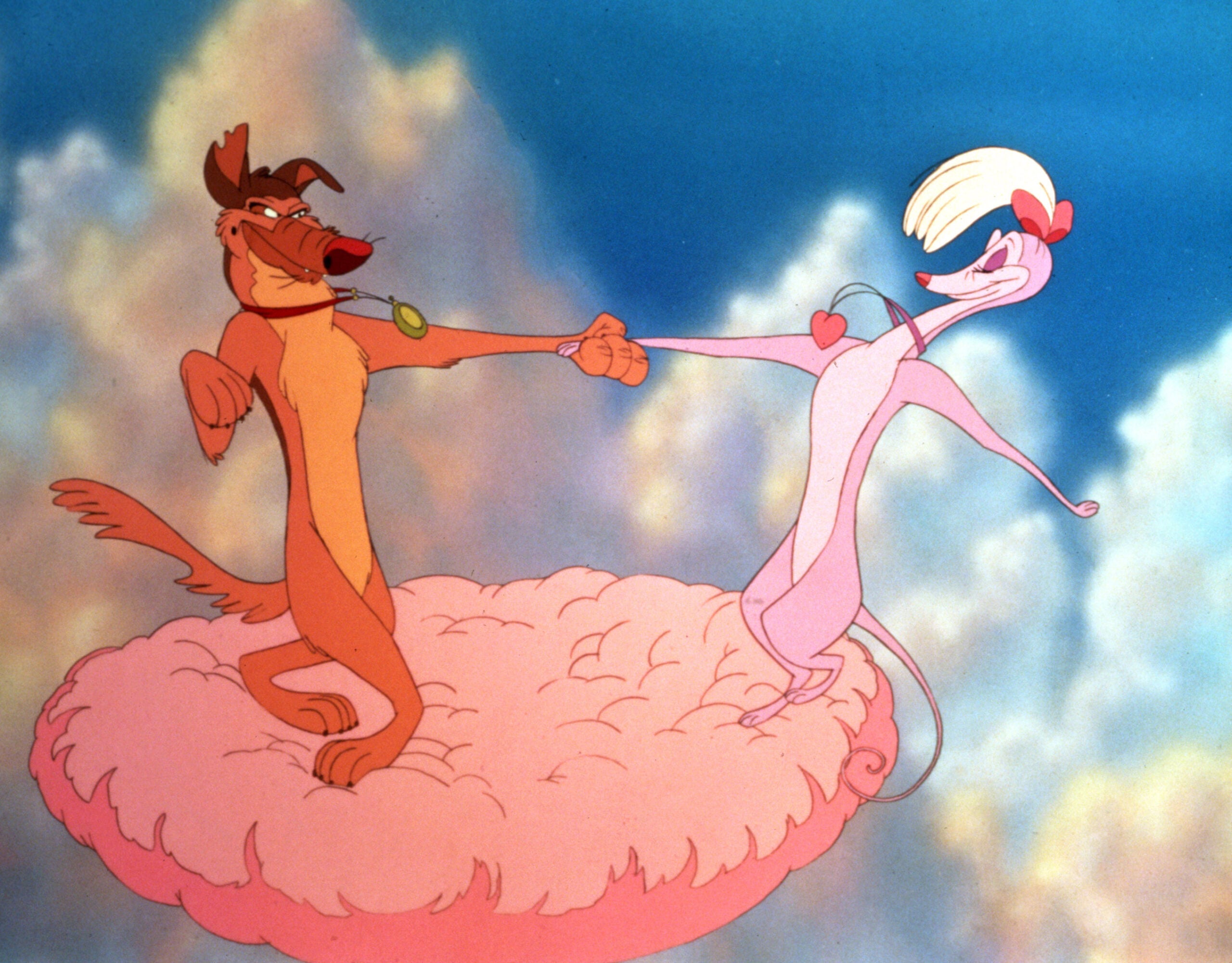
A couple Bluth films from this era of struggle are worth mentioning: 1995’s The Pebble and the Penguin and 1997’s Anastasia, which became his most commercially successful movie. Bluth has said that his blueprint for constructing a good story includes “a hero, a villain, and a clown.” This formula is painfully obvious in The Pebble and the Penguin, a movie so basic in its story—the seabird hero must propose to the female he loves with a special pebble before her other villainous suitor gets to her—that its simplicity actually becomes confusing. The audience keeps expecting some complexity or deeper nuance that never arrives. As a result, it’s best watched in the same spirit one brings to a trippy Dario Argento movie or a theatrical version of an airbrushed mural of a whale jumping out of a cyan ocean at sunset. The jittery, squash-and-stretch animated performances feel like comedians performing on cocaine. The penguins, eerily, have teeth. All of the saturated landscapes hypnotize the eyes and melt the brain. If only it had a Goblin soundtrack.
Bluth made Anastasia at a new studio, Fox Animation, owned by 20th Century Fox. The historical fantasy film, based on the famous tale of the Russian Grand Duchess, was photographed in live action for reference, and has some of the best rotoscope-assisted animation ever put to film. Bluth found a way to combine rotoscope techniques with traditional animation to merge the specific and the general. The drawn performance of the lead, voiced by Meg Ryan, is more subtle and naturalistic than most Disney princesses. Here we see an instance of Bluth’s faith in classical animation being bent to a cost-cutting technique—rotoscope—and yielding a stronger, more unique, and more idiosyncratic vision because of it. The problem with complete dedication to what’s known as “full” (or “expensive”) animation is that artistic merit becomes tied inextricably to cost. Ideally, an animator finds their art in themselves and their own peculiarities. Bluth achieved this magnificently in his best movies—Anastasia, just like The Secret of NIMH, could have been made only by him.
Disney acquired the Fox Animation Studio catalogue in 2019, and today, Anastasia is streaming on Disney+. In 2026 it seems the Disney corporation owns nearly everything. The dream of someone inside that behemoth leaving to rebel against the machine, railing against it, and causing the corporation to feel betrayed and threatened by a singular artist is long gone. But Don Bluth, the last major creator to scare the monster Mouse, built a singular body of work with his blend of Disney-inflected traditionalism and personal Disney-dissenter spirit, all executed in beautiful hand-drawn animation that he still teaches today.
Dash Shaw is a cartoonist of Blurry and Like Swimmers (both NYRC) and the writer-director of Cryptozoo (Magnolia Pictures) and the forthcoming Unknownia (MUBI).
This story is part of the Summer 2026 issue of Film Comment.
By clicking Sign up, you agree to our site’s Terms of Service and consent to our Privacy Policy.
Get full access to Film Comment with a paid subscription. Already signed up? Log in.
Thank you for signing up for The Film Comment Letter.
Check your email to set up your account and get access to select articles, or become a paid subscriber for full access.