Corey Devon Arthur and Sandro Ramani on In Exchange For Flesh
The directors discuss their powerful short, which blends personal testimony and experimental techniques to expose abusive prison practices
The directors discuss their powerful short, which blends personal testimony and experimental techniques to expose abusive prison practices
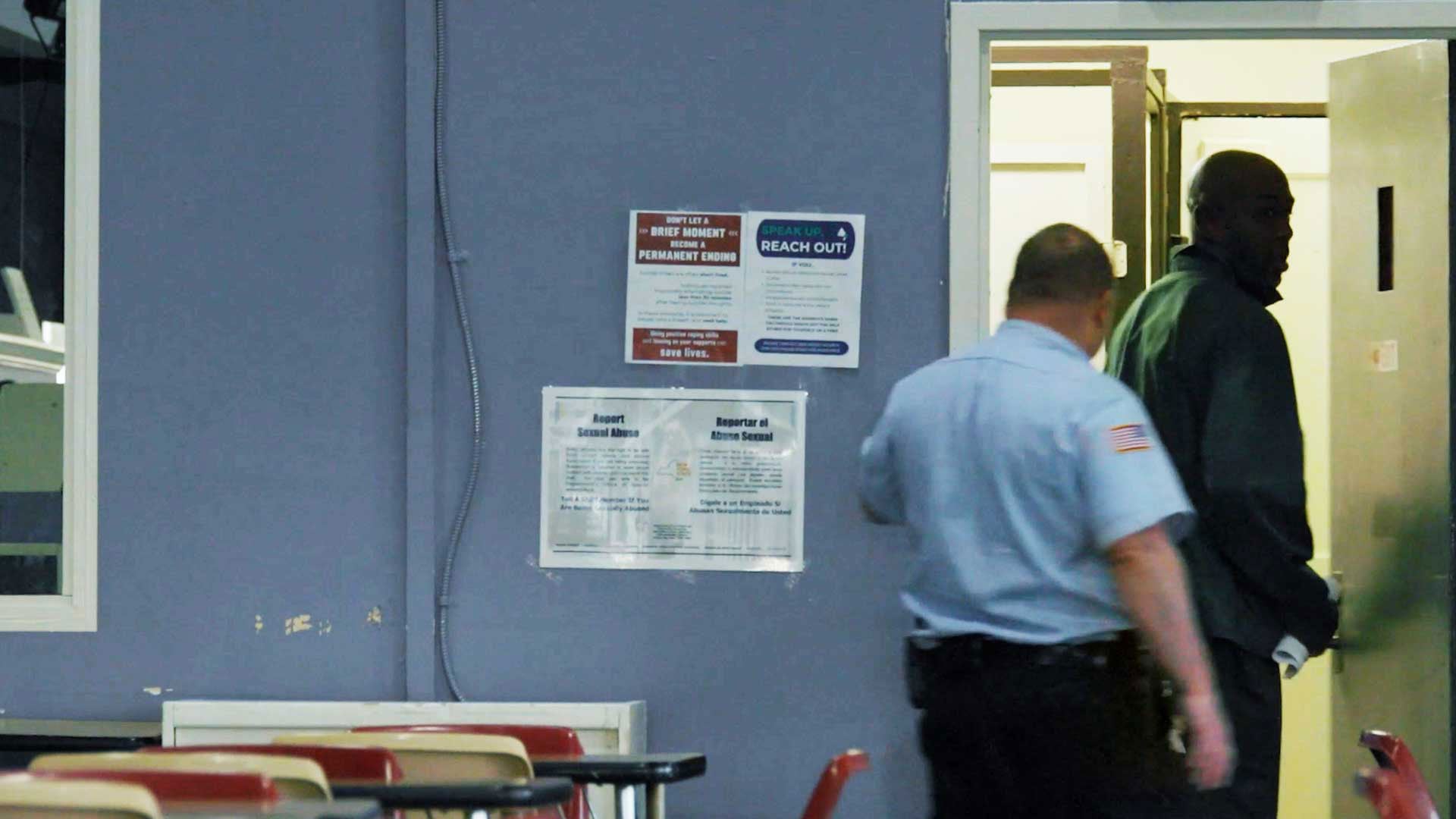
In Exchange For Flesh asks 15 minutes of its audience—the length of a short in film industry terms and an eyeblink in a person’s life, especially for those who walk free in society without experiencing the prison system’s recasting of the calendar into interminable containment. For Corey Devon Arthur, who co-directed the film with Sandro Ramani while serving a life sentence in prison, these 15 minutes are the culmination of years of personal growth and public outreach focused on abusive prison conditions.
Featuring archival material, Department of Corrections and Community Supervision (DOCCS) training videos, and testimony from Devon Arthur as well as Sara Keilly, In Exchange for Flesh documents the ways in which the practice of strip-frisk functions as a form of everyday abuse in prisons. As Corey writes, “In my 43 years of life, I’ve been strip-frisked over 1,000 times.” Every individual who passes through the system is vulnerable to this violation of the Fourth Amendment, which proclaims “the right of the people to be secure in their persons.” But who counts as a person, and according to whom?
The rationale for the strip frisk is finding and confiscating contraband, but contraband is widely known to be trafficked more commonly by staff rather than inmates. If the search doesn’t halt the flow of drugs, phones, or weapons, then what is its function? As jailhouse lawyer and anarchist-abolitionist Martin Sostre declared after enduring a year-long solitary punishment for refusing what is described in corrections parlance as a “rectal examination,”, “They may succeed in beating me to death, but they shall never succeed in forcing me to relinquish what in the final analysis are the final citadels of my personality, human dignity, and self-respect.” In Exchange For Flesh extends the liberatory struggle against state abuse of prisoners in novel form.
Many prison documentaries thread questions of guilt and innocence through the needle of a redemption arc, positioning viewers as if they are parole-board evaluators. Corey and Sandro’s film takes an inventive stylistic approach, keeping one foot in sympathetic sit-down interviews and B-roll, and another in experimentation. The film’s densest sequence collages Corey’s reflections on the incident that landed him in prison at 19 with his appearances in the racist news media, building to an excerpt from Bob Ross’s The Joy of Painting. It’s an unexpected and challenging rhyme: Ross builds light on the canvas; DoCS training videos detail procedures for a “visual search;” and the edit joins Corey in his search for a method to demand dignity, even—and especially—for those who aren’t “innocent.”
I spoke with the directors over Zoom on April 17, 2026, just days after Devon Arthur had walked out of prison for the first time in nearly 30 decades, after finally being approved for parole
Thanks for making time today.
Sandro Ramani: We walked into my apartment 15 minutes ago. This is the first time Corey’s been here, and now we’re together.
Corey Devon Arthur: Crazy. The whole story, full cycle. We did the work. We lived the words. We did it with the books where our ancestors spoke. There was nothing cowardly about what we did. It wasn’t illegal to exercise our full constitutional rights.
That’s at the heart of your project. It has to do with your legal rights, and with dignity.
CDA: It deals with humanity. Every human being is entitled to a social contract that predates us. You can’t do this unless we have a system where we can all get along. We didn’t do anything special, we just rebalanced what it was supposed to be. Treat me like a man, treat me like a person, and I may act like one, but if you continue to treat me like chattel, I will hate you. Give me a reason to love you, and maybe my heart will soften. That’s what this film is about. I’m trying to show you there’s a moment to be soft, there’s a moment for us to change.
I don’t want to disagree with you, but I do think the film is special! It’s special for audiences to have access to your words, to Sara’s testimony, and to how you assemble the images, Sandro. How did you two first come into contact?
CDA: Earlier, I did a project called She Told Me Save the Flower. It was my plea to the world to introduce feminism inside of the prison system. I’d been there at that time for 22 years. I put together a collection of paintings [exhibited at My Gallery NYC in 2023] that went through the roof, and Sandro filmed it all. That was our first time. We developed a code-speak. A lot of this was intuitive, and that intuition turned into a type of symbiotic consciousness.
SR: Empowerment Avenue was organizing the exhibition; they needed a video component to be screened with the project. I visited Otisville in 2022 to meet him and discuss the project, and then we started talking regularly after that. In the beginning, we had to build language and trust, where I know what to say and what not to say. A lot of our work happened in person. By 2022 [Empowerment Avenue connected us in advance of the exhibit], I was going to prison to meet him. For prison visits, you spend six hours. There’s no recording. The guards are nearby, but you can speak plainly. If you’re going to build relationships, you’ve got to go in person. I’ve heard stories of people saying the wrong thing on the phone, and then someone goes to the box [solitary confinement]. Corey wrote an article for The Marshall Project that he can talk about. It’s the thesis for the film, which is that the [strip frisk] happening inside prison, if you did it in free society, you would land in prison. It’s abuse. We talked for a long time, and finally we were like, let’s make a project. We didn’t know what it would be because I had no idea that I would be allowed to bring cameras inside.
In the United States, on one hand, we are drenched in TV, podcasts, and media about cops and prisons. On the other hand, people on the outside don’t really know what’s going on. They don’t have any access. It is tricky to get cameras in.
CDA: The media’s been following me around since I was a teenager. We looked at the films that were already there of me. I think it gave us a better way to position ourselves, because we’ve seen what I look like on film from multiple sources.
SR: I called the NY Department of Corrections Public Information office to ask if our cinematographer, Peter Peregrine, and I could film with two incarcerated people for an independent documentary at two separate NYS prisons. Initially, the answer was no, due to short staffing, but after submitting a proposal showing limited DOCCs resources were needed we got approval at both prisons. The day when we brought cameras in [for Corey’s interview], we had no idea what to expect. We’re walking in, we’ve got six duffel bags of gear. They’re having us bounce back and forth between buildings. I said I’m here for an interview. They ask, which position are you interviewing for?
CDA: That’s typical corrections.
SR: I’m speaking plainly now because Corey’s out. Basically the way it works is it’s a blend of severe bureaucracy and severe incompetence. Like, they’re making us count the camera screws because we didn’t inventory them. But then once we got inside, they cleared out of the visit room and were like, are you from Netflix? Corey, in the film, you can see he’s talking very plainly about how corrections officers are abusing the vulnerable prison population. As he’s saying that—
CDA: —the guard is standing right behind me.
SR: I was thinking they’re going to shut this down. But they didn’t. It’s almost like the gear legitimized the operation. In that moment, it was about getting the testimony. This had never been captured on camera before, someone inside talking about this issue specifically at length. It was like a behind-enemy-lines type situation where we needed to get out before they confiscated it. When the interview ended, the guard came back, and we kept rolling. Corey is checking out, signing his papers, and he’s walking towards the end of this long visiting room. The guard kept the door open. We didn’t know if we were about to watch Corey be strip-frisked. We kept rolling, and there’s this moment where Corey and I lock eyes. He’s about to be sexually abused.
We see you hold your fist up, Corey.
CDA: The interview’s over, right? I go to give [Sandro] a hug. I said, listen, don’t turn the cameras off. Don’t stop rolling. He said, I got you. This is how I move, yo. I choreographed that.
SR: Something Corey and I talked about a lot is how America is obsessed with retribution and justice, and people getting what they “deserve.” It’s ingrained in our culture, and that is reflected in media about prisons. Film crews bring cameras into prison often, but these programs typically are not criticizing the Department of Corrections. In that sense, access is usually given with a condition, implicit or explicit. The initial premise of this project was we’re not going to collaborate. We’re going to resist, and make it legally, which we did. We got approval, but we’re not going to work in collaboration. This was happening no matter what. That’s why we use the word contraband to describe the film: what the film became in post-production would likely never be shown in a prison.
CDA: That’s what made this project special. We would have found a way to package this resistance up and get it to you. Whether I had to draw it, spin it, read, whatever. It just so happened that we got lucky, and we got lucky because we took the shot.
At the beginning of your film, there’s an appearance by Martin Sostre, who is important for his prisoner rights work.
CDA: Sostre, he’s my predecessor. Look at me, I’m bald like him! If you go to Study and Struggle, I wrote articles about him and Garrett Felber, who wrote the book A Continuous Struggle [A 2025 biography that detailsSostre’s work as a groundbreaking jailhouse lawyer and community organizer). Felber made me realize the connection between me and Sostre. I said, okay, I was meant to do this. If I didn’t step up into this, I’d be a fool. What do you think I was given freedom for? To come out here and eat McDonald’s? No. I was given freedom to forge this fight forward.
Let’s talk more about how you built the team. Corey, you give very powerful testimony, as does Sara Keilly. How did you get to know Sara?
CDA: We all worked together with Empowerment Avenue [a nonprofit that works with incarcerated writers and artists]. She’s a co-writer on the film, I’m a writer, and we all know each other through Emily [Nonko, executive producer and former director of Empowerment Ave]. I told you we deal with equality when it came to strip frisk, so what about women? What about transgender women? Sara can speak to you about the differences of the strip frisk, but she could also speak about how it’s more humiliating when you’re a woman.
SR: Sara had a very unique experience starting in men’s prisons. You’re going through the strip process in men’s prisons, as well as other forms of intensive abuse, and then landing in a women’s prison and seeing the differences. The process to get into the women’s prison was even more intense than the men’s prison, and we had even less room to figure stuff out on the fly the day we were filming with Sara. Sara was vital to the film, and how we told this story.
CDA: It balances out [prison media]. You see them Love After Lockup and Love During Lockup shows? They’re a bunch of bullshit. I feel like they violated my culture. Those shows are so disrespectful. They make a parody of our pain. You can do what you do, but you can’t make a couple of minutes to make the public aware of what’s going on in here? You wanna take our bread and not give us nothing back? You’re making a profit off our existence.
I hope that people who see this film might become more open to the idea that strip frisk is a form of abuse.
CDA: I mean, it’s rape. You’re forcing me to do something sexual—that could be construed as sexual—when I don’t want to, against my will… no, no, no, no. Why can’t I walk through that [scan] machine? It does a better job than you, and you have officers that say, well, you prisoners are pretty slick, you know ways to get around the system. Then build a better system. Stop punching down on us and upgrade your tech.
SR: There’s always been this disconnect with free society and prisons. I think people in free society, they’re too busy, they’re going about their life, they’re scrolling Instagram. Prisons are in the corner of their mind, or non-existent, and prisoners are as well, right? Where we’re at in America right now, as a free person, you’re probably closer to landing in prison for some random reason than you’ve ever been before. You could take the wrong picture and be in some sort of cell or prison situation. You’re closer now than you’ve ever been before to being strip frisked. Is it really removed from you? Think about that.
You’re out now, Corey, and the film is, too. With more inside/outside collaborative filmmaking relationships happening, is there also an opening for people to get their stories out, for audiences to hear these stories? What are you discovering with your film as you’re touring?
SR: It’s a very intense watch. Whatever the place is that we’re showing has to be prepared. You need to do trigger warnings, and you need to get people prepared for what they’re going to see. The training videos we show in the film are really visceral, absolutely intense if you’re not ready for them, especially if you’ve gone through the prison system yourself, or have been impacted by abuse. People are opening up to it, but there’s a limit that I’m finding as well. It’s not mass market.
The film is an impassioned call for dignity, and part of what comes with dignity is vulnerability. Corey, you talk about when you were under 21 in prison and facing strip frisks, how you cried out for help. Then the film cuts to black. It’s such a powerful moment. You put yourself on the line by making yourself so vulnerable in this scene. That’s not a small thing to do. You’re in tears.
CDA: That’s the thing when we’re working with someone you love. [Sandro] let me drill. That’s why I was able to be me. He created that space as a filmmaker. That’s why I’m mostly proud of this film, because we did it as a team. We’re doing this because we want things to be worked out better for people. Me, I have a lot of healing to do. I have a lot of apologizing to do. I don’t need much. I just need to work. I love doing this. The fact I’m even talking to you… homie, you know they had a noose around my neck when I was 19 years old? This was my path back to respectability. I could bring opportunities to my friends and my brothers and sisters. I can be a decent human being if I try. Not only did I try, I did it.
SR: Corey and I co-directed, but Corey put his life on the line to make it–literally, that’s not a figure of speech. He was retaliated against at the very end. He ended up in the box. I think it gets into this question of what relationship you have with the project and the people putting their lives on the line for what you’re filming. As Corey said, you have to build immense trust and relationship for years before you even get into it. It’s not like I can come in and be like, hey, nice to meet you, do you want to just talk on camera about these incredibly awful things happening to you your whole life?. A lot of media about prisons is produced and distributed all on the outside, with little input from incarcerated people. This project was conceived and produced from inside prison. Corey raised the grant money for the film and holds the primary ownership rights.
There’s a phrase in one of the archival training videos shown in the film: “the correct procedure for a visual search.” It stuck with me because in the film, I can sense a search. It’s looking for a new visual language. It’s growing. That’s at the core of this film: people can change.
CDA: Like you said, I’m home, so the story ends well. It has a beginning; it has a hell of a middle midpoint. I get to tell a story. I won.
Jason Livingston is a filmmaker and media artist currently based in Buffalo, NY. He volunteers with the Wyoming Correctional Facility as part of Wave Farm’s Arts in Corrections NYS program.
This story is part of the Summer 2026 issue of Film Comment.
By clicking Sign up, you agree to our site’s Terms of Service and consent to our Privacy Policy.
Get full access to Film Comment with a paid subscription. Already signed up? Log in.
Thank you for signing up for The Film Comment Letter.
Check your email to set up your account and get access to select articles, or become a paid subscriber for full access.