Il Cinema Ritrovato 2026: Balls of Fire
This year’s edition of the Italian festival devoted to restored and rediscovered films brought the heat
This year’s edition of the Italian festival devoted to restored and rediscovered films brought the heat

It was at about 11:20 p.m. on the first Sunday of the 40th edition of Il Cinema Ritrovato—the wonderful festival of restored and rediscovered films that takes place in Bologna, Italy, in June each year—that I idly began to wonder if I might actually die. The Piazza Maggiore, with its massive outdoor screen—a venue where the night before we’d all swooned through Murnau’s Sunrise (1927)—was packed right through to its surrounding porticos. It was my sixth movie of the day, if you count Anna (1953), the Visconti-directed, Magnani-starring short that preceded the Magnani-ficent Bellissima (1951)—and count it you should, because it’s great.
I’d been wowed by Kon Ichikawa’s slinky, witty Ten Dark Women (1961), in which a man’s wife and nine mistresses conspire to bump him off. I’d been dazzled by the Father’s Day counterprogramming of Joseph L. Mankiewicz’s crackling House of Strangers (1949), in which the unjustly imprisoned ex-con played by Richard Conte and his love interest (Susan Hayward) trade zingers in the shadow of Edward G. Robinson’s short-yet-towering patriarch. And I’d been thoroughly taken with Robert Hamer’s characterful The Long Memory (1953), which sees another unjustly imprisoned ex-con (John Mills) trying to choose between new love and old vengeance while squatting in an abandoned barge on the bleak postwar Thames Estuary.
Mostly, though, I’d just been hot. Bologna’s notoriously under-air-conditioned cinemas struggled to offset the record-breaking heatwave, not to mention the cumulative effect of 400 bodies thrumming with boiling blood crammed into the full-capacity theaters. And on that first Sunday night, in the standing-room-only Piazza, hours after nature’s aircon, aka nightfall, ought to have cooled things down, steady rivulets of sweat continued to trickle down the backs of my legs as I leaned uncomfortably against a stone pillar still warm to the touch. My apartment, icebox-cold, was two minutes away. But the movie was David Lynch’s Wild at Heart (1990), and having done the “I’ll just stay for the next scene” dance with myself repeatedly, at around the moment Sailor and Lula are zooming down that nighttime highway, my soul suddenly detached itself from its damp housing and floated away with the “Wicked Game” instrumental, reverbing off the facades of the surrounding palazzos. Whatever the consequences for my aching, earthbound carcass, I was in it for the long haul.
Extreme heat warps the movie-watching experience. The stakes are higher, your tolerance lower, and the multitude of panting, perspiring bodies around you—not to mention the unfortunate odors and the endless thwapping of fans—make the out-of-body transcendence we yearn for harder to achieve. So when it happens anyway, you can be pretty sure the catalyst is something special, like Ritwik Ghatak’s masterpiece Subarnarekha (1965), part of a retrospective of all eight of the Indian Bengali director’s completed features.
Ghatak, I confess, is new to me, but I cannot imagine a better entry point than Subarnarekha. Epic, beautiful, and exquisitely performed, it follows Ishwar (Abhi Bhattacharya), a well-educated, upright Bengali who, along with his kid sister Sita, is caught up in the mass displacements that followed the 1947 partition of British India. At their refugee camp in West Bengal, Ishwar takes Abhiram, a boy left parentless after his mother was dragged away by the authorities, under his wing and raises him alongside Sita. But when Sita (now a radiant Madhabi Mukhopadhyay) later wishes to marry Abhiram, Ishwar baulks at his lowly origins. So the lovers elope and have a child, while Ishwar sinks into alcoholic depression, only to encounter Sita again under the most tragic of circumstances. This is an astonishingly poignant portrayal of the migrant’s plight, and of how coincidence may seem a random factor in life when it’s actually an agent of fate—which, in newly riven India, is inextricably entwined with caste.
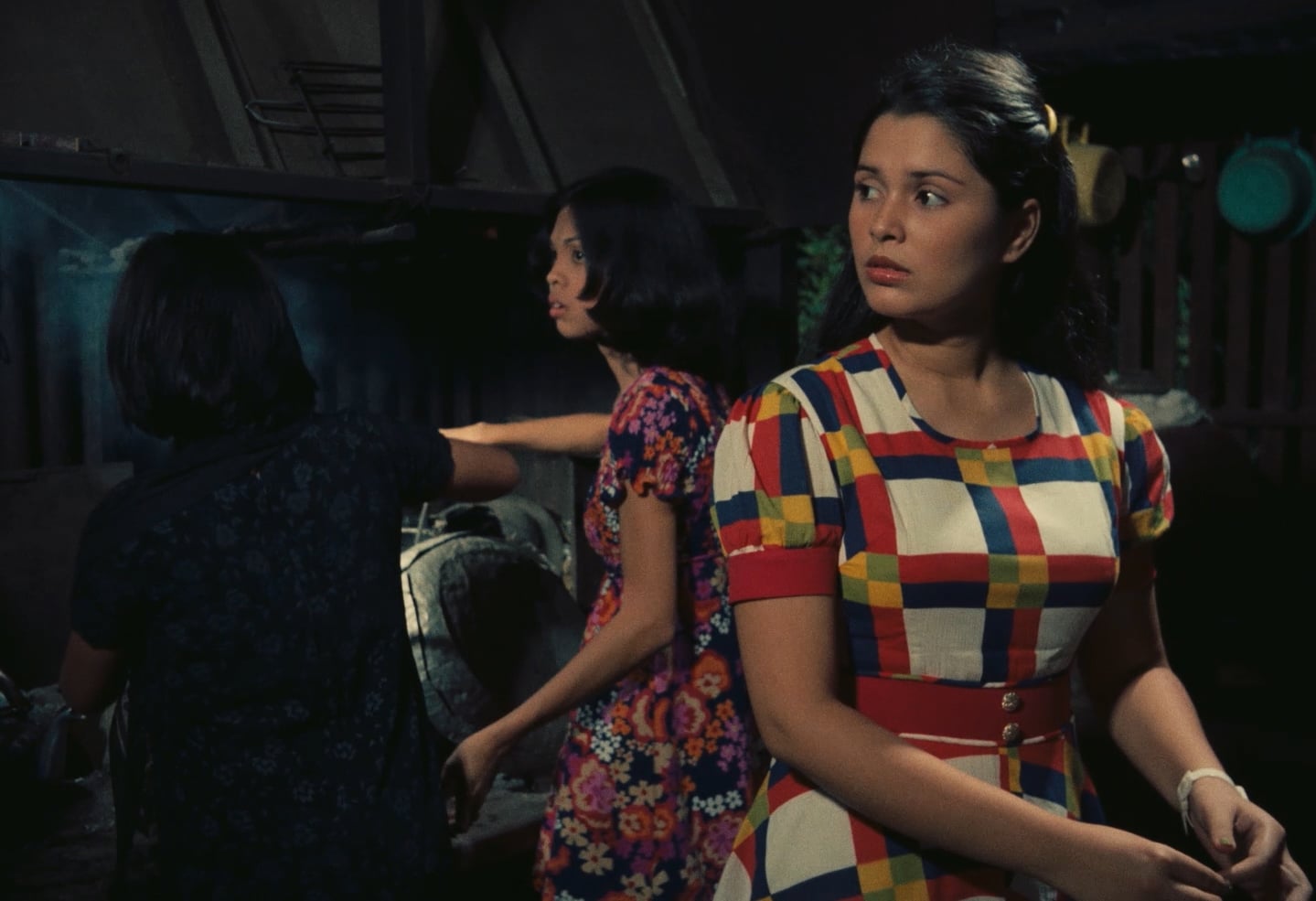
Class distinction, social ostracization, and the cruel hypocrisy of the elite also run through Weighed But Found Wanting (1974), another standout by Filipino master Lino Brocka, whose Bona (1980) made my Ritrovato ’24 highlight reel. A melodrama that sprawls wide and cuts deep, it follows Junior (Christopher de Leon), the privileged son of a philandering father and a meddlesome mother who rebels against the stifling hierarchies of his town by befriending two local outcasts—a leper and a mentally ill woman. Bookended by a forced abortion and a childbirth, the film’s attitude toward sexual consent in the context of disability is undoubtedly dated, but otherwise Brocka deploys his technical mastery with a thrilling moral clarity that transforms a soap-opera-sordid storyline into a resonant parable of power and complicity.
Mitchell Leisen was the subject of this year’s Hollywood-director retrospective, while festival-poster-girl Barbara Stanwyck also had a strand, curated by the great critic Molly Haskell, that showcased the star’s flinty charisma. It so happens I did a Leisen deep dive during lockdown, and was already aware that the undersung filmmaker had a much higher hit rate than his posthumous relegation to journeyman status suggests. Mind you, he also made an outright clunker or two: I knew, for example, to avoid Death Takes a Holiday (1934), a film so turgid it makes its widely panned 1998 remake, Meet Joe Black, seem pretty good by comparison. Conversely, I was disappointed that The Mating Season (1951), my second-favorite Leisen comedy (after his undisputed pinnacle, 1939’s Midnight) was not in the selection. Nonetheless, I got to fill some gaps with the creaky-but-fun Murder at the Vanities (1934), the warmly peculiar Darling, How Could You! (1951), and the terrific Stanwyck/Leisen noir No Man of Her Own (1950), all of which confirmed Leisen’s deft touch, especially with the performances of his leading ladies—a roster that came to include Claudette Colbert, Joan Fontaine, Carole Lombard, Olivia de Havilland, Jean Arthur, and Stanwyck.
Alongside Frank Capra’s Ladies of Leisure (1930)—only Stanwyck’s third starring role, and already she blisters the paintwork—most of the Classic Hollywood selection was enjoyable, but none passed the “did it make me forget how hot I was?” test as well as John Berry’s He Ran All the Way (1951). John Garfield is crazy good in his final role, playing a small-time desperado hiding out with a family of hostages after he’s conned the daughter (a heartbreaking Shelley Winters) into letting him take her home from a public swimming pool—as eccentric a location for an uncute meet-cute as has ever been seen in a hard-boiled noir. Garfield’s unrepentant, venal-yet-vulnerable performance makes him an electrifyingly odd kidnapper, matched by Winters playing up the ambivalence of a callow girl who is maybe in love with her captor, or maybe just conning him back.
You can average five films a day at this festival and still feel like a slacker. I managed to see only one title each from the Daisuke Itô and Juan Antonio Bardem retrospectives and did not overly care for the reclaimed French New Wave entry La Dérive (1964), directed by Paula Delsol, one of the few women directors in the lineup. But I loved the borderline-surreal shotmaking of Yuri Illienko’s A Well for the Thirsty (1965), admired the trenchant social realism of the Iranian restoration The Cycle (Dariush Mehrjui, 1974), and spent whole lunchtimes refreshing the booking home page, hoping in vain for a ticket to one of the other sold-out Ghatak screenings. It wasn’t to be, but the thing about this festival is that nothing you miss here is gone forever. I did not die at Il Cinema Ritrovato, and perhaps nothing does, because it represents a kind of movie afterlife, which is one reason attendees often refer to it as “cinephile heaven.” Even in years when it’s hotter than hell.
Jessica Kiang is a freelance film critic and a member of the Berlinale selection committee.
This story is part of the Summer 2026 issue of Film Comment.
By clicking Sign up, you agree to our site’s Terms of Service and consent to our Privacy Policy.
Get full access to Film Comment with a paid subscription. Already signed up? Log in.
Thank you for signing up for The Film Comment Letter.
Check your email to set up your account and get access to select articles, or become a paid subscriber for full access.