I Think We’re Alone Now
Disclosure Day, Steven Spielberg’s latest sci-fi opus, offers further evidence that you can't always go home again

Disclosure Day, Steven Spielberg’s latest sci-fi opus, offers further evidence that you can't always go home again
At the time of the making of Close Encounters of the Third Kind in 1977, Steven Spielberg, then 30, declared himself an “agnostic,” situating himself between those who believed in extraterrestrials on the one hand and those who did not on the other. But more recently he has, by his own admission, slipped into the believer category. The proof presumably is his new movie, Disclosure Day, which posits that extraterrestrials have been among us for some time, a fact known since the Roswell incident of 1947 to a secret government agency determined to keep the rest of us in the dark. The rationale behind the secrecy, which suits their experimental purposes, is that humanity isn’t ready for the revelation that we are not alone in the universe; it would presumably collapse all the foundational myths built upon our belief that mankind is unique, causing crises of faith and order. Heading up this biotechnology outfit named Wardex, begun under Richard Nixon, is the sleekly villainous Noah Scanlon (Colin Firth). Eager to blow the lid off the conspiracy is Daniel (Josh O’Connor), a cybersecurity expert and former employee of Wardex who has turned whistleblower and joined a rebel intelligence group run by Colman Domingo. Their anthem: the 70-year-old cover-up has to end… with full disclosure to the public.
Spielberg’s long-suppressed action/sci-fi muscles seem to have demanded a workout after his most recent film, The Fabelmans (2022), an incandescent family portrait of his childhood, his parents, and their marriage. Both dramedy and origin story, that film found the anxious young protagonist being led by his parents to his first movie, DeMille’s traumatic (for him) The Greatest Show on Earth (1952). One scene in particular reverberates through his boyhood—the violent clanging of an onrushing train. His scientist father may talk all he wants about persistence of vision, but the kid reacts like those early viewers of the Lumière brothers’ The Arrival of a Train at La Ciotat (1896) are said to have reacted. He doesn’t run for the exit, but it does give him nightmares. Afterward, and in stages, he plays out the scene with his own electric train, crashing and photographing it, thus setting the template for one of the most successful directorial careers of all time: that of resurrecting and playing out one’s fears in order to tame and exorcise them.
The new film comes at us like that onrushing train. Will some impressionable youth be so terrorized by the thunderous opening of Disclosure Day that he’ll need to find a way to re-create and subdue its impact? At first, there is just sound, an unplaceable deafening din, which turns out to be the slams and thwacks of pro wrestlers; the crowd cheers wildly, all is mayhem… and at the still center is an inert spectator with his eyes glazed over, O’Connor doing hapless as only he can. Daniel is grabbed from behind, then hauled into an anonymous shed and forced into a confrontation with government operatives over a memory key he apparently possesses. This, the film’s MacGuffin, is the secret file that will expose Wardex’s conspiracy. Daniel is concerned only with retrieving Jane (Eve Hewson), his girlfriend who’s been taken hostage. And so begins a noisy, intense, nonstop roller-coaster ride through Spielberg’s latest thriller, so extravagantly tumultuous that it makes E.T. (1982) and Close Encounters of the Third Kind look like modest independent films.
There are magic wands (well, fobs) by which to bend another’s mind, forest animals and birds that speak (well, convey messages), and high-speed car and train chases that are funny and scary at the same time. Except when they are just too much. Oh, and did I mention that Jane turns out to be a devout Catholic? She was a onetime novice in a convent run by a Mother Superior whose humanitarian impulse to accept the possibility of other beings underscores the theme, which might be encapsulated by E.M. Forster’s “Only connect!”
The film is sometimes its own worst enemy, so bombastic and overlong it almost obscures its very real charms: the cast, for one. O’Connor’s bright but befuddled mathematician is matched by a magnetic Emily Blunt as Margaret, a TV weather girl who becomes an improbable channel of extrasensory knowledge. Earlier Spielberg films veered closer to the headlines, sometimes to an uncanny degree—The Terminal (2004) touched on anti-immigration policies, Minority Report on surveillance and preventive detention, A.I. Artificial Intelligence (2001) on the enticements and terrors of the titular technology. Yet the new film may coincide with a more diffuse, all-purpose anxiety: with so many potential disasters on so many fronts, one that is actually knowable and traceable is almost comforting (it manages to eclipse a looming Korean missile crisis). Even those who don’t believe in extraterrestrials believe in cover-ups.
“The new film may coincide with a more diffuse, all-purpose anxiety: with so many potential disasters on so many fronts, one that is actually knowable and traceable is almost comforting.”
The Fabelmans are not forgotten. Blunt’s character could be Mitzi, the show-off mother played by Michelle Williams in the 2022 film. When we first meet her, Margaret’s a chatterbox, a feverish, discontent, frustrated diva—like Mitzi, who “always [has] to be the center of attention.” She’s venting nonstop to her musician boyfriend (an engaging Wyatt Russell); she wants to move upward and outward from this nowhere station in Kansas City. Suddenly, she is stilled by the sight of a cardinal: something is being transmitted. She begins speaking in Russian, then other languages. As she’s rushing to the studio, a cop pulls her over, and she ducks a ticket when she discovers she can penetrate his mind and know what’s troubling him. At the station and on-air, she begins stuttering in a language that, like the tune in Close Encounters, is understood by the aliens—and, in this case, their imprisoners, who immediately organize a militia to go after her.
Margaret’s vessel of empathy—which, seen as an evolutionary advantage, becomes the driving emotional force of the film—was Mitzi’s as well; it was Spielberg’s mother, a concert pianist, who understood the artistic impulse in her son, while his science-obsessed father derided it as a hobby. Indeed, math-whiz Daniel comes off as an avatar of Burt (Paul Dano), the nerdy, tech-genius patriarch in The Fabelmans. Margaret is the yin to Daniel’s yang: gender stereotypes, perhaps, but also classic opposites. And O’Connor is the fish-out-of-water character we’ve come to know in the Spielberg surrogates, representatives of his own agony as a Jewish outsider in WASP enclaves. The touchstones of Spielberg’s childhood (and his cinema) are all here—but caught up in the film’s relentless momentum, they feel more symbolic than real. Charismatic as Blunt and O’Connor are, they are dwarfed by the landscape, like figures in a giant board game.
There are familiar themes in Disclosure Day, and familiar weaknesses as well. Daniel and Margaret’s respective partners are treated as plus-ones with almost no backstory. Although Jane will become crucial to the plot, when it emerges that she is a devout Catholic, Daniel seems as surprised as we are. And Margaret’s musician boyfriend must play the role of befuddled earthling, eventually left by the wayside (literally, at a gas station) while Margaret surrenders to her mission. The screenplay is by the commercially reliable if impersonal David Koepp (co-writer of 1993’s Jurassic Park; 1997’s The Lost World: Jurassic Park; 2005’s War of the Worlds; and 2008’s Indiana Jones and the Kingdom of the Crystal Skull), which may account for a certain hollowness at its core, the absence of that child’s sense of wonder so intrinsic to the Spielberg magic.
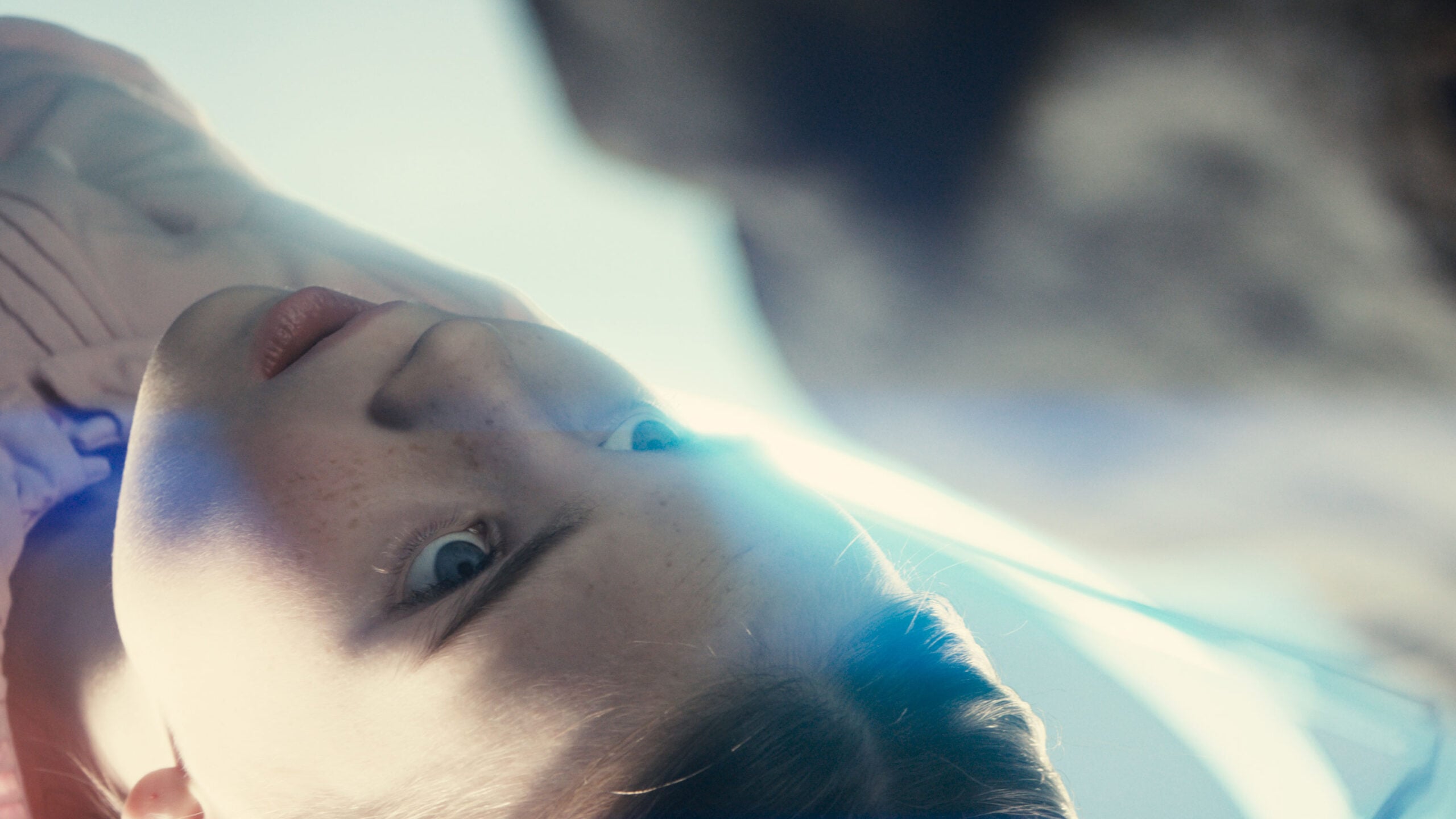
Crucial to his project is the importance of home, of being dispossessed and finding one’s way back. Here it’s Margaret who must, under the guidance of Domingo’s Hugo, return to her own childhood and confront the moment that set in motion the chain of events that led her here. Early on, we’ve been introduced to Hugo’s “office,” a movie set with lighting, props, and cameras, where the all-knowing director gives orders to his operatives and coordinates their moves. This strange, jerry-rigged environment, a copy of Margaret’s old bedroom, seems inescapably physical yet also metaphoric: a doll’s house for the retrieval of associations and images. Janusz Kamiński’s cinematography exquisitely captures an ambiguity—is this happening in the story’s observable reality, or is it in some imaginative realm?—that runs throughout the film. Spielberg and his cameraman are masters at giving us widescreen spectacle and small-screen intensity. Signature moments are crowd scenes where people, transfixed in one way or another, and because of the precise distance between them, can seem both together and isolated.
But somehow the parts don’t quite cohere into a whole. Despite a team of technicians whose credits go on interminably at the film’s end, the VFX is disappointing. As the film nears the end of its two-and-a-half-hour runtime, the climactic revelation is both murky and disappointing. And do extraterrestrials still have to be the squiggly stick figures with oversized heads of ’50s black-and-white fantasies? Haven’t they been around long enough to acquire a more expressive look, to speak in an oracular but comprehensible tongue? And if they’re so much smarter than we are, representing a higher power, you’d expect them to meet us halfway—or be on a mission to annihilate us trigger-happy earthlings, instead of letting their kind suffer at our hands. If Spielberg has anything to do with it—and surely if anyone will be in their good graces, it is he—they will at least give us a hearing.
Lately, Spielberg’s name seems to conjure up the beatific notion of a movie theater filled with people of all ages, all laughing at the same jokes, gasping at the same terrors, crying at the same agonies. That phantom of audience unity was a myth even before “business model” algorithms began to create horizontal slices of the populace based on age, gender, and even ethnicity. When Spielberg and Lucas came along, with them was born the multiplex and the blockbuster, and the lavish fantasy addressed to the putative kid in all of us; we who in the ’70s watched these spectacles put the brakes on indie filmmaking experienced them differently than later moviegoers. When and if you came to admire or love Spielberg (and even which films you love) may have everything to do with your age and gender. Still, Spielberg has more than survived the test of time. In the lead-up to Disclosure Day, the internet bubbled with fans and critics listing their selections of the 10 or 20 (or however many) Best Spielberg Films. For what it’s worth, mine are A.I., Empire of the Sun (1987), Catch Me If You Can (2002), and The Fabelmans. So call me an agnostic who veers, from time to time, into believer.
Molly Haskell has written for many publications, including The Village Voice, The New York Times, Ms., Saturday Review, and Vogue. She is the author of Steven Spielberg: A Life in Films and From Reverence to Rape: The Treatment of Women in the Movies.
This story is part of the Summer 2026 issue of Film Comment.
By clicking Sign up, you agree to our site’s Terms of Service and consent to our Privacy Policy.
Get full access to Film Comment with a paid subscription. Already signed up? Log in.
Thank you for signing up for The Film Comment Letter.
Check your email to set up your account and get access to select articles, or become a paid subscriber for full access.