Future Shock: Toy Story 5
The latest entry in the long-running Pixar franchise features typically spectacular animation, but pulls its punches in its critique of the tech industry
The latest entry in the long-running Pixar franchise features typically spectacular animation, but pulls its punches in its critique of the tech industry
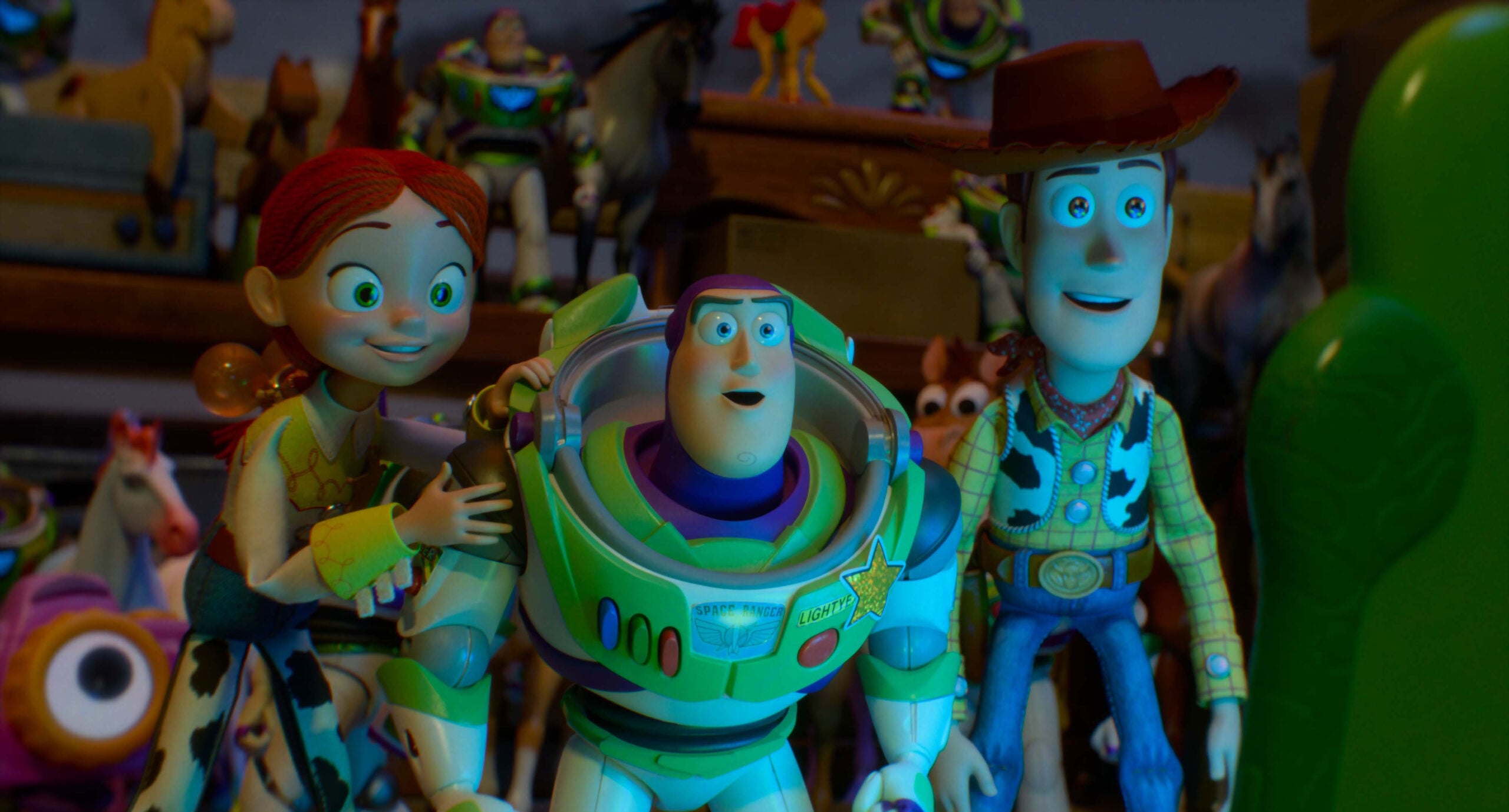
As long as life presents new and petrifying existential crises, there will be Toy Story sequels to help us cope with them. I say that with the profoundest gratitude, even if the latest seems a bit reluctant to bite the hand that funds it. The 1995 original, which launched not only Pixar’s flagship franchise but also the era of computer-animated cinema, allegorized every older sibling’s fear of replacement by surprise household additions. Later entries dealt with separation anxiety, the heartbreak of one-sided devotion, and the question of when to put one’s own needs ahead of the mission. The fourth and least essential installment, released in 2019, introduced us to Forky, a neurotic plastic spork who is convinced he’s trash and determined to throw himself away despite the pleas of his friends (a crisis that’s taken about as far as you’d expect in a family-oriented Disney tentpole).
Now, the series gives us analog angst in the age of A.I.—a concern it tries to allay while repeatedly waffling on technological dependency, like a loving parent afraid to take too strong a position. Child-protagonist Bonnie, who’s aged from about 4 to 8 in the 16 years since Toy Story 3, acquires Lilypad (read: iPad), a frog-themed tablet that immediately hijacks her attention and puts her support network of secretly sentient toys out of business. Intrepid cowgirl-doll Jessie (voiced by Joan Cusack), the sheriff of the playroom since Woody’s de facto retirement, has been outgrown or discarded by two prior owners, and the dread of losing Bonnie to a smug touchscreen of dubious intent brings out her inner Luddite. Together with her tongue-tied admirer Buzz Lightyear (Tim Allen, given more to do than in Toy Story 4) and the weatherworn but eternally on-call Woody (Tom Hanks, given much less), she resolves to free Bonnie from Lily’s algorithmic clutches and find her a worthy human friend.
Director Andrew Stanton, whose WALL-E (2008) lobbed the most scathing critique of dehumanizing tech ever released by Disney’s multimedia empire, seems at first to be in a comparably subversive mood, as Jessie condemns digital gadgets for ruining childhood by replacing unbridled creative play with robotic button-pushing. But the aughts are long over, and these days you can go only so far in a film destined for endless looping on smart devices (indeed, Amazon has already tried to sell me a Lily-inspired iPad case). Toy Story 5’s noncommittal takeaway is that tech reinforces social hierarchies already in place, but in the right hands, it can also bring an end to loneliness and isolation. Tablets don’t alienate people; people alienate people.
The animation, of course, is breathtaking: note the texture of the little girls’ hair, and compare the photorealistic pet pig Jimmy Dean with Scud, the blocky bull terrier from the first film. Though Toy Story 5 sometimes suffers from a variant of Wes Anderson Syndrome (cramming the frame with too many characters for most to leave a lasting impression), and Lily is an underdeveloped foe, there is at least one newcomer, named Smarty Pants, worthy of the pantheon. Casting Conan O’Brien as a potty-training aid who looks like a Fisher-Price toy from the ’80s but somehow has Wi-Fi capabilities might be Disney’s wildest gambit since Jemaine Clement voiced a tricked-out, Bowie-channeling giant crab in Moana (2016). Now as then, the comic payoff is immense. But the film’s masterstroke is making supporting cast–MVP Jessie its heroine. In contrast with the last entry’s misguided decision to counter all the male energy by turning easygoing Bo Peep into a pragmatic porcelain Wonder Woman, Toy Story 5 takes its plucky, openhearted rag doll and deepens her character without betraying her essential nature. Someday, someone will earn an Oscar nomination for voice acting alone, and in a fair world, that someone would be Joan Cusack next year.
For my own part, I was 10 years old when the franchise debuted, and my first foray onto the internet was at a friend’s home, prompted by a magazine ad urging us to “click into cyberspace with Buzz and Woody!” My first tears at any movie came at the distressingly late age of 25, in response to the last three words spoken by Woody to his favorite deputy Andy as the college-bound teen leaves childhood behind (inarguably the finest line reading of Tom Hanks’s career). I’ve seen the tales presented on ice, at sea, and in every conceivable format. Watching the fifth installment, older than Hanks was when he recorded dialogue for the first, I can’t help but feel that the series is stealthily addressing the ultimate anxiety. At least four of the voice actors in Toy Story 5 are soundalike replacements for cast members who’ve passed on, and many of the others are distinctly grizzled. Woody, like countless of us former buckaroos, is balding and out of shape. Yet the film, like each of its predecessors, finds our steadfast collective facing off against the menace of the day, quelling their fears of obsolescence, and discovering their strings still have a bit of pull left in them. Perhaps those of us who loved the saga when it was brand new are no longer flying with abandon. But there’s a lot to be said for falling with style.
Steven Mears is the copy editor for Film Comment and is a contributing writer to the magazine. His work has also appeared in Metrograph’s Journal, Bloodvine, Field Notes, Galerie, and other publications.
This story is part of the Summer 2026 issue of Film Comment.
By clicking Sign up, you agree to our site’s Terms of Service and consent to our Privacy Policy.
Get full access to Film Comment with a paid subscription. Already signed up? Log in.
Thank you for signing up for The Film Comment Letter.
Check your email to set up your account and get access to select articles, or become a paid subscriber for full access.