Full Spectrum: I Love Boosters
Boots Riley’s latest eye-popping caper makes magic out of Marxism
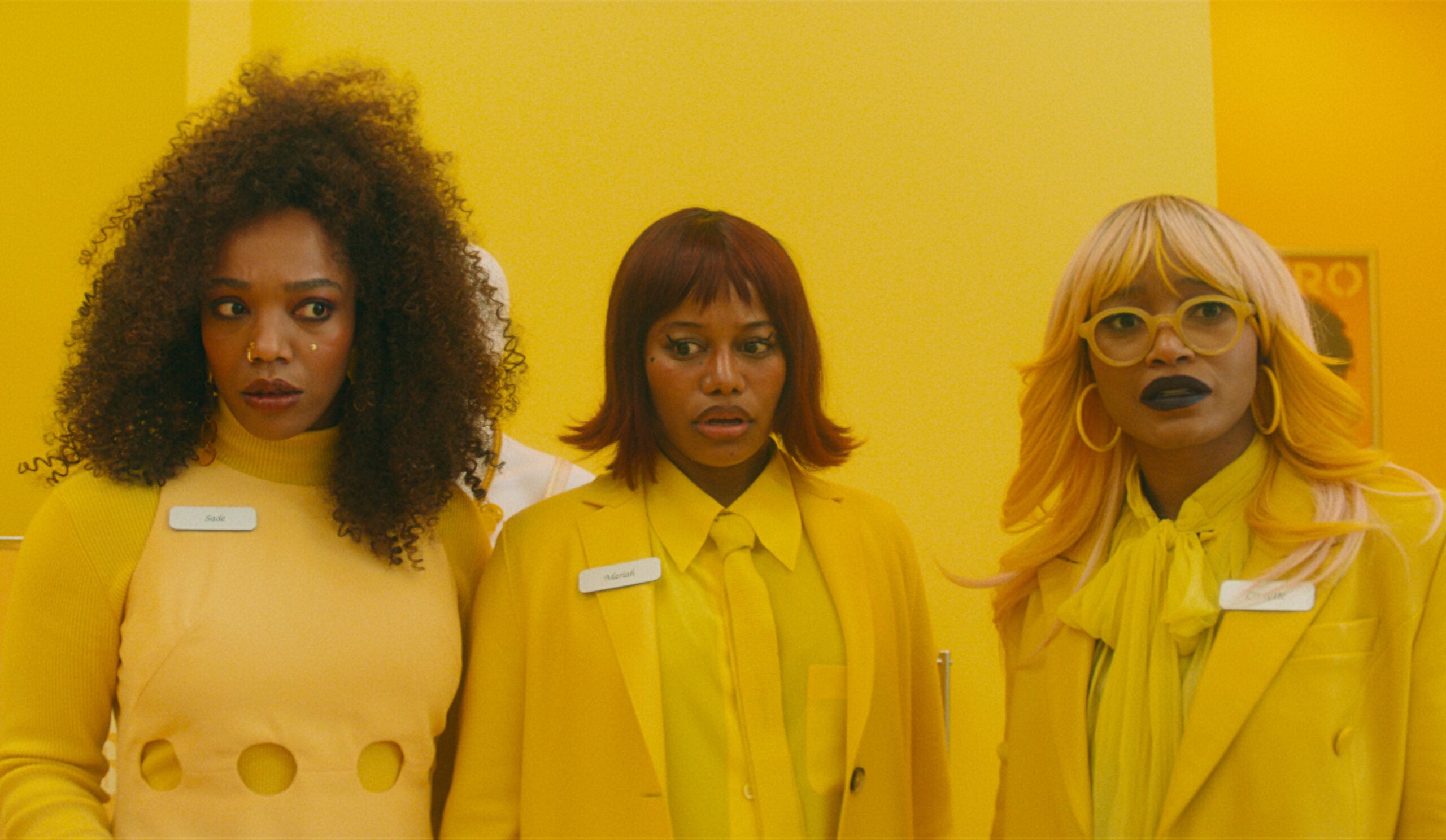
Boots Riley’s latest eye-popping caper makes magic out of Marxism
It is a truism in edit rooms and feedback sessions that the beginning of the film teaches the viewer how to watch the rest. Its form, its style, its methods of building tension and release, and the kind of attention it demands are all announced. This is often summed up as “the rules.” Anything is possible until the first image shows up. Then an agreement is reached with the viewer, and possibility declines toward probability. Both Terry Gilliam’s Brazil (1985) and Michael Haneke’s Caché (2005) feature television screens in their opening images, but no viewer would watch the latter and anticipate any elements of the former. In Brazil, the camera pulls back to reveal a holiday display in a department-store window, with the pseudo-kitsch of a heating-duct advertisement splashed across several TVs. A bomb goes off after 30 seconds. The demanding, static image of a Parisian street that Caché opens with tells us right away that it will take quite a bit longer for Haneke to detonate his bomb.
As Sorry to Bother You (2018) and I’m a Virgo (2023) showed (and I Love Boosters confirms), Boots Riley works against the grain. His first feature begins with Cash (LaKeith Stanfield), down on his luck and in need of a job, seeking employment with a telemarketing firm. The world he lives in is not unlike ours, only a little louder, more color-coordinated, and more literal: to represent the telemarketer’s intrusion into our lives, Riley puts Cash in the same room as the people he calls; to capture the code-switching tacitly demanded by the job, he has Cash speak to telephone prospects in the “white voice” of David Cross. The punch lines work because they’re only a few steps beyond what is expected. But bit by bit, they expand the film’s limits until it nearly bursts. Riley’s films are maximalist not only because they are loud, zany, and brightly colored, but also because he seems to ask, at every moment, “what else can we add in?”
Maximalism is a high-wire act. The pleasure and risk derive from the same source, which, over time, creates an escalatory ladder. It is hard enough to walk a tightrope. By the golden age of funambulism, performers captured attention by taking increasingly audacious risks, from acrobatics to sitting down and cooking breakfast over the Niagara Falls. Asking what else we can add in is the natural course for attractions, but the unspoken understanding is that the audience is there to see how far is too far. People watch skywalks because someone might plummet to the earth. Maximalists openly display the possibility of failure, and success only demands that even more be done next time. Sorry to Bother You unfolds for much of its runtime in the tradition of the turn-of-the-millennium anti-work movies like Office Space, The Matrix, and Fight Club—all of which ended with, if not quite marriage, then at least an affirmation of romantic love. But Riley’s film swerves dramatically from that template—and from its own definition of reality—the moment that Cash walks into the wrong bathroom at his boss’s house during a party, and a shackled man-horse hybrid stumbles out of a stall begging for help.
Well-known filmmakers can only really pull off that kind of trick once. Thereafter, the audience knows to expect something, even if it’s not quite sure what that is. I Love Boosters solves the problem by introducing its fantastic and outlandish elements from the start. Its bright, hard-edged blocks of color, reminiscent of the comic-book style of The Fifth Element (1997) or Amélie (2001), are so recognizably unrealistic that we know right away this world is not only heightened, but other than our own. Social relations, however, remain the same. Corvette, played by Keke Palmer, squats in an abandoned chicken shop and makes money by boosting, or stealing expensive clothes to resell later. She is a frustrated designer who, in different circumstances, would be the one making the items she steals. Christie Smith (Demi Moore), the woman behind the brand Corvette and her accomplices target most often, is the person Corvette thinks she wants to be: successful, fashionable, and unbothered by bills and eviction notices that gather enough mass—in a recurring visual gag—to rival James’s giant peach. [Ed. note: the rest of the piece delves in some detail into everything else that Boots Riley does add in. Readers who prefer surprises are advised to proceed with caution.]
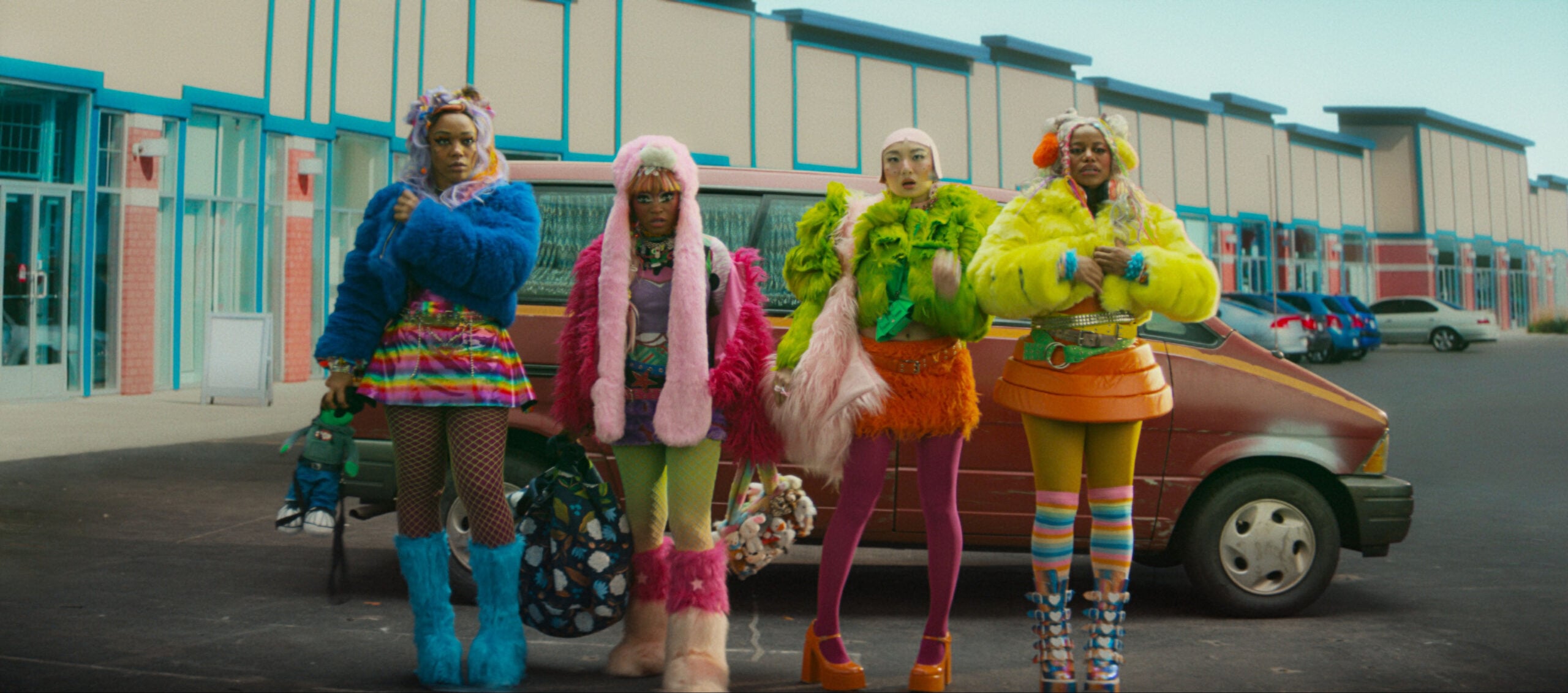
Christie, who declares a manhunt to find the “urban bitches” behind the shoplifting spree, has no idea that the ringleader is one of her greatest admirers and, eventually, an employee at one of her brand’s stores. Corvette knows that this nine-to-five won’t do much to solve her financial problems, and only takes the job so she can better plan a heist. She and her gang—including Sade (Naomi Ackie) and Mariah (Taylour Paige)—are all searching for a way out of the desperate straits of their class position. I Love Boosters identifies two central impediments: the balance of power in capitalist society and the psychological identification of the poor with the wealthy. Corvette is unimpressed by the pyramid scheme run by a self-help scammer (Don Cheadle, in heavy prosthetics as a sign of things to come) that has recruited Sade, with its list of billionaires at the top (Bill Gates, Elon Musk) and promises that you, too, can exploit others enough to reach the grand prize: $12,000.
One has to assume that Musk and Gates have long since forgotten what that amount of money even means to most people. But until Christie steals one of Corvette’s designs, our heroine can’t see that she, too, has been ensnared by a similarly shaped scheme, wherein respect, power, and profit all funnel capital toward the top. Her own love of fashion prevents her from conceiving that a métier that requires dedication, belief, and talent, and that produces glamour, beauty, and perhaps even rapture, relies on the exploitation of disrespected and disavowed workers—typically in the Global South—who are never allowed near the spotlight’s rim when the artist is honored.
The only way out, in the end, is for the Chinese working class and the Black American working class to unite via a machine that is at once a teleportation device and a Ghostbusters-like ray gun, though instead of wrangling ghosts it “heightens the contradictions.” For a certain segment of the audience (for example, the one with whom I watched Raoul Peck’s The Young Karl Marx, leaning forward in giddy anticipation when the eponymous thinker drunkenly slurs that philosophers have hitherto only interpreted the world rather than changing it), this moment will be the most satisfying laugh line. In a $20 million movie, dialectical materialism is both explained and deemed necessary to the salvation of humanity via its eventual culmination in a general strike. Recognizing that each is suffering from the fundamental capitalist contradiction between collective labor and individual profit, Chinese workers in garment factories and American retail workers organize in order to attack the vulgar spectacle of the fashion show in tandem, and thereby correct the course of a grim future. To say, again, that Riley is a maximalist is simply to say that all of this happens while LaKeith Stanfield’s character lurks around the edges pursuing a romantic relationship with Corvette, who loses interest when she learns he is an ancient bisexual demon whose preternatural skill at oral sex results in climax as well as the loss of his lover’s soul. That is one way to go from backflips to cooking an omelet above a gorge.
Riley is outraged and loves the outrageous. His style is comic, but not exactly satirical. His films show more concern for their utopian elements than their dystopian ones, in part because the latter need little elaboration. Save the fantasy: what is wrong in his world is wrong in ours, and broad comedies are not the place to draw fine distinctions among, say, the various factions of the capitalist class. Their inhumanity is clear in what they are willing to do to workers’ bodies (turn them into half-horse hybrids in Sorry to Bother You) and their own (shed their skin in I Love Boosters). These are all sight gags. The metaphor of stop-motion-animated think-tank employees literally sloughing off their skin and pulling on other (typically Black) skin-suits in order to popularize reactionary positions on television makes “astroturfing” sound like a prudish euphemism for the discursive distortions of American politics and media.
“Riley is outraged and loves the outrageous.”
While Riley loves to skewer the enemies of the working class, his films take greater delight in organizing and rebellion. In Sorry to Bother You, union organizers played the part of traveling gunslingers. In I’m a Virgo, the protagonist—a comics-obsessed, 13-foot-tall teenager—learns that no superhero worth the name would spend so much time aiding the police when the law is what people need protection from. In I Love Boosters, Marxism is the secret power that can enable the exploited to return health to their bodies and cast off their oppressors. In terms of similarly sized movies that spend a fair amount of time making jokes about oral sex, this is a long way from American Pie (1999).
There are always haves and have-nots in Riley’s worlds. In spite of the body humor, at once bizarre and nightmarish, the movies are fairly classical in form: they have a hero and his or her call to action, stumbling blocks, change, and ultimate victory. Only here, the transformation the hero undergoes is the development of class consciousness and engagement with an organized left. Sorry to Bother You landed in 2018 in the midst of a decade marked by a resurgent labor movement and uprisings and protests against inequality, police brutality, and racist immigration policies. Its flamboyant call to arms (to both unionize your workplace and take direct action) was partially drowned out in popular memory by its pithiest joke: that in order to make more money, Cash adopts a “white voice.” A mentor figure, Langston (Danny Glover), tells him just to do what he does “when you’re pulled over by the police.” Formally, the gag is one that has existed since the advent of the talkies: an expected sound is replaced by an unexpected one. Stanfield’s mouth moves, but David Cross’s voice comes out. Cash is quickly promoted. In I Love Boosters, Mariah has developed the ability to hold her breath and so appear to have fairer skin, thus enabling her to steal with ease. The money isn’t good enough in either case. Passing pays, but only for a time.

Riley is no neorealist in either style or worldview. He spends no time showing us how the poor might, through economic and spiritual degradation, be pushed to burglary as the last and only resort. I Love Boosters takes for granted that property is theft. Boosting is merely redistribution. Historically, it has been quite difficult to get movies like this made, even long after the Hays Code expired. Materially, it helps to have a star who wants to play the role of a working-class hero. Aesthetically, it helps to have a star who can carry a film being pulled in so many directions with the grace of Keke Palmer. Palmer has been a famous actress since she was a child—which, as evidenced by many cases, does not always translate to continued success as an adult. But in role after role, she has displayed the charm, presence, and comedic intuition necessary to ground the outlandish, while exaggerating the commonplace. That she can make didactic discussions of dialectical materialism sound easy and colloquial is perhaps just the skill one ought to expect of actors—to make the unnatural natural. But it is difficult to produce both goofiness and gravity. Riley demands it of her here—as did Jordan Peele in Nope (2022)—and she rises to the occasion, anchoring a movie that depicts the death of her character’s father by way of a coin moving so fast it pierces his head like a bullet.
In one moment, as Corvette tries to walk up the ridiculously canted floor of Christie’s high-rise apartment, her legs spin beneath her like the Road Runner’s. It is a throwaway joke, but a useful one. Riley is clearly intrigued by the comedic possibilities inherent in the racialization of ways of talking, moving, and appearing. The cartoon-like quality of the film completes a circuit. In 1933, the groundbreaking Betty Boop short Snow-White featured an astounding sequence wherein Koko the Clown is transformed into a ghost while singing and dancing to “St. James Infirmary Blues.” His sinuous slides are rotoscoped renditions of Cab Calloway’s moves, which give way to the ever-more-extraordinary acrobatics made possible by animation. The movement of Black performers set the baseline for the fantastic in the golden age of animation: if Calloway can move like this, imagine him without the impediments of gravity and anatomy! Jazz, juke joints, and the like were already otherworldly to the mainstream of American culture, being at once desired and denigrated just as their creators were. Many decades later, Palmer is unbound by the dictates of reality too, but now it’s a capitalist, instead of a queen, who must fall.
The American left is awash in losses. When it is not angry, it is elegiac. Riley’s mode is ecstatic, exploding beyond its own container. His most provocative conceit is the one animating both of his feature films, as well as his TV show: what if the left actually won? Vengeance might be joyful, or even funny. But there is something doleful in this provocation. In our world, there are great barriers preventing universal working-class solidarity. There are, however, opportunities. When hegemony decays into mere domination, it engenders reaction. Corvette does not want to overthrow Christie at first, she just wants in. It is Christie’s pursuit and exploitation that drives Corvette right into the arms of a nascent labor struggle. Riley has the American and Chinese working classes unite by recognizing that they are on the same side of the contradiction; the trouble in our world is that American workers are victims of exploitation as well as beneficiaries of a system even more brutal to workers beyond their country’s borders. I Love Boosters solves this with tools we don’t have. We do not have teleportation devices. We do not have recourse to fantasy. It would take great power to unite retail workers and garment workers. It would take great power to remake the world anew. We cannot flip a switch and heighten the contradictions. But even without all that, we still have what they have. It’s not magic; it’s Marxism.
Blair McClendon is a writer, editor, and filmmaker. He lives in New York City.
This story is part of the Summer 2026 issue of Film Comment.
By clicking Sign up, you agree to our site’s Terms of Service and consent to our Privacy Policy.
Get full access to Film Comment with a paid subscription. Already signed up? Log in.
Thank you for signing up for The Film Comment Letter.
Check your email to set up your account and get access to select articles, or become a paid subscriber for full access.