Zidane: A 21st Century Portrait
The immersive 2006 documentary brings the viewer onto the pitch through close observation of one of the game’s most compelling figures
The immersive 2006 documentary brings the viewer onto the pitch through close observation of one of the game’s most compelling figures
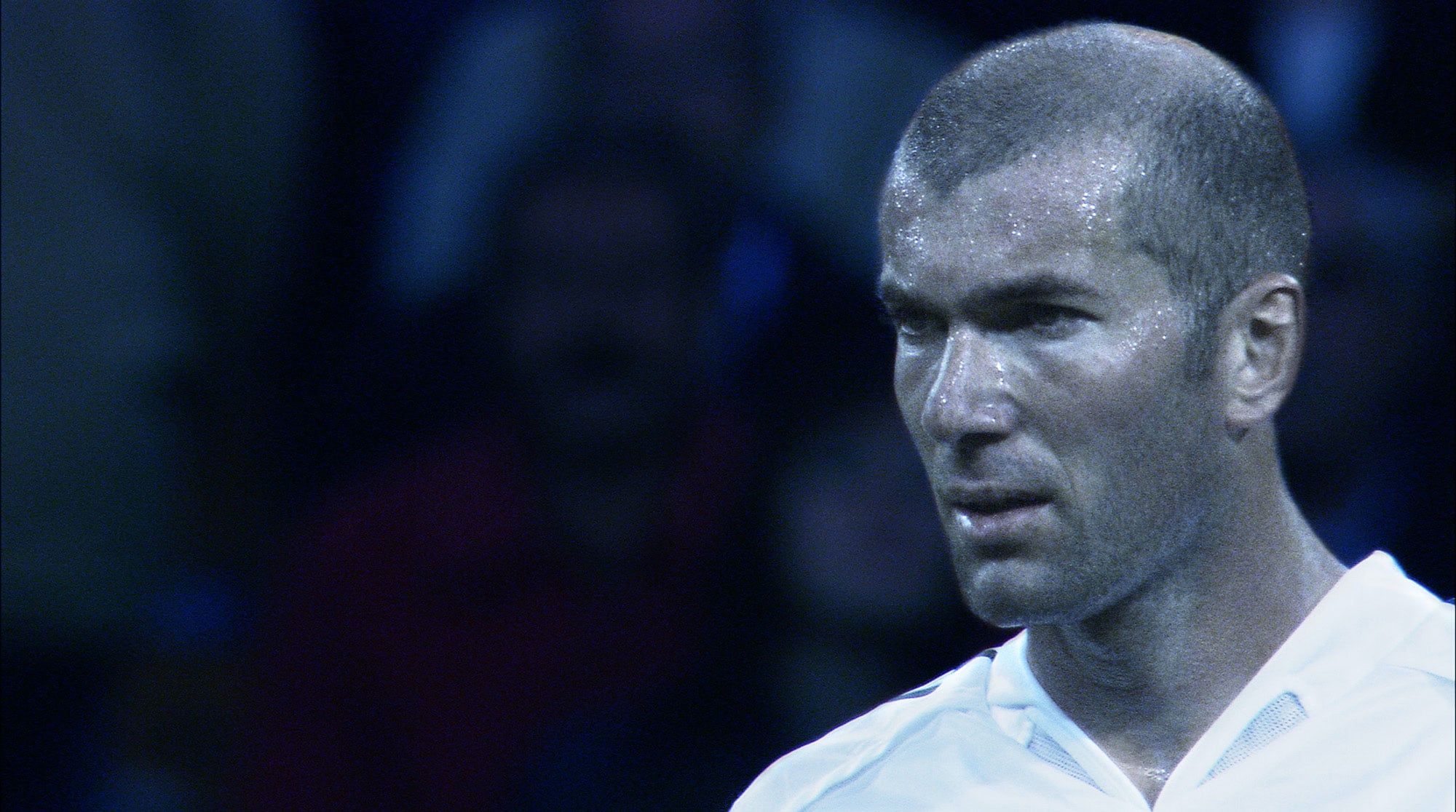
If you can’t afford the preposterous price of admission to a World Cup match at MetLife in New Jersey but still want an immersive soccer experience this summer, the Guggenheim might have you covered. Zidane: A 21st Century Portrait (2006), one of the most stunning films made about the sport, will be screened on a continuous loop during regular museum hours in the Peter B. Lewis Theater from June 11 to July 19; the screening commemorates both the start of the 2026 World Cup and the film’s 20th anniversary.
A collaboration between Scottish artist Douglas Gordon and French artist Philippe Parreno, the documentary premiered in a single-channel version at the 2006 Cannes Film Festival, before the two-channel video installation was acquired by the Guggenheim. The film, assembled from footage captured by 17 synchronized cameras placed around Madrid’s Santiago Bernabéu Stadium during a match between Spanish Premier Division teams Real Madrid and Villarreal on April 23, 2005, exclusively tracks the legendary French-Algerian footballer and Real midfielder Zinédine Zidane, who was, at that point, one of the sport’s most compelling stars.
Unfolding in real time across the entirety of the match, the film occasionally offers glimpses of the superstar’s on-ball brilliance: a backheel pass, a sudden shimmy into space, a bursting sprint into the box. The film’s transcendental power, however, lies in the moments when we see Zidane simply observing, waiting. Like most players, he spends much of the match off the ball in a state of anticipation—gliding across the pitch at a slow trot and studying the ball and the opposition’s movement, all of which escapes our view. The longer we watch him, the more his habits and idiosyncrasies emerge: tugging at his socks whenever play stops, dragging his right boot across the grass every few steps. Over time, the film’s hypnotic rhythms wash over us—the dreamlike, droning score, composed by Scottish post-rock band Mogwai, certainly helps to lull the viewer into a trance—and the film transforms the live spectacle of the game into a concentrated portrait of an individual at work.
Shot on lustrous 35mm by Oscar-nominated DP Darius Khondji, the film frequently lingers, under sparkling stadium floodlights, on Zidane’s brooding gaze. He smiles only once; even after setting up a goal for fellow superstar Ronaldo with a perfectly weighted cross—here, Gordon and Parreno cut to a wide angle—Zidane remains stoic while his teammates celebrate around him. Near the end of the match, a brawl breaks out, and Zidane—after being restrained by his teammate David Beckham—is ejected from the game, bringing the film to a close. It’s ominous to watch Zidane’s intensity up close; he rarely expresses any emotion, which makes his eruptions all the more surprising (his notorious headbutt happened after this match during the 2006 World Cup finals).
The film does not provide any explanations for his anger or his genius. Famously a man of few words, Zidane was interviewed by Gordon and Parreno for the film; excerpts occasionally appear as on-screen text. Depending on your taste, these reflections might come off as either highfalutin or aphoristic (one reads, “Sometimes magic is close to nothing at all”). But explanation is beside the point; it is enough to watch Zizou’s elusive profile in long-lens, his bald spot shining with sweat, his majestic figure enveloped by the sounds of ambient guitar and the restless hiss of the spectators. By fixating on one person on a pitch over the course of 90 minutes, Zidane: A 21st Century Portrait reminds us of something elemental about both football and cinema: the stunning and simple beauty of a body moving through space, and the dramatic tension of observation itself.
Samuel Brodsky is a Chilean writer and filmmaker based in New York.
This story is part of the Summer 2026 issue of Film Comment.
By clicking Sign up, you agree to our site’s Terms of Service and consent to our Privacy Policy.
Get full access to Film Comment with a paid subscription. Already signed up? Log in.
Thank you for signing up for The Film Comment Letter.
Check your email to set up your account and get access to select articles, or become a paid subscriber for full access.