Teo Hernández at MoMA
A new series presents the Mexican experimental filmmaker’s lyrical portraits of bodies in space
A new series presents the Mexican experimental filmmaker’s lyrical portraits of bodies in space
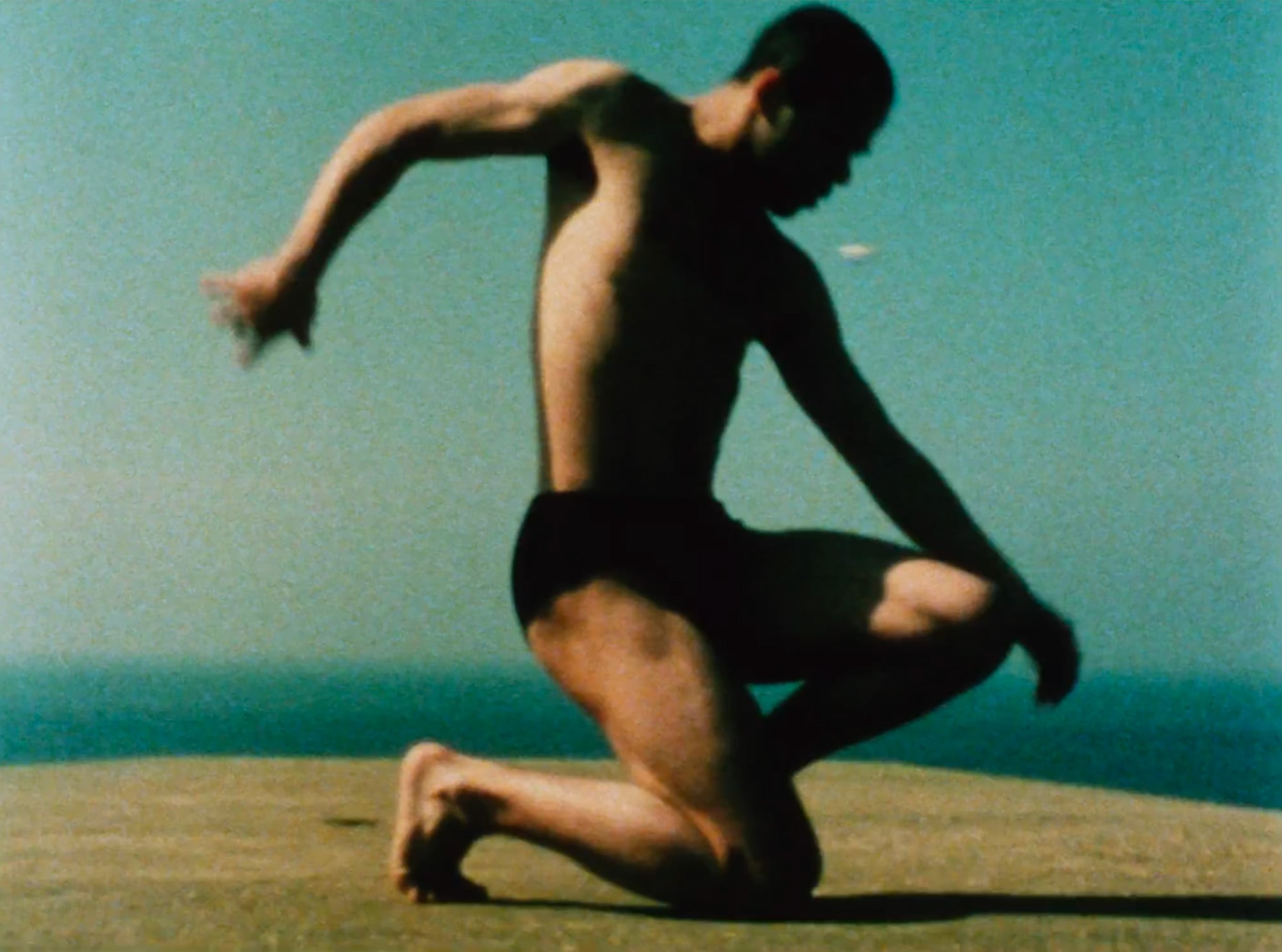
Between 1968, when he completed his first film in Paris, and 1992, when he died at the age of 52 due to AIDS-related complications, Teo Hernández made over 150 films. This body of work, which he conferred to his partner, the artist Michel Nedjar, survives at the Centre Pompidou and is shown infrequently outside of France. Kicking off on May 14 and running through May 26, The Museum of Modern Art’s retrospective, “Teo Hernández: A Pomegranate Orchard and the Bitter Well,” is a welcome exception. Across 12 programs, the series will showcase 19 of Hernández’s films—inimitable flurries from an itinerant life spent testing the limits of cinematic representation—alongside a selection of works from his collaborators, the members of the short-lived MétroBarbèsRochechou Art Collective.
Hernández, whose work could be described as small-gauge baroque, is recognized today as one of the most important experimental filmmakers from Mexico—a curious notion, considering that he made most of his films in France, where he spent the latter half of his life in self-exile. He was born in 1939 and grew up in Ciudad Hidalgo, Michoacán, in a militantly religious environment (a result of Michoacán’s fierce defense of Catholicism during the Cristero War of the late 1920s). That Hernández was gay was unacceptable to his wealthy, conservative family; that he wanted to be an artist, doubly so. So, in 1965, after a brief stint in Mexico City during which he co-founded the nation’s first independent film group with his friend, Antonio Campomanes, and stops in San Francisco and London, Hernández made his way to Paris.
In France, he became associated with “L’École du corps,” a loose group of experimental filmmakers that included Maria Klonaris and Jakobois, among others. As the name implies, their films dealt graphically with sexuality and the politics of the human body, and were mostly filmed on Super 8, a format that offered intimacy and control. Although Hernández objected to the “L’École du corps” label, works like the emotionally and sexually uninhibited Un film provocado por (1969) and the tranced-out dance film Pas de ciel (1987) share a clear affinity with those made by MétroBarbèsRochechou Art Collective members Gaël Badaud, Michel Nedjar, and Jakobois. Their work, like that of Hernández, depicts leisurely strolls, erotic encounters in parks and on city streets, and hangouts with friends—in other words, the lives of artists devoted to finding their own ways of moving through the world.
The immediacy of shooting on 8mm and Super 8 allowed Hernández to mount small-scale productions of epic stories like the life of Jesus and Oscar Wilde’s Salomé. His work moves from the mythic to the mundane, often making use of costumes that evoke the idols seen in Kenneth Anger films and using his technical wizardry to transform outtakes from everyday life into quasi-lysergic visions. Hernández’s films move at a spellbinding speed, characterized by rat-a-tat-tat poetic montage, an exquisite control of light, and an openness to interventions from the world outside the putative narrative. Open to change at every second, his works exist at the crossroads of fiction and documentary, improvisation and premeditation. This fluidity is their magic. As he wrote in his diary in 1983, “My objective is to push the limits of the image to the point of fracture . . . That is where it produces something more: an alliance of chance and the filmmaker’s gesture.”
Nuestra Señora de Paris (1982) and L’Eau de la Seine (1982–1983) are paradigmatic examples of his impressionistic approach to documentary—if not for his tendency to jerk the camera around or zoom in and out, they might be mistaken for straightforward portraits of places. Feuilles d’eté (1983) and 4 à 4 MétroBarbèsRochechou Art (1980–83) offer further proof of his technical mastery—using rapid pans, zooms, and focus shifts to blur on-screen reality—and his penchant for collaboration with actors, dancers, and other filmmakers. Features like Salomé (1976) and Lacrima Christi (1978-79) reflect his career-long interest in myth and memory. It’s fitting that he once considered titling his autobiography Between the Sea and the Sky: at once grounded in bodily experience and in search of spiritual sustenance, Hernández’s films oscillate from one extreme to the other, breaking down any preconceived distinction between mind and body in the process.
The author wishes to thank Andrea Ancira, Byron Davies, Carlos Saldaña, and Francisco Algarín Navarro for their assistance.
Nicolas Pedrero-Setzer is a Mexican-American film critic, editor, and film programmer based in Brooklyn, NY. He is currently the managing director at Le Cinéma Club and managing editor at Screen Slate. His writing has appeared in Film Comment, Reverse Shot, and MUBI Notebook.
This story is part of the Summer 2026 issue of Film Comment.
By clicking Sign up, you agree to our site’s Terms of Service and consent to our Privacy Policy.
Get full access to Film Comment with a paid subscription. Already signed up? Log in.
Thank you for signing up for The Film Comment Letter.
Check your email to set up your account and get access to select articles, or become a paid subscriber for full access.