Cannes 2026: Language Barriers
Festival selections Fjord, The Beloved, and I'll Be Gone in June grapple with what’s lost—and gained—in translation
Festival selections Fjord, The Beloved, and I'll Be Gone in June grapple with what’s lost—and gained—in translation
This year on the Croisette, it’s easy to lose count of the number of logos that precede a film’s opening credits, representing money patchworked together from across multiple countries, each contribution with its own strings attached. In recent times, David Cronenberg, for instance, has been open about the fact that the French leading man (Vincent Cassel) of his Toronto-set The Shrouds (2024) was a condition of the film’s considerable French funding. Such requirements have led to an emergent narrative trope: co-stars from different countries addressing each other in their own native languages within the same scene, in the guise of characters who are said to be just sufficiently multilingual to understand each other without the aid of uncinematic on-screen interpretation. The execution of this conceit can be elegant, as in the harmonious, mutually intelligible French-Japanese exchanges in Ryûsuke Hamaguchi’s All of a Sudden. Cristian Mungiu’s Fjord, another Competition selection, is more in the mode of 2023 Palme d’Or winner Anatomy of a Fall, in which the art-house Babel is leveraged into a fruitful study of cultural mistranslation.
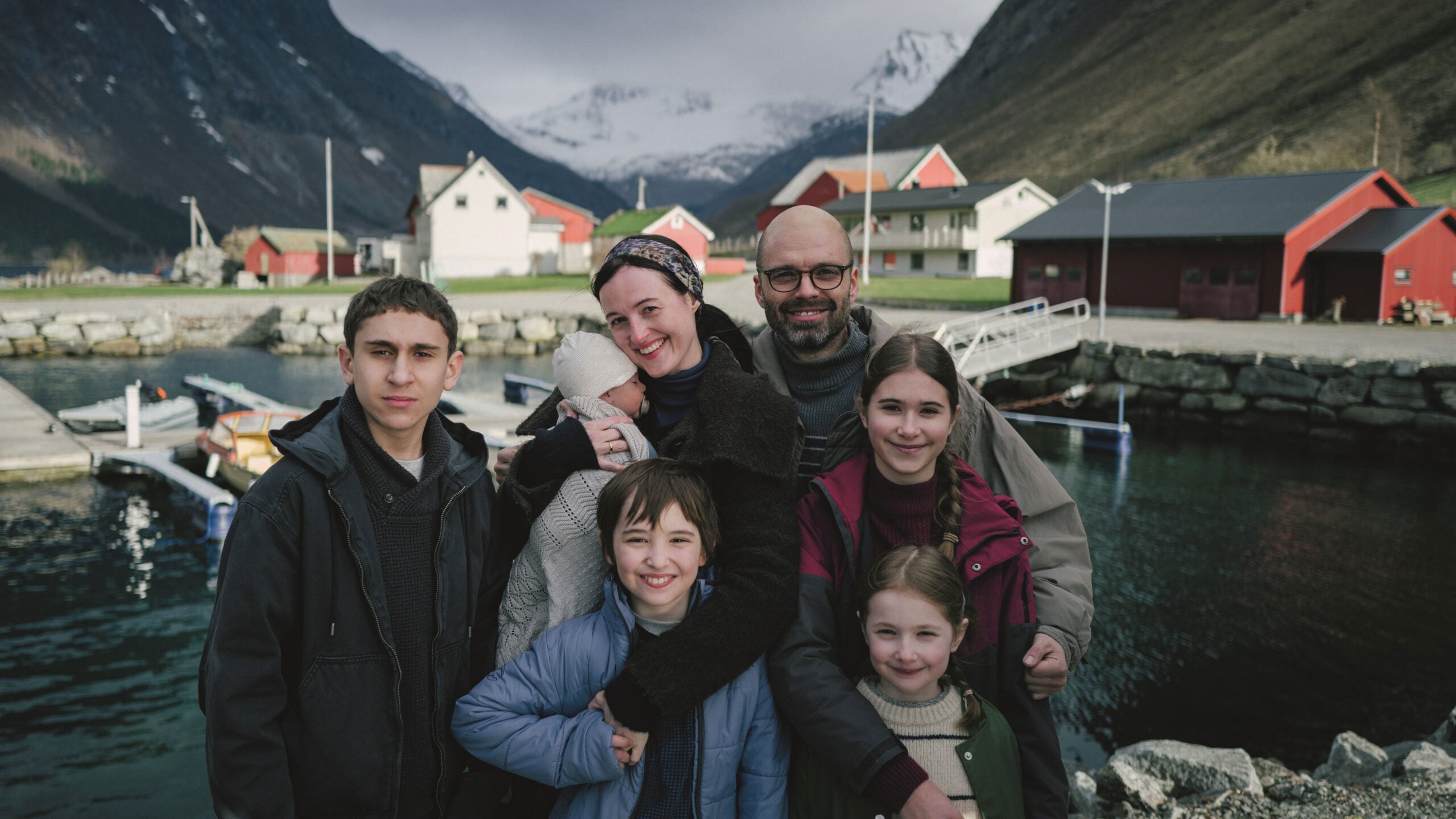
In Fjord, Mungiu’s first film made outside of his native Romania, the Romanian-born American actor Sebastian Stan and the Norwegian actress Renate Reinsve play Mihai and Lisbet Gheorghiu, a married couple with four school-aged children and a breastfeeding baby, who have newly relocated from Bucharest to the wife’s homeland: a Norwegian village that’s little more than a few small houses grouped around a harbor consisting of a single dock. Mihai and Lisbet are members of an evangelical sect—they met while Lisbet was on a mission in Bucharest—and they raise their children strictly, with mandatory Bible study and a demerit system. Stan, afforded a rare chance to speak his first language on screen, is nearly unrecognizable under a balding pate and heavy, black-framed glasses, giving Mihai the hunched anti-charisma of a schlub with the weight of the whole patriarchy behind him.
In the butterfly-effect plotting of Mungiu’s films, incidental and ambiguous gestures, often hidden in the blocking of a single long take, acquire load-bearing narrative importance. That happens here when Lisbet, stressed out and sterilizing milk bottles in the kitchen, disciplines her rambunctious kids when they knock over a pot of scalding water. The following day, their eldest, Elia (Vanessa Ceban), shows up at school with a possibly unrelated bruise on her shoulder, triggering the Scandinavian taboo against corporal punishment. After an interview with the Romanian-speaking children in Norwegian and English, all five offspring are placed in foster care pending an investigation—including the infant, who will undergo a brain scan for evidence of (the fiercely disputed) shaken baby syndrome.
In R.M.N. (2022), Mungiu built a small-town controversy over migrant labor into a microcosm of Romania’s suspicion of outsiders and the persistence of ethnic animus in the contemporary E.U. Fjord transposes this thematic framework to Northern Europe, again referencing actual recent cases, but this time indicting a rather different form of intolerance. Amid the rising tide of populism across Europe, Nordic immigration policy has grown more hostile, especially to Muslims. Mungiu points out the ways in which the Gheorghius, religious conservatives from a country considered backward, are singled out for their inability to assimilate the progressive values undergirding the welfare state. The fact that Mihai and Lisbet do not permit their children to watch YouTube is a mark against them, despite it being the dream of every parent in the developed world to reduce their kids’ screen time. Here in Cannes, art is affirmed as an expression of cosmopolitan, humanist values that are assumed to be universal. Fjord asks whether or not many of these values—secularism, a commodified liberal commitment to free agency—are not simply elite heuristics.
The dialogue of Rodrigo Sorogoyen’s The Beloved is mostly in Spanish, with smatterings of English heard during the production of a film-within-the-film. Actor Marina Foïs plays a French producer of the Spanish film; in addition to various Spanish entities, The Beloved’s backers include France’s Le Pacte. But the primary miscommunication in the film is familial, not linguistic. In its 20-minute opening scene, renowned director Esteban Martínez (Javier Bardem) meets his estranged adult daughter, actress Emilia Vera (Victoria Luengo), for the first time in years to offer her a role. Sorogoyen, making his Competition debut, supersizes an intimate encounter, shooting the lunch in intense over-the-shoulder close-ups, the camera so tight that partial faces fill a widescreen frame. The dialogue blurs the professional and the personal: Esteban has a reputation for running volatile sets, but for some years now he has been in recovery from the addictions that cast a shadow over Emilia’s childhood. He’d like to reconcile with her, albeit on his own terms: by putting her in a project that, as he points out, is leagues better than the cheesy telenovelas she’s been in up to now.
The film that Emilia agrees to participate in is a period drama set in the Spanish Sahara. While Esteban’s ’90s breakthrough, which we see in a Blu-ray clips, was a kinky low-budget crime drama, Desert looks a bit like a handsomely directed white elephant. (Esteban’s elaborate long takes, achieved through the loyal efforts of cast and crew, signal his need for control; auteurs might not get away with being as dictatorial as they used to, but father still knows best.) Sorogoyen keeps a number of balls in the air—Emilia’s nervous drinking, the reformed Esteban’s wounded pride, social hierarchies on set and off—culminating in a full-on meltdown brought about by a shaking dolly shot, stilted dialogue, prop food, weeping child extras, and several clashing egos.
It’s such a virtuoso set piece that the film takes a little breather after, in the form of a landscape montage, and never really puts its foot back on the gas for the homestretch. Sorogoyen switches up film stocks throughout, sometimes for consecutive shots, and toggles unpredictably between color and black and white, which comes off more forced than freewheeling in a script-forward project. Desert is less evidently autobiographical than the film at the center of last year’s similar Sentimental Value, and for a film about the intersection of life and art, The Beloved feels quite impersonal. But it plays well thanks to Bardem’s powerful presence, and Luengo’s determination to hold the screen opposite him, which mirrors her character’s drive to escape the shadow of her paterfamilias.
One more film about what is lost or found in translation: I’ll Be Gone in June, the first feature written and directed by Katharina Rivilis, in Un Certain Regard. The film comes via Wim Wenders’s company Road Movies, and the influence of its producer’s American films is evident in the visuals, a Stephen Shore exhibition’s worth of dusky desert vistas and roadside attractions. The story opens with German exchange student Franziska “Franny” Berger (Naomi Cosma) arriving in Las Cruces, New Mexico at the start of the 2001-02 school year, having been randomly assigned a host family. Though Franny’s arrival in America coincides with the seismic release of Jimmy Eat World’s Bleed American, I’ll Be Gone in June is not a pop-culture memory palace; nevertheless, it is recognizably a teen movie, its supporting cast waxing and waning in prominence as the school year unfolds. (Franny also experiences a key rite of passage of millennial adolescence—namely, a humiliating infatuation with a boy who looks like Skeet Ulrich.)
German filmmaker Rivilis was indeed an exchange student in Las Cruces in 2001, and her coming-of-age, already a culture shock, would have become weirder still after the teachers wheeled TV sets into classrooms for the students to watch news reports of 9/11. A European painting Americans as exotic archetypes, she exaggerates—but not really—the surreal militancy of everyday life in the Freedom Fries era, the sycophancy to men in uniform and the dinner-table bloodlust. For every opportunistic plundering of the American imaginary (red, white, and blue cans of Pabst Blue Ribbon are a strategic choice as firing-range targets), Rivilis gets at something true about the Bush years, as in a classroom discussion about current events to rival the one in Kenneth Lonergan’s Margaret (2011). The crucial difference is that these kids are as glib, vague, and meatheaded as my own peers in the Class of 2002. In writing the film, Rivilis jogged her memory by consulting artifacts including her old high-school yearbook, which, a quarter-century on, must have seemed an impossibly strange and remote context in which to see herself. The poetic kitsch of America in I’ll Be Gone in June achieves a woozy authenticity. The film is true to the experience of someone who was changed in ways she can’t articulate by a time and place outside the continuity of the rest of her life.
Mark Asch is the author of Close-Ups: New York Movies and a contributor to Reverse Shot, Screen Slate, Little White Lies, and other publications.
This story is part of the Summer 2026 issue of Film Comment.
By clicking Sign up, you agree to our site’s Terms of Service and consent to our Privacy Policy.
Get full access to Film Comment with a paid subscription. Already signed up? Log in.
Thank you for signing up for The Film Comment Letter.
Check your email to set up your account and get access to select articles, or become a paid subscriber for full access.