Cannes 2026: Home Again
James Gray’s Paper Tiger, Ryûsuke Hamaguchi’s All of a Sudden, and Radu Jude’s The Diary of a Chambermaid are standouts of the festival’s first week
James Gray’s Paper Tiger, Ryûsuke Hamaguchi’s All of a Sudden, and Radu Jude’s The Diary of a Chambermaid are standouts of the festival’s first week
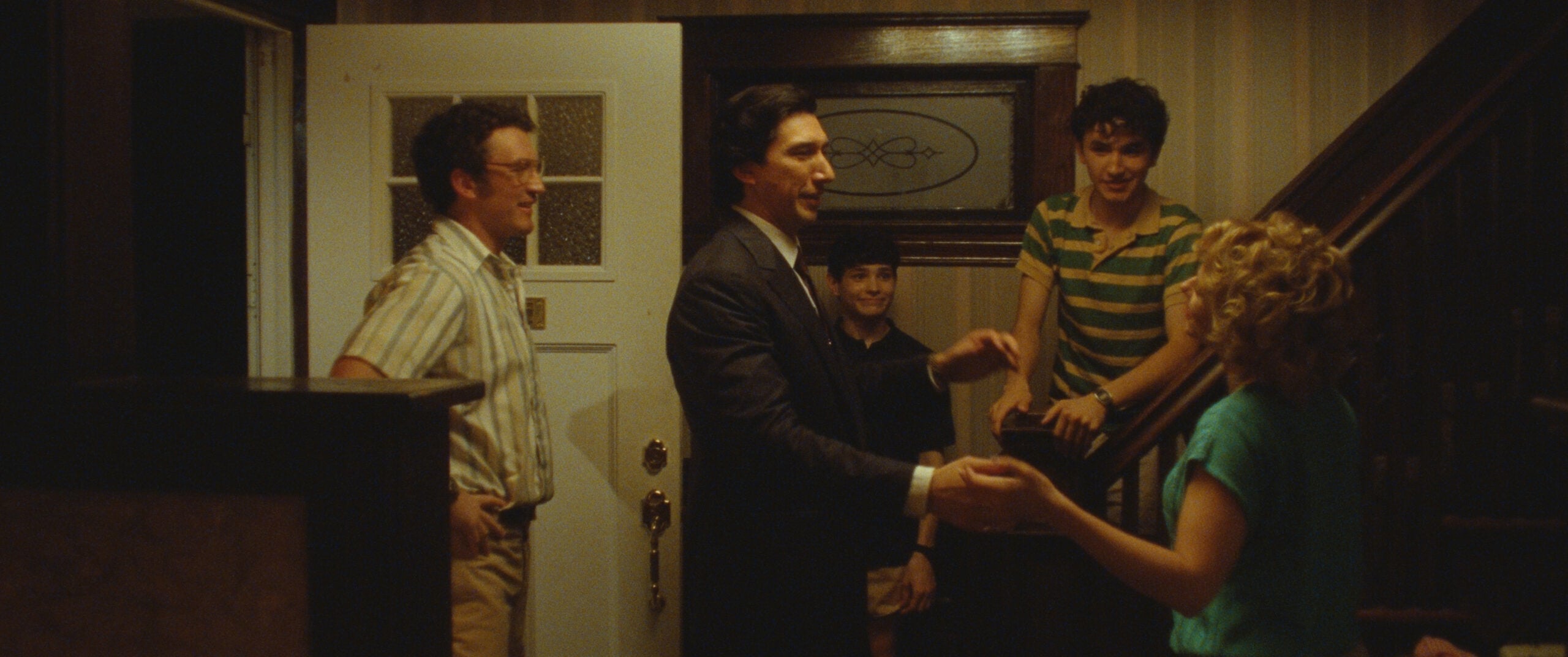
Invigorated as I was by the conceptual prowess of Jane Schoenbrun’s Teenage Sex and Death at Camp Miasma, my one major reservation is that I simply didn’t have that much fun—at least not as much as I would’ve expected from a film about slasher movies, the people who love them, and the perverse networks of desire flowing out from this relationship. Maybe Schoenbrun didn’t care to reproduce the precise pleasures of problematic gorefests, but the unexpected absence of such thrills did have me wondering when we’d get our first joyride here at Cannes. Lo and behold, it came on the first Saturday of the fest from none other than James Gray via his Paper Tiger, a tense, wacky, weepy crime drama about a Jewish family that gets inadvertently targeted by the Russian mob in 1980s New York. If that sounds like a retread for Gray—our most consistent chronicler of retro NYC, its outer boroughs, and its working-class families—it’s been too long since he’s managed, as he does here, to strike such a satisfying balance between old-school melodrama and muscular suspense. We Own the Night (2007) might have been the last such achievement, and like that film and the director’s two previous, Little Odessa (1994) and The Yards (2000), Paper Tiger concerns brotherly bonds; men whose loyalties press up against their differences.
On the one hand, we have Irwin Pearl (Miles Teller), a schlubby engineer and genial father of two teenage boys; his wife, Hester (Scarlett Johansson in a mop of curls and thick glasses), may not call all of the shots, but her nasal bray and antsy vigilance give her a more commanding presence than her passive hubby evokes. Conversely, Uncle Gary (a typically roguish Adam Driver), a former NYPD officer–turned–street-smart businessman, first waltzes into the Pearls’ home like a king, carting in a few trays of takeout from the high-end steakhouse Peter Luger, seemingly accustomed to sharing his opulent lifestyle with his little brother’s more humble clan. With college expenses right around the corner, Irwin agrees to join Gary’s latest venture: providing consulting services to a newly ascendant Russian syndicate that has taken over the empty properties along Brooklyn’s Gowanus Canal. Soon, naïve Irwin rubs the Russians the wrong way, and finds himself—and his family—menaced by their henchmen. Meanwhile, Hester (much like Gray’s own mother) discovers she has a brain tumor that will kill her within the year, a malady that—like the vats of oil being dumped illegally into the Gowanus by the Russians—gestures at the city’s history of pollution and corruption, as well at the cancerous pursuit of the American Dream. A number of genuinely eerie set pieces—most impressively, a climactic chase scene among the tall grass outside of LaGuardia Airport, punctuated by deafening sound design—give the film a fable-like quality. This artifice melds nicely with the cast’s broad, expressive performances, with particular kudos to Johansson for balancing her character’s more bombastic outbursts with a guarded interiority. Hester refuses to share the news of her illness with the rest of her family, her withholding never eclipsed by the film’s masculine intrigue, but simmering—like bubbling toxins—beneath the flashier events.
But enough about the Americans. At Cannes, there’s always a heavy showing of French fare by the country’s homegrown filmmakers, though this year, in particular, saw the arrival of several titles en français by directors from other parts of the world—no doubt taking advantage of the country’s relatively robust co-financing schemes. Asghar Farhadi’s Parallel Tales adapts Krzysztof Kieślowski’s 1988 A Short Film About Love (so, in other words, Rear Window) with a cast of French heavyweights, including Isabelle Huppert, Virginie Efira, and Vincent Cassel. Ryûsuke Hamaguchi’s All of a Sudden, which also stars Efira, exploits the City of Light to its full advantage, staging the director’s signature talking scenes against a dynamic backdrop of moving trams, elevation-shifting walkways along the Seine, and facilities and gardens whose shades of green and blue create painterly impressions beneath the moonlight. There’s a historic relationship between French and Japanese cinema—to start with, postwar Cahiers du cinéma critics were instrumental in bringing the works of now-canonical directors like Ozu and Kurosawa to the West—and the 21st century, especially, has seen a number of Japanese auteurs work with Gallic stars and templates. Hirokazu Kore-eda, whose Sheep in the Box is in competition this year, enlisted Juliette Binoche and Catherine Deneuve for The Truth (2019); and Nobuhiro Suwa has, at this point, made just as many films in French as he has in Japanese, beginning with H Story (2001), his modern riff on Hiroshima mon amour (1959). Hamaguchi, thankfully, isn’t interested in making his version of a French bourgeois drama. If any reference could be invoked, Jacques Rivette comes to mind for his winding, desultory narratives and the connections he forges between women, who meet and love each other according to a private—sometimes magical—logic.
This is the case with All of a Sudden, which follows the relationship between Efira’s Marie-Lou, the visionary head of an assisted-living home in Paris, and Mari (Tao Okamoto), an experimental-theater director who has terminal cancer, and likely only a few months to live. The two women land in each other’s lives after Marie-Lou spots the autistic grandson of Mari’s lead actor running around tram tracks during her commute home. Concerned for the boy, she rushes to his aid, stabilizing him until his caretakers arrive. When Mari shows up, she invites Marie-Lou to her show, a one-man performance about an Italian psychiatric hospital and the struggle to “make the impossible possible” when it comes to the humane treatment of the sick and disabled. Marie-Lou herself is dealing with a seemingly impossible situation as she fights to reform her workplace according to the principles of “Humanitude,” a caretaking method that emphasizes direct communication with patients and encourages them to be autonomous. It’s a risky, expensive undertaking—and some staff members are vehemently against the extra training and workload—but Marie-Lou is determined to realize this compassionate aim.
At 3 hours and change, All of a Sudden spins out a flurry of ideas about the capitalistic underpinnings that structure the health-care industry; the heightened fragility of our bodies under the demands of modern labor; and the roles of art, improvisation, and public dialogue in reducing, if not collapsing, the distances between us. It’s all very idealistic, and Marie-Lou and Mari sometimes border on the angelic, yet there’s something about Hamaguchi’s patience—each scene is unrushed, as if dictated by rhythms independent of the everyday hustle—that elaborates, by the film’s end, a deeply felt understanding of what it means to care and love. From the moment Marie-Lou and Mari begin their friendship, they never leave each other’s sides: one walk along the river extends into unbroken days of companionship at Marie-Lou’s job and in Mari’s home in Japan when her illness flares up with a vengeance. The women speak to each other in a blend of French and Japanese, underscoring the precious, private nature of their bond, through which they create both a profound form of communication and a means of inhabiting the world more empathetically.
By contrast, Radu Jude’s French debut, which premieres in the Directors’ Fortnight section, kicks sentimentality to the curb—though it shares with All of a Sudden the use of date-stamped intertitles, a pivoting between different languages that calls attention to the modern flux of cultural identities, and (a less forgiving) commentary on French social relations with its immigrant communities. Octave Mirbeau’s 1900 novel, a pillar of French literature reimagined for the screen by the likes of Jean Renoir, Luis Buñuel, and Benoît Jacquot, is the ostensible source text for Jude’s The Diary of a Chambermaid. But as in his recent Kontinental ’25 (2025), another reworking of a Western European classic (Rossellini’s Europa ’51), Jude is less interested in the original’s bourgeois psychodramas of sex and murder than in wryly foregrounding its class divisions and adapting them to modern European dynamics of labor and exploitation. Not that Jude throws out sex entirely: in typically bawdy fashion, scenes of the protagonist, a Romanian housekeeper named Gianina (Ana Dumitraṣcu), rehearsing a burlesque stage rendition of the Mirbeau story in which she pleasures herself with a broomstick across from her lascivious master, are sprinkled throughout. The performance is being put on by a community group with a progressive vision—their plays cast nonprofessional migrant actors—and this conceit pokes fun at the virtuous trend of culturally diverse reimaginings of canonical works at the same time that it pushes these works off their pedestal. In any case, the figure of the maid remains a fetish object in Jude’s hands: not a sexy dream of domination but a salve for liberal guilt.
Sweet as a peach when speaking French and prickly in her native Romanian, Gianina lives with her wealthy employers (Mélanie Thierry and Vincent Macaigne) in Bordeaux. Her daughter remains in Romania with her grandmother, though the girl routinely checks in with her distant mother via heartbreakingly shitty video-chat screens, often observing Gianina play with and tend to the couple’s young son. What do you call the specific trauma of watching your parent perform the attentive mama to someone else while you remain neglected at home? Tracking the three-month lead-up to the winter holidays, when Gianina is meant to reunite with her little girl, Jude showcases the peculiar nature of her thankless work in vignettes. We see her clearing her patrons’ collection of exotic knickknacks and cooking for dinner parties attended by enlightened guests who treat Gianina like a walking history lesson instead of a human being. Arguably, most of what our heroine suffers are microaggressions, but their steady accumulation assumes an uncomfortable weight by the film’s end, when money comes to flatten all pleasant pretenses of cultural exchange: some people throw cash at their problems; others hold out, smiles clenched, waiting for it to solve theirs.
Beatrice Loayza is a contributing editor at Film Comment and a regular contributor to The New York Times, the Criterion Collection, The Nation, The New York Review of Books, and other publications.
This story is part of the Summer 2026 issue of Film Comment.
By clicking Sign up, you agree to our site’s Terms of Service and consent to our Privacy Policy.
Get full access to Film Comment with a paid subscription. Already signed up? Log in.
Thank you for signing up for The Film Comment Letter.
Check your email to set up your account and get access to select articles, or become a paid subscriber for full access.