Cannes 2026: Fairytale in the Supermarket
This year’s festival presents a cross-section of an industry in flux
This year’s festival presents a cross-section of an industry in flux
War, censorship, issues around representation, filmmakers’ access to financing, and the role of the theatrical experience amidst a sea of handheld small screens: all of these were topics succinctly addressed, or at least artfully alluded to, by Cannes Festival President Iris Knobloch and Artistic Director Thierry Frémaux as they revealed this year’s Official Selection lineup on April 9. “The news coming from all around the world is anything but reassuring,” Knobloch began before noting that the festival’s birth, in 1939, was a moment of “great uncertainty” as well. At such moments, “when the world is getting darker and losing its bearings, showing films from all walks of life is not a trivial gesture,” she continued. “It is defending what is most precious to humanity, its capacity to dream and think freely.”
The lineup, heavy on international art-house auteurs and light on starry Hollywood offerings, reflects some of these anxieties, in many cases through a historical lens. Among the Official Selection films announced by Frémaux this year are highly anticipated titles by returning Competition directors, including Ryûsuke Hamaguchi’s French-language All of a Sudden; Cristian Mungiu’s Norway-set Fjord, which reunites A Different Man (2024) stars Sebastian Stan and Renate Reinsve; and Russian director Andrey Zvyagintsev’s Latvia-shot Minotaur. Connecting with Knobloch’s comments about the birth year of the festival, there are several pictures set during or in the aftermath of the World Wars, including László Nemes’s French Resistance story Moulin; Emmanuel Marre’s Vichy-set A Man of His Time; Paweł Pawlikowski’s Cold War–era road-trip picture Fatherland, which stars Hanns Zischler and Sandra Hüller as author Thomas Mann and his actress daughter Erika; and, out of competition, Antonin Baudry’s wartime Charles de Gaulle biopic, De Gaulle: Tilting Iron.
There are 12 newcomers to the Cannes Competition, including Anatomy of a Fall screenwriter Arthur Harari with The Unknown, a body-swap mystery starring Léa Seydoux. Queer themes are represented in Official Selection films by Pedro Almodóvar (Bitter Christmas); Javier Ambrossi & Javier Calvo (The Black Ball); Ira Sachs’s AIDS-era Competition entry, The Man I Love; and Jane Schoenbrun’s Un Certain Regard opening-night film, Teenage Sex and Death at Camp Miasma, a MUBI title.
Missing so far are the sort of big-budget Hollywood entertainments, such as Steven Spielberg’s upcoming Disclosure Day, that often appear in Out of Competition slots. As evidenced by One Battle After Another and Sinners both having foregone festival premieres and done well, critically as well as commercially, studios are increasingly skipping high-profile festival launches. For other American companies, the cost of bringing a film to Cannes—the first-class airfares, which have escalated over the last two months due to the Iran war and rising costs of fuel; the obligatory beach parties; the traveling glam squads—may simply be too forbidding in this climate. Said Frémaux to Variety, “Americans in the industry all come to Cannes—the artists—but the studios . . . They need to relearn how to travel light. What we want to show are films. A film, a director—that’s enough.”
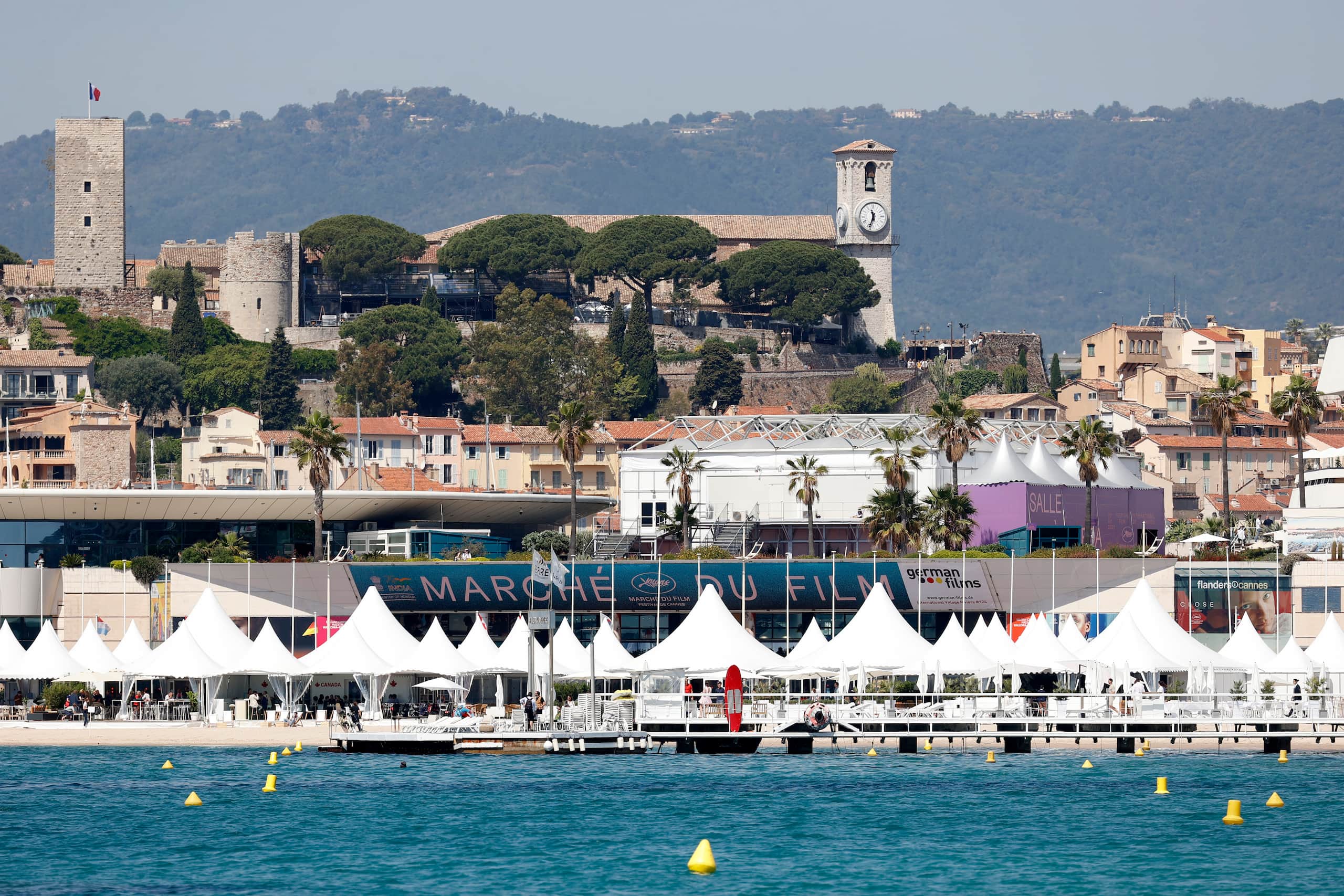
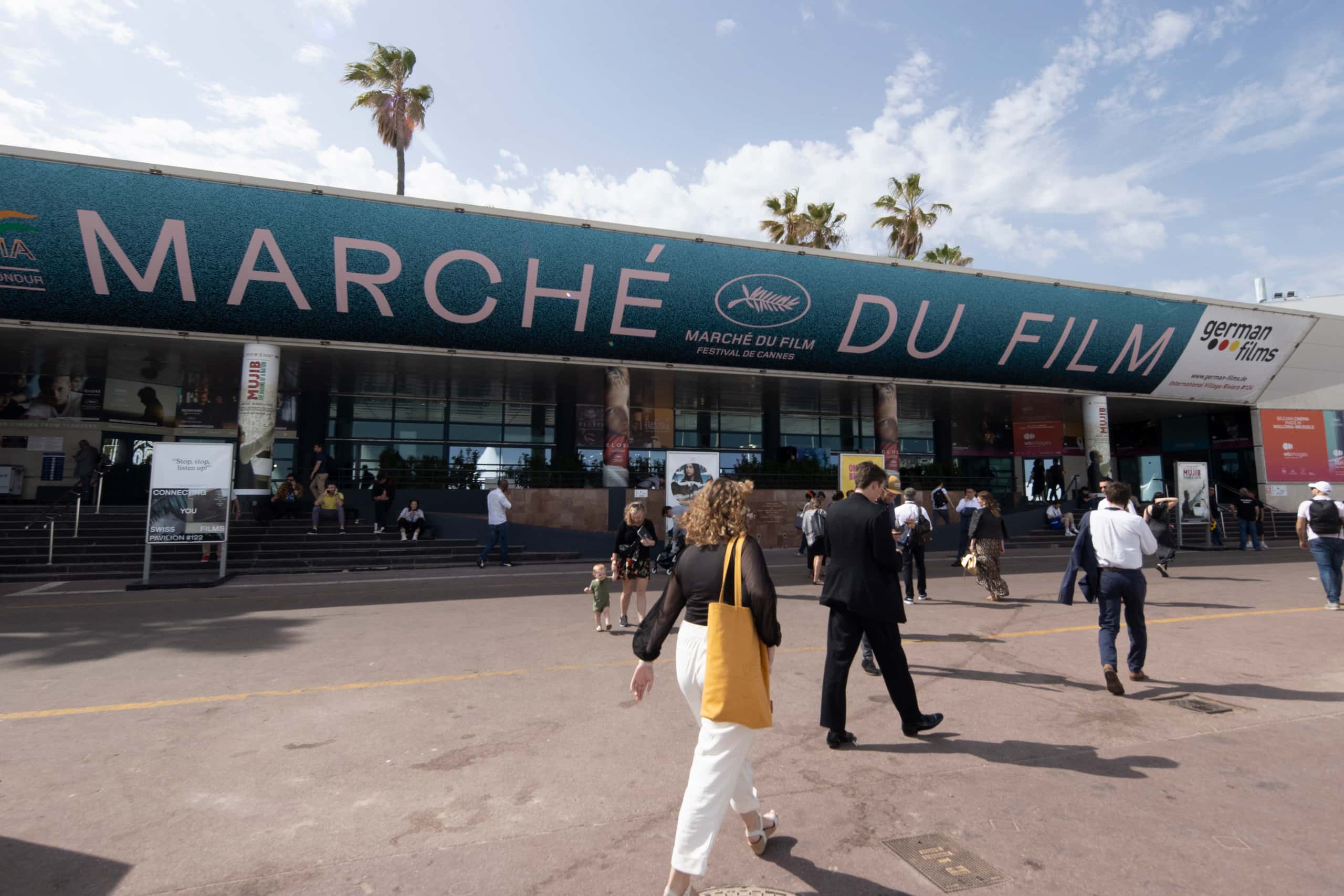
With its never-changing pageantry—the red carpet, the Camille Saint-Saëns preshow music, the pristine sound and projection in the brutalist Palais des Festivals—Cannes “is still the most important art house–inflected international film market,” says Kino Lorber CEO Richard Lorber, whose company’s past Cannes acquisitions have included Yorgos Lanthimos’s Dogtooth (2009) and Jean-Luc Godard’s Goodbye to Language (2014). But, he adds, “Despite all the fan mania—people lining up in front of the Palais with their ladders and lunchboxes—it is still absolutely a B2B industry-focused market.” Indeed, a fuller assessment of Cannes today, and its role in the cinema ecosystem, requires a consideration of the festival selections alongside developments and trends captured by the accompanying Marché du Film (Cannes Film Market), many of whose attendees often spend a week on the Croisette without ever seeing a single Competition title.
Knobloch acknowledged the vexing challenges of film financing at the press conference, saying Cannes must “open the access—access to finance, access to projects, and access to decision-making positions.” The Marché du Film is entering the fourth year of its Cannes Investors Circle, which connects selected projects with a curated group of private investors, as European governments now face “guns vs. butter” discussions that could impact state cultural funding. “This may sound very surprising to an American producer,” laughs Alexander Glehr, a producer of Marie Kreutzer’s 2026 Competition title, Gentle Monster, “but European producers normally don’t have much connection with investors.” That’s why an Investors Circle invitation in 2025 was fortuitous for Kreutzer’s film. Just months earlier, the production lost €2.3 million from its finance plan when, amidst austerity measures, the Austrian government radically slashed funding for the Austrian Film Institute’s ÖFI+ subsidy program.
“We had to rethink the whole production and find other solutions,” says Glehr. In the lead-up to the event, the Circle scheduled preparation meetings with lawyers who explained not only the expectations of private-equity investors but also how to interact with them conversationally. The Gentle Monster team wound up meeting Singapore-based Desmar Films, a creative partner that also financed the remaining gap—“a percentage comparable with the production companies Film AG, Komplizen Film, and Kazak [Productions] and their investments,” says Glehr. Other partners included the Austrian Film Institute, broadcasters, regional funds, Eurimages, and international sales agent MK2. “Through their collaboration with IPR.VC, [MK2] were able to lend the necessary weight to the film’s promise at the outset of financing with a strong involvement. Without them, we maybe would not have made it to the Investors Circle in the first place,” says Glehr.
“A fuller assessment of Cannes today, and its role in the cinema ecosystem, requires a consideration of the festival selections alongside developments and trends captured by the accompanying Marché du Film.”
The U.S. title The Man I Love is financed entirely out of equity, with the exception of a loan against the New York State tax credit; it marks production-and-financing company Big Creek Projects’s first appearance at the festival. But Siegel and McGehee, who co-founded the company with Mike Spreter, have a long history with Cannes, having screened their own directorial debut Suture in the 1994 Un Certain Regard section. After the company raised the funds needed to finance Siegel and McGehee’s 2022 picture, Montana Story, Siegel says the three partners asked themselves, “Could we do this in a bigger way? Can we help filmmakers we admire who are in that same position of having to raise equity? And can we help them as creative producers too?”
After producing Siegel and McGehee’s 2024 movie The Friend and executive producing Hailey Gates’s 2025 Sundance Grand Jury Prize–winning Atropia, the trio heard about Sachs’s 1980s-set NYC queer drama, which takes place a decade after his Peter Hujar’s Day (2025). “We were able to use capital from Big Creek Projects to build the financing,” says Siegel. “We got involved really early on, even before the [final shooting] script [was ready].” Following the Competition announcement, the filmmakers struck a deal with Paris-based MK2 for international sales and Memento for French distribution. But WME, the film’s North American sales agency, will be waiting to secure U.S. distribution at Cannes, where The Man I Love is one of the few English-language acquisition titles in the Official Selection.
Despite Knobloch referring to “our attachment to the movie theater at a time when screens can be held in the palm of our hand,” the Marché expands its scope this year with a new half-day Creator Economy Summit aimed at social-media creators. As for A.I., today’s film-culture villain, Knobloch said, “We are defending the freedom of creation for all human beings, but only for human beings . . . A movie is not just a patchwork of data, it’s a personal vision.” Cannes-watchers were quick to jump on the statement because it was announced minutes later that the Out of Competition section would include Steven Soderbergh’s John Lennon: The Last Interview, for which the director deployed A.I. to visualize, in his own words, “thematically surreal images.” But Knobloch was making a distinction here between using A.I. tools and using A.I. to generate stories themselves. Indeed, the former is not outside the remit of the Marché du Film, as evidenced by its second annual A.I. for Talent Summit. An invite-only part of the Cannes Next program (an “innovation-focused” business-and-networking forum), the event has doubled from one to two days this year and will offer “C-level executives, investors, [and] senior technology professionals” discussions on how “artificial intelligence is reshaping the future of cinema and the wider content industry.”
Genre-adjacent titles have long found a home at Cannes, with this year’s representation including Na Hong-jin’s Competition entry Hope, which stars Michael Fassbender and Alicia Vikander in an alien-visitation drama set in the shadow of the Korean DMZ; Schoenbrun’s Teenage Sex and Death; and Zachary Wigon’s late Un Certain Regard addition, Victorian Psycho, a Bleecker Street release. Genre films also have a proper home in the Marché du Film at Frontières, a two-day industry programming-and-networking event co-presented with the Fantasia International Film Festival. In its Buyers Showcase, films in postproduction are presented to sales agents, buyers, and festival programmers, while the Proof of Concept section features presentation videos of “projects in advanced financing.”
Nearly a week after the Official Selection announcement, Julien Rejl, the artistic director of the Directors’ Fortnight, revealed his section’s lineup—an eclectic mix hailing from 19 countries, including Sudan, Guatemala, Venezuela, and Cyprus. The opening-night film is Beanpole (2019) director Kantemir Balagov’s New Jersey–shot Butterfly Jam, starring Barry Keoghan, Monica Bellucci, and Riley Keough alongside Turkish-American newcomer (and Garden State resident) Talha Akdogan. There are new films from Radu Jude, Lisandro Alonso, and Clio Barnard; three feature documentaries, including William and David Greaves’s Once Upon a Time in Harlem, which premiered at Sundance; and three animated features, including Quentin Dupieux’s Vertiginous. (Dupieux has another film at this year’s festival: Full Phil plays in the Midnight section.) There’s also feature-debuting American independent filmmaker Reed Van Dyk, following up his 2017 Oscar-nominated short, DeKalb Elementary, with an Iraq War–vet drama, Atonement, based on a 2012 New Yorker article.
While Rejl overweighted acquisition titles in previous years, there are several Quinzaine entries arriving with U.S. distribution in place, including two already acquired by NEON: the Greaves picture as well as Clarissa, Arie and Chuko Esiri’s Lagos-set adaptation of Virginia Woolf’s Mrs. Dalloway. With NEON’s succession of Cannes buys in 2025—seven among all sections—festival attendees were accustomed last year to waking up each day to yet another acquisition by the distributor. That most likely won’t be the case this year simply because NEON has already pre-bought so many titles, fortified by its Pay One licensing deal with Hulu, which gives the streamer exclusive rights to stream the films after their theatrical and home video releases. For some NEON acquisitions, like James Gray’s Paper Tiger, announced on April 22 as a late addition to the Competition, the deal likely constituted the “contractual issues,” in the words of Fremaux, that had kept the film from the first round of announcements.
For Clarissa, the NEON acquisition was an early spark that enabled the film’s making. “I was just blown away by what was an incredibly audacious, beautiful, and elegiac adaptation of [Virginia Woolf’s] book,” producer Theresa Park of Per Capita Productions says of the Eyimofe (This Is My Desire) (2020) directors’ script sent to her by UTA. Then two difficult years of unsuccessful financier outreaches followed, with many, remembers Park, saying, “We would do it if you do it for $1 million, and we would do it if you do it for $2 million.” “But,” she maintained, “our budget was $4 million.”
But with Sophie Okonedo attached and interest from Ayo Edebiri and David Oyelowo, Park was able to secure NEON’s early commitment to distribute in the U.S. as well as sell foreign territories. Still, the finance plan was incomplete, and Park realized she needed a partner “with deeper relationships in Africa.” She connected with Invention Studios head and Severance producer Nicholas Weinstock, who studied in Africa and was a member of the jury at the African International Film Festival in Lagos in 2023. Weinstock had experience developing projects across the African continent, including a recent partnership with the Kenyan government to support Kenyan creatives, but a first round of approaches to individuals and companies there was unsuccessful.
“Nigeria is the second-biggest movie market in the world after Hollywood,” explains Weinstock. “It’s bigger than Bollywood. They make 2,500 movies a year in a thriving ecosystem. But if you’re in Nigeria and you’re making movies, you’re usually making them for $5,000, $10,000. Some of the big ambitious ones that go to film festivals are $120,000. And ours was $4 million. You would think we were making Avatar.” When one financier pointed out that the top-earning Nigerian film to date only earned $2 million, half of Clarissa’s budget, Weinstock and Park argued that the NEON distribution guarantee, the cast’s international star power, and the filmmakers’ acclaim would ensure an expanded worldwide audience. In the end, the film’s budget was raised primarily from institutional equity sources in Nigeria—CANEX Creations, an investment subsidy of Afreximbank’s Fund for Export Development in Africa, and MBO Capital—with less than 10% covered by debt financing.
Cannes today, says Lorber, is less a legible map of the industry than its own “landscape, or terrain.” He says, “Whereas before there were reliable markets based on what you’d expect in one section or another, or a new focus, like the ACID section or the Doc Corner, now there are a multiplicity of new initiatives and ventures. Sometimes you get a snapshot in your mind of what the big picture is, but then it dissolves very quickly.” Still, the continuing preeminence of Cannes is a testament to the festival and the market’s combined ability to feed on these energies without making the sorts of equivocating shifts—toward greater celebrity, audience-friendly fare, or television—that some other festivals have made in recent years. After all, even this year’s debuting Creator Economy Summit is focusing on Instagram, TikTok, and YouTube creators “as they expand into long-form storytelling and film production.” Speaking, for example, is YouTuber Markiplier, who earlier this year self-distributed his horror video-game feature adaptation, Iron Lung, to over 3,000 U.S. theaters.
“In the ’80s, there was a lot of thinking about the death of cinema,” said Fremaux at the April 9 press event. “Jean-Luc Godard and Serge Daney said a lot about that, and today I think we can say that those questions moved aside, but [the] language of cinema won. It is everywhere.”
Scott Macaulay is a journalist and film producer based in New York City.
This story is part of the Summer 2026 issue of Film Comment.
By clicking Sign up, you agree to our site’s Terms of Service and consent to our Privacy Policy.
Get full access to Film Comment with a paid subscription. Already signed up? Log in.
Thank you for signing up for The Film Comment Letter.
Check your email to set up your account and get access to select articles, or become a paid subscriber for full access.