Interview: Robert Redford
Robert Redford on his new film, The Milagro Beanfield War, directing and acting, Sundance, and his remarkable career to date
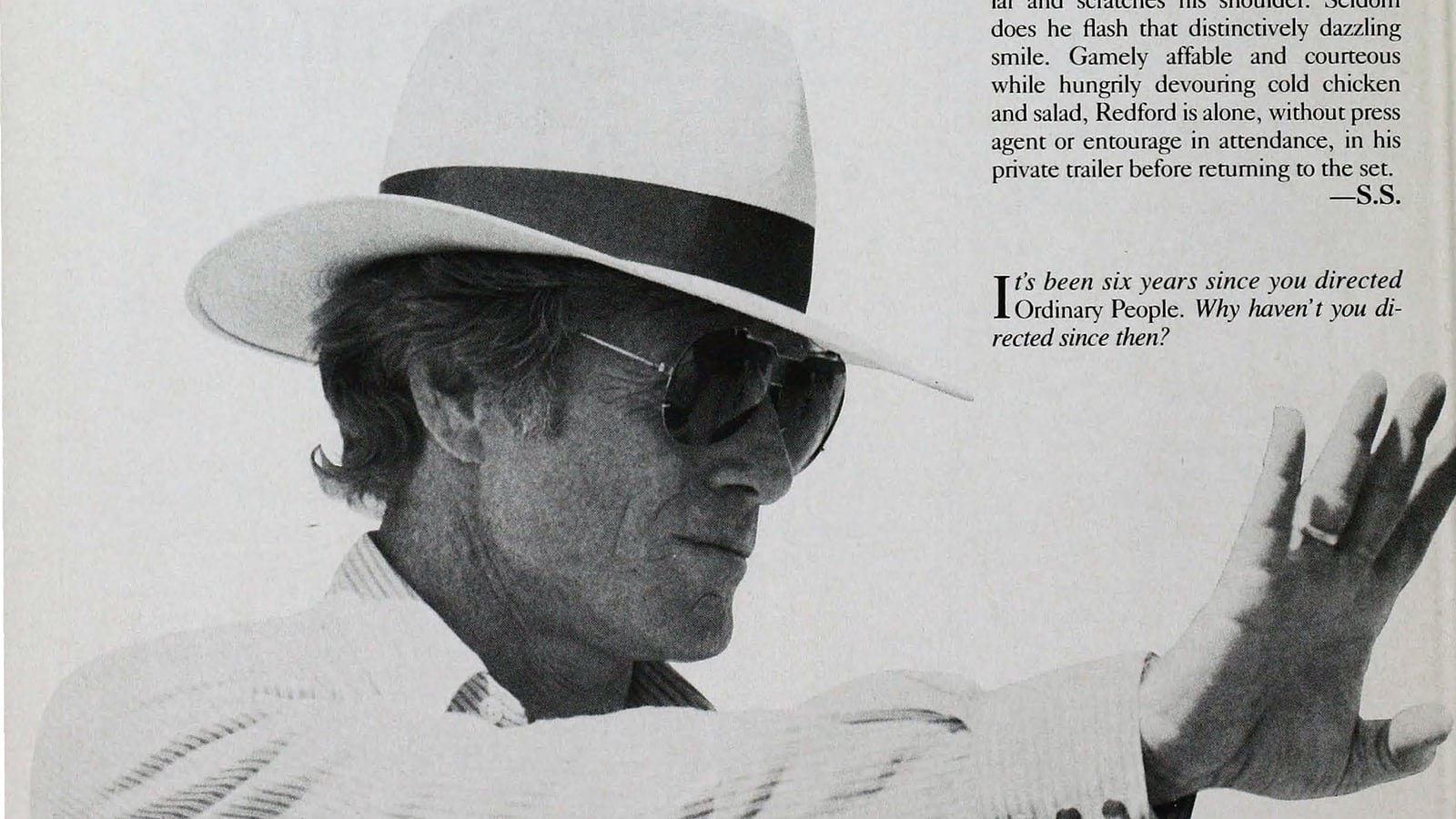
Robert Redford on his new film, The Milagro Beanfield War, directing and acting, Sundance, and his remarkable career to date
He’s never on time. Hell, they don’t get their first shot ’til 10:30 and have to stop at 7. But that’s nothing new—he was never on time when I worked with him on Butch and Sundance.
—a Milagro Beanfield War crew member
There’s nobody on this set who’s got a bigger dick than he does. Whatever he wants, he gets.
—a Milagro production assistant.
Even in this remote location, Robert Redford can’t escape the glare of the curious, the blaze of the spotlight. Truchas, New Mexico, has the oddest looking bunch of tourists and locals—retirees in biking suits, ladies in furs, and run-of-the-mill sightseers—lined up along the one main road that runs through this small town 40 miles northeast of Santa Fe.
Wearing shades and his standard outfit of 501 Levi jeans, Tony Lama boots, and denim shirt, Redford ignores the crowd and concentrates on an elaborate outdoor scene in the mock town square built for the movie. Today, the locals have assembled to watch Redford direct a scene with Christopher Walken and Ruben Blades for the movie of John Nichols’ 1974 novel, The Milagro Beanfield War. Truchas is less awed by the cast—John Heard, Sonia Braga, Daniel Stern, and Melanie Griffith—than it is by the director. Isn’t that Robert Redford? It’s a miracle he’s here.
Milagro, which means “miracle” in Spanish, is already overbudget and behind schedule, a combination of weather and directorial temperament. Redford revises the script as he films, and takes his time to get it right. (In fact, since principal photography wrapped in October ’86, Redford has reshot material, including the title sequence.)
“I’m told we need to cut pages, and I’ve just written another scene where the pig’s petted!” marvels James Parks, the latest writer to do a polish on the screenplay. Already, over the past three years, Nichols and then David S. Ward (who also gets credit) have struggled to condense the novel into a two-hour movie.
Redford invites journalists to watch nearly two hours of assembled footage on a Beta cassette and then attend the dailies, flown in from Los Angeles. Dede Allen, who worked with him on Ordinary People, huddles with him at these sessions, but she must leave soon for hospitalization in Manhattan.
For the interview, Redford proved himself true to form by running late, arriving in a last-minute rush on a bicycle. At 50 he is thin, with ramrod-straight posture and sunlit blond hair. His face, neck, and hands are weathered and heavily lined. He is parchment. He speaks in measured, clear sentences, as if he can visualize what he’s saying in print. Occasionally, he thrusts his hand through his open shirt collar and scratches his shoulder. Seldom does he flash that distinctively dazzling smile. Gamely affable and courteous while hungrily devouring cold chicken and salad, Redford is alone, without press agent or entourage in attendance, in his private trailer before returning to the set.
It’s been six years since you directed Ordinary People. Why haven’t you directed since then?
One of the reasons is I purposefully took two years off—I’d planned to do that. I don’t have any timetable career-wise. I had reached a point in my life with that film, a lot of things were culminating, and it felt like a very right time to take off from the business for a while. I came back, and the three or four things I had in development to direct didn’t come to fruition, including this. Three years ago I tried three drafts with John Nichols, the author, and they weren’t right. I wanted to work. And it was a question of what was going to be ready first, so I took a job as an actor.
What was the problem?
The chief problem with Milagro was one that faces any film that was made from a book. Film is not a literary medium. It was compounded by trying to take 680 [actually 630] pages of a rather meandering narrative that has the luxury of being able to kind of drift and float and bob and weave and stall and then go forward, charging ahead like lightning. You’re condensing a 680-page book into a 120-page screenplay. That transference was obviously difficult, all those characters.
You say David S. Ward, who wrote The Sting, found the structure to “lick the book.” What does that mean?
To reduce the number of characters and not lose the weight or the depth of the piece, or the humor and the color, became a real task. I was having trouble getting a comedic structure that I could build on. I knew what I wanted to do with the piece, but I wanted a structure in place—which characters would be left in, which characters taken out, which sequences would be lifted out, what would be kept in, how it would move the story along and keep the dramatic and humorous content. David Ward got that, and the rest I thought I would work on myself—I was looking forward to that.
The script has been constantly revised while filming?
Yes, I think the script was a little more in place in Ordinary People, but I always do that; even the ones I produced—constantly work every scene. I believe in leaving it loose until all the elements are in place—the actors, the location, the setting, the weather. The weather’s another character in the piece—it’s like a ghost that hangs over the production, like Amarante’s ghost.
Were you attracted to the plot because it has a land developer in conflict with local residents?
Now you’re moving into the political, philosophical arena.
Chances are more than likely that the West as we know it, vast parts of this country that have been left undisturbed, are doomed. They’re not doomed to a future; they’re doomed to the life they’ve had to date. Meaning, they’ll be developed. It’s in our nature. We’re a development-oriented society, we’re profit-oriented. It just stands to reason that finally, in time, despite the toxic substance scare, despite the air pollution problem, despite overpopulation, that we will still find some way to continue to build. Which means we will go to places where there are places to develop, which is mostly the West.
So I’m assuming that despite all the battles—and I count myself among some of the warriors that go against excessive or indiscriminate development—in time all that space will be gone, converted to some other use. Which means we will lose a lot of our tradition, and therefore a lot of our cultural roots. And therefore it will be our fault and our choice. We won’t be able to turn around and say it was taken from us, from the outside. We can’t say there we were, they bombed us from a foreign country or they sailed from across the seas and took our lands from us. It means we took the land and made the choice to convert it to some other use.
In that sense, whatever gain is made in this film, or this story, is a battle being won. Maybe not the war. But that’s what I would like to focus on: the value of battles being won. And if it’s just a brief moment of joy, of the human side of things to say, then I think it’s worth it. But no one’s disillusioning themselves into thinking they’re making a big political statement out of this thing. Many who sympathize with the plight of these people would be the first to sell their house to a developer if they had the money.
Is that it?
I like people in a dilemma. I like people faced with a question that requires action, that requires commitment and conviction, people that are hit with a hard choice. To me that’s the stuff of dramatic content. What’s happening in Milagro is a microcosm of what’s happening all through the West and around the country. People make their choice: Do they want to preserve the culture or give it up for a higher profit gain? Which is what usually happens. It’s creating a lot of paranoia, schizophrenia, and depression.
It’s happening all over the Midwest—small towns being deserted, farmers bankrupt.
We have Farm Aid—the liberal parts of our country are very generous about the underprivileged parts. We gather together to help the poor and feed them if they’re hungry. We gather to help the farmers and the dying industry, which is a radical change from the past. Yet there is this inexorable push to give up those things for profit, and I just find that interesting to tell stories about.
Did you have to give up anything to get this made?
It wasn’t an easy project to get a studio to back. There were the conventional axioms that were thrown my way: Who wants to see a bunch of Mexicans running around the hills of New Mexico? The more dignified responses were: “It’s a marvelous story, but it seems a bit diffuse” and “Why would you want to do something like that?” No, it was not easy, but neither was Ordinary People.
Did you have to sign for another picture to do this? Agree to cast a star?
I didn’t have to give up something; it didn’t get that bad.
You’re now in the position of making this just as Frank Price, who has worked with you on this and Out of Africa, resigned. Does that worry you?
It’s kinda like people playing the game musical chairs but also adding to the mix a hot potato: while you’re playing musical chairs, here’s the potato you have to keep flipping back and forth. Hollywood certainly has become musical chairs. It’s interesting that the business would get to a point where they make their severance deals as they go into something. And they make better exit deals than entrance deals. Which tells you how long they expect to be around, so we shouldn’t be surprised that nobody is around very long.
The shifting sands of major studio leadership, which seem to be moving more and more toward lawyers and accountants and people of a different trade, raise a great voice for independent film. Which is one of the reasons that five or six years ago we were talking about the business moving more in this direction as the product became more centralized and real knowledge about the art of film became more foreign to the leadership. Those two things running concurrently, it seemed to me a good time to start looking for alternatives. Pretty soon it would be such a costly business.
You’re referring, of course, to the Sundance Institute you founded. What else about Milagro interests you?
Stories about this country, characters on this landscape, are what interest me the most. Our own history interests. So if those stories are to be told, we need more diversity. Maybe that will happen with this current trend. I like Frank Price and think he has a good gut, a good sensibility, and he’s one of the few people in this industry who had any experience in film. He was a writer.
What’s your reaction to all of this studio shuffling then?
It’s a great time to put your head down, get a bead on what you want to do, cover yourself with thick armor, and do it. And don’t be dependent on anybody in that shifting atmosphere [of studio politics].
You’ve just begun with John Heard, the last of the eleven major roles filled in this ensemble. Yet beyond Christopher Walken, it’s hardly a box office cast.
I really like this cast. It feels very good to me. It’s risky, I won’t doubt that. When you look at it as a whole, it’s got an odd chemical composition, but it feels totally right.
Julie Carmen, who plays the wife of Joe, the beanfield grower, said she was cast without meeting you in person—she just sent her video clip in as an audition. And Chick Vennera, who hasn’t been seen much since Schlesinger’s Yanks, has the pivotal role of Joe.
A gut thing with Julie. Chick came in at the very end. We’d gone through an enormous spectrum of possibilities, and Chick came in at the eleventh hour, and it was the desperate zone at that time.
The cast said you like lots of takes. And although it’s only one film, you’re being called “an actor’s director.”
I will tell you why I think that may be. I’ve worked with directors who do a lot more takes. Sydney [Pollack], for example. It isn’t as much that, as I think a lot of actors these days are used to working slambang, out of television, where they don’t take a lot of time. Also, I think our business has moved away from the actor and toward the personality. And the directors have moved more toward the special effects and the craft and the skill of celluloid camerawork, rather than communication with the humanistic side of it, which is the actor’s role. Those things I think have produced a condition where people think it’s rare to have so many takes. I don’t think there are so many takes. There are some scenes where I’ll take a lot of takes because I know we can get more or because there’s a special composition of the scene, you know, where there are three or four things happening at once and you have to get it timed right. Otherwise there are scenes where it’s one take and we’re out of there.
On the dailies I saw with Heard and Sonia Braga, he began with one mood and by the fourth take had altered that completely.
We try a lot of things. I think (since it was his first day) it’s only fair to let an actor go and build up steam and put it all out there.
You changed the name of the VISTA worker that Dan Stern plays from Goldfarb to Platt.
I don’t like token characters, and I felt that was a bit of a token Jew. I didn’t care for that and didn’t feel it made any difference.
You dropped a lot of the Chihuahua exclamations from the book to avoid stereotyping, but I understand there’s Spanish.
We have a lot of Spanish spoken but spoken in a way and coupled with a physical gesture that you know what’s being said. I’m not too big on stereotypes. I think there are such things as types—and they’re very clear types. They hit a certain way. But to caricature? I like characters, not caricatures. I like to think that all the characters—not caricatures—are in this place.
Do you arrive with a vision of a film?
This is what’s great about film. I have an idea in my mind about what I’d like to see—in the landscape and the visual look of the film and the behavior of the people. But I have no idea what’s going to take place. And to me that’s one of the most exciting ideas about film, that film really does have a life of its own, which is one of the reasons I’ve never really subscribed to the auteur theory. You find that out in the editing room.
It just takes its own life. I remember there were several scenes in Ordinary People that I wanted to keep in desperately. I hung on and on, and finally the film itself kicked them out, like the immune system in the body, just rejected it. Finally I just said, “Gee, this is a lovely scene, but it belongs somewhere else. It does not belong in this film.” It’s just miraculous to me. I love it. I love it because of the unpredictability. It’s a chancy business, and that’s why nobody’s ever been able to predict success in it. I think that’s great, because film has a life of its own.
Would you ever choose directing over acting?
If I were faced with the choice, I’d probably direct.
There’s a lot I’d like to do as an actor. Unfortunately, my career as an actor has been somewhat weighted by that movie star category. With that, some options were reduced so that you were not allowed some flexibility you might have been able to keep when you were just an actor. Suddenly when you were considered a star, you started feeling like a type, an object, rather than just an actor. Somehow your options started to diminish, just the way you’re judged by both critics and the public. Well, he’s this and he can’t do that.
But Jack Nicholson did O’Neill in Reds—
Jack I really admire. I think Jack’s a personality. But he is so fierce about not being labeled a star that he takes small parts and big parts. It’s more like European or English classical actors, who take big and small parts and go back and forth on the stage.
Speaking of which, on Out of Africa you were chided for a “lazy” interpretation of Denys Finch Hatton. You began that film using an English accent…
That’s a good example. Sydney and I were first talking about it and I said, “Sydney, let’s go for this one—let’s go all the way out and have fun.” Because there’s so little part there. It was a symbolic character, a point of view that said simply: I want to be free.
I thought the least that we could do was an accent, and we started to do it. And then Sydney and I, well mostly Sydney, said, “I don’t think anyone’s going to go for it.” That was very sad. Because, of course, he was right. Because we were playing around with something that might have been destructive or distracting. Since it was not the accent but the essence of the character, we decided to go the other way… I went with it.
I remember before we started the film I had been in Africa, and a woman at the party I was at in Nairobi said, “Are you going to do this Out of Africa?” And I said, “I don’t know.” And she said, “You couldn’t.” I said, “Well, who was I going to play—Karen Blixen?” And she said, “You couldn’t play Denys Hatton because he was bald!”
“By God, I’m so glad you told me!” I told her. I was kidding. It’s that mindset that so many critics have. I really believe that’s the attitude that some critics have, that you can’t even attempt some classics. Gatsby was doomed. So many critics like to think that’s a special area that they inhabit, the literary piece. They can’t face the idea that this bastard child called “Hollywood” could do it justice. So you’re just a sitting duck. Unless you have a lot of integrity and intelligence and big vista shots and a lot of big stuff going on, chances are you’ll be widely criticized. If I’d been right on with the accent, a lot of people would’ve been disturbed.
Yeah, people would say “Who does he think he is, Cary Grant?”
Yeah, [a laugh] exactly. Since that wasn’t the point, I think most critics miss the point of it. What is the point of this? If you’re being faithful to Isak Dinesen, you’re being faithful to a myth anyway because a lot of what she said wasn’t true; it was myth to begin with, and on top of that, you have a mythical character. So where are you? What difference does it make? It’s what you feel about one human being engaged to another.
Why is “Bonifacio the Bandit” written on the clapboard?
I was just having fun. I’m bored with my name. I don’t like seeing it in print. I’ve used this for a long time just for the hell of it. I put it on my dressing room because I hated the Toonerville Trolley that came by at Universal Studios. I find that a particularly loathsome, brave new world. You hear the reverberations starting before it even comes around the corner.
This was when you were filming Legal Eagles?
This was during The Sting, when they first started all that shit. Now they come every five minutes. [Gloomily] You can’t escape the tour.
Several years ago I was in Gallup, New Mexico, on the street in a festival. Everything was crazy. Crazy times. Stuck in traffic in my car and I was with my family. And a guy across the way leans out of his car and yells “Bonifacio!” It means “good face” or “good faith,” but I didn’t know what it meant. [Ruben Blades had said it means “pretty face.”] I looked over my shoulder thinking he was relating to somebody behind me and it was me. I had no idea what he was doing. And he got out of his car and he came across to me, and he was yelling and he just kept saying, “Bonifacio” and looking up to the heavens and looking at me and smiling and turning around going like this. [Gestures] I think the guy was drunk, insane, mad, or whatever it was, but it sure had an impact on me. I never found out what he meant, never found out what was going on.
After winning the Directors’ Guild Award and then the Oscar for People, do you feel pressure now to try and repeat that?
I don’t feel that way about those things, so therefore it doesn’t have the…
I was really honored by the DGA—that’s very special stuff. And to get the Academy Award, of course, that’s very special. Also, [it] has a liability attached to it, too. Suddenly, there’s all this pressure on you—everyone wants to know what you’re going to do next. Other people say it, not you. I don’t feel any pressure at all to duplicate, because you just move on and do other things as you see them. You don’t try to repeat. I think it’s a mistake to try to repeat yourself. So there’s no feeling like that, since I don’t like the idea of doing it anyway. And every experience I like to think of as new, because that keeps you going stronger. So I never had any problem going on to the next thing. But I also had a pretty squinty eye about the whole thing in the sense of “Oh, Jesus” about the stuff that comes with it. A real shroud. It can be a liability.
Like a weight?
A weight, absolutely. So I don’t feel anything about Ordinary People other than that it represents something in the past that I was honored for, and that was the end of that.
Do you have any directors, any films, that are an influence?
One of the nice things about directing is that there’s no foregone thing. There’s no prototype other than films I’ve enjoyed through the years, which have ranged from Singin’ in the Rain, which is hardly a model for this, to Treasure of the Sierra Madre, which might be. There are films I’ve admired in the past, but none of them have been held as models.
It’s the same as an actor. There are performances I’ve enjoyed, but no actor I’ve needed to emulate or look up to in any particular way. Just performances I enjoyed.
The nice thing about directing is that there’s nothing out there in front. I don’t see many movies—and that’s a detriment, by the way. I don’t say that as a boast but as a liability. Because it leaves me not aware enough of what is going on. Except for actors—I like to be kept abreast of actors’ work. On the good side, there’s nothing out there. And that feels really good.
Your own position as a developer with Sundance is in contradiction to your movie?
Have you ever seen it?
No.
It’s a place you’d have to see, Stephen. Stephen’s your name?
I understand you can’t stay there.
There’s no lodging. You’d have to see it. To see exactly what it is. It’s accepting that there is development, but trying to put land use to a different order.
How do you enhance this environment by keeping it? How do I keep this place the way it is? Obviously I can’t keep it unless I put something on it to create some revenue. What is that going to be? I don’t want a resort. There’s great skiing there. Our scheme there is to have proper land use, because you spare the land and create something that’s in harmony with the landscape rather than against it.
Sundance supports movies. Was Milagro developed there at all?
Yes, just a little bit. But by me alone.
Will Sundance ever produce?
No. I think that would defeat the purpose. The point of Sundance is development and experimentation. You have to keep free to do that. Once you get into production, you’re competing with studios; that brings money into the picture and that changes the whole… One of the things you feel when you come to Sundance is this wonderful spirit. I believe that because there’s no money, there’s not that pressure that comes with money. Actors and filmmakers all feel wild.
You’ve said you’re not interested in political office—
Particularly these days.
Why particularly these days?
I think it’s a very tough time for national figures, and it’s mostly due to the press. And the way they’re— Ever since Watergate, I think the press has kind of taken a turn. It’s become fashionable to overscrutinize public figures on the assumption that something is wrong. And the loss of privacy is enormous. And for a public figure who had any sense of integrity for his family—to put them through that! I suspect a lot of the good people don’t want to get into it because of that reason. Why should I subject myself to this kind of exposure and treatment constantly? I think too much of my life and my family, so I won’t do it. Besides, I can make more money elsewhere. So a combination of a chance to make money these days and the fact I’ve just mentioned. I don’t think under the present scheme of things we encourage much bravery in politics. We don’t seem to elect people who are brave or courageous or speak independently or truthfully. First, I don’t think the public wants to hear bad things. So we elect people who tell us good things about ourselves, even though they might not be true.
So much of what we’re living in, in terms of what we’re told by the Administration, is fantasy. It’s dream talk. And it’s dream talk aimed at creating the illusion that we’re this perfect country, strong, courageous, and bold. The country at large obviously doesn’t want to hear we’re not. So we support people who feed that fantasy.
I don’t like that. I don’t want to be a part of that. And I don’t think it’s a negative to not want to be part of bullshit.
This story is part of the January-February 1988 issue of Film Comment.
By clicking Sign up, you agree to our site’s Terms of Service and consent to our Privacy Policy.
Get full access to Film Comment with a paid subscription. Already signed up? Log in.
Thank you for signing up for The Film Comment Letter.
Check your email to set up your account and get access to select articles, or become a paid subscriber for full access.