Better Out Than In
John Early’s remarkable directorial debut filters the ravages of an eating disorder through the funny-yet-sincere lens of camp
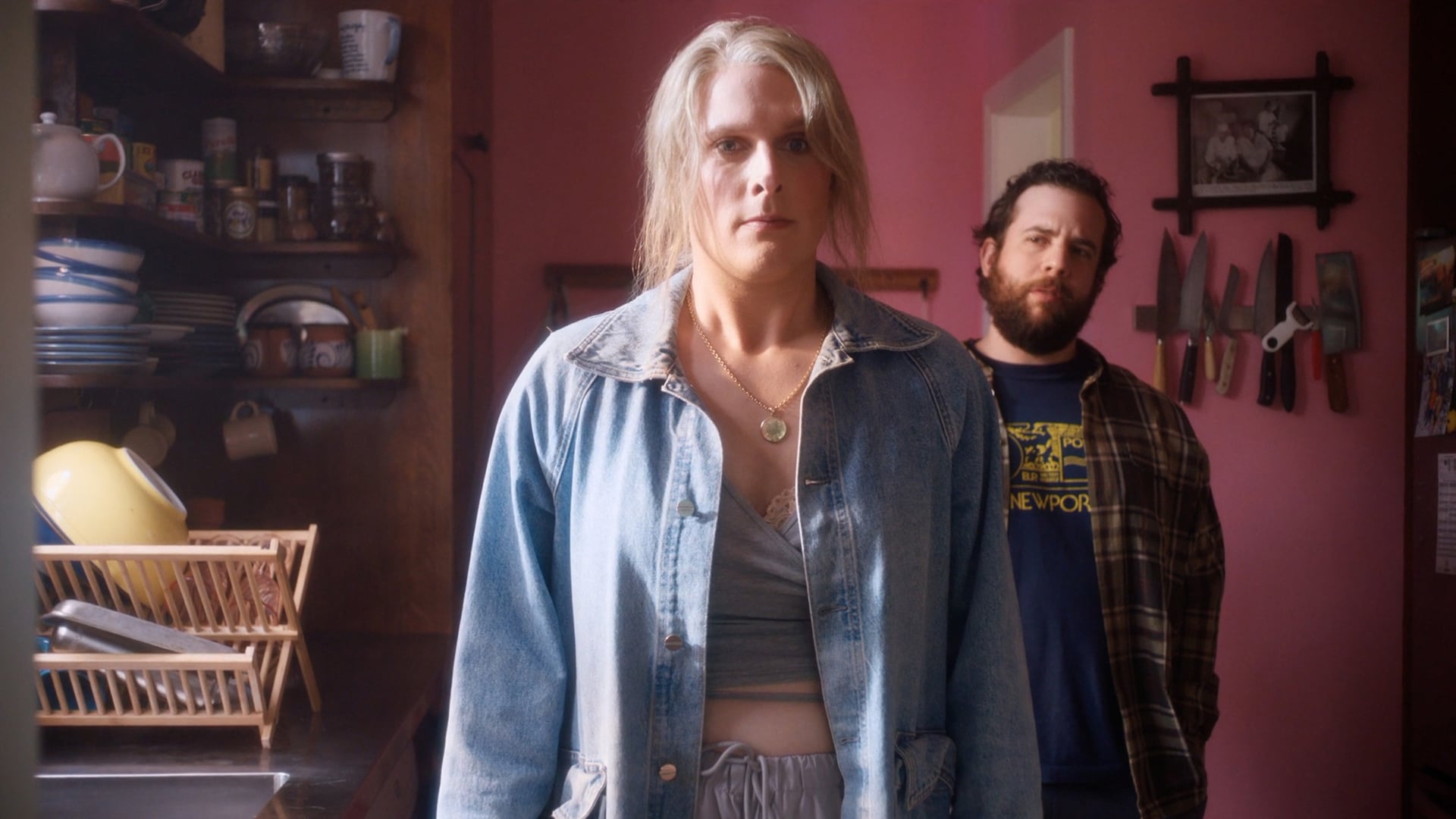
John Early’s remarkable directorial debut filters the ravages of an eating disorder through the funny-yet-sincere lens of camp
It could be said that to love a person is to take them seriously, but not too seriously. The same could be said for loving certain works of art. Consider Maddie’s Secret, the feature directorial debut from actor and comedian John Early. Inspired by his love of the made-for-TV movies of the 1980s and 1990s, Early has reworked and updated the premise of Arthur Allan Seidelman’s Kate’s Secret, first broadcast on NBC in 1986. In that film, an affluent suburban housewife’s façade of perfect composure and hypercompetence begins to crack, revealing an unsuspected struggle with bulimia. Transposing the story to present-day Los Angeles, Early positions his heroine—played by the director himself, in drag—as an aspiring food-media personality working as a dishwasher at Gourmaybe, a start-up web-content studio that produces viral cooking videos.
“Camp is art that proposes itself seriously, but cannot be taken altogether seriously because it is ‘too much,’” Susan Sontag wrote in her canonical 1964 treatise “Notes on ‘Camp.’” Kate’s Secret can be appreciated as a pristinely “naïve” camp text, exemplifying Sontag’s formulation of “failed seriousness”: the film foregoes subtlety and descends into maudlin moralizing in its too-earnest zeal to drive home the private implications of a very real and serious public-health concern. Maddie’s Secret, meanwhile, signals its camp intentions overtly, first and foremost via casting. The film and its characters operate within a hyperbolic comedic register marked by what Sontag called “a relish for the exaggeration of sexual characteristics and personality mannerisms.” Early embodies our protagonist as a blonde beacon of heterosexual feminine goodness, as wide-eyed and wishful as the prototypical Hollywood-bound ingenue, and beloved by nearly all—particularly her devoted bear of a husband (Eric Rahill) and her lesbian bestie (Kate Berlant).
This “gag,” easily mistaken for cheap parody, is in fact the film’s masterstroke, and its boldest adaptation of the source text. As Maddie, Early is “passing” not just in the sense of gender play, but in the way that a skilled impressionist could be said to pass for a cherished celebrity—or as a woman like Maddie might project an idealized, aspirational version of herself. With his heartfelt interpretation of the Kate/Maddie character, Early approaches the source text not as fodder for mockery, but as an authentic—if “failed”—attempt to grapple seriously with the affective unruliness of its difficult subject matter.
Beyond Kate’s Secret, Early has cited an eclectic array of “women’s pictures” and psychodramas as tonal and stylistic influences: not just Death of a Cheerleader (1994) and similar staples of the small-screen “movie of the week” genre, but also Showgirls (1995), Flashdance (1983), and Marnie (1964). As other critics have noted, numerous images in the film (a character dramatically reflected in a TV screen; a gossamer-thin slice of translucent purple potato held up to a sunlit window) pay overt homage to Douglas Sirk and other mid-century melodramatists, and its precisely calibrated sense of irony is always in dialogue with those two leading contemporary masters of intentional camp, Todd Haynes and John Waters.
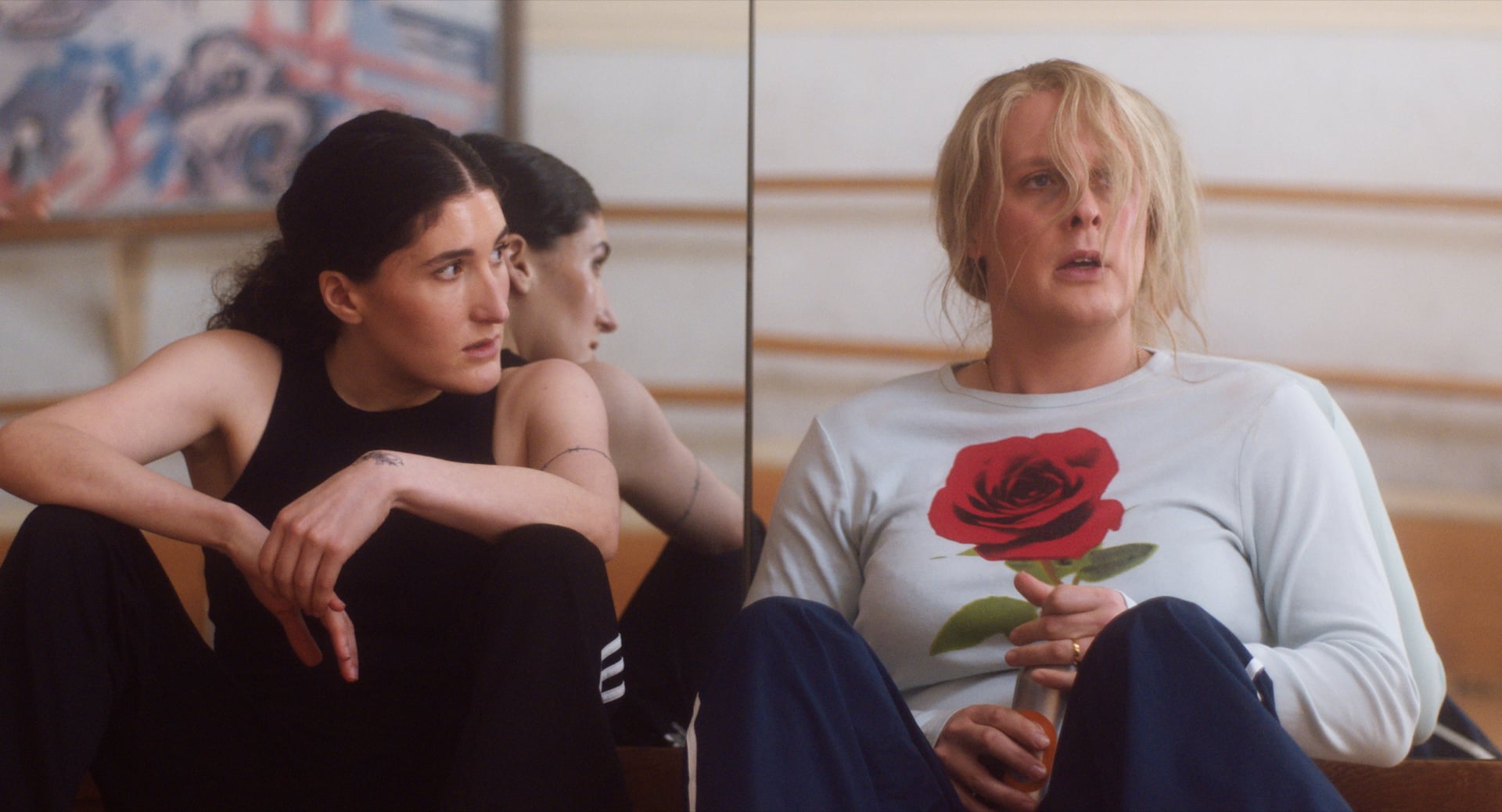
Maddie’s Secret revels in its own artifice: every aspect of the film’s aesthetic logic announces itself in quotes, in the same way that an influencer’s home furnishings, perceptible in the background of a YouTube makeup tutorial, might be carefully curated to serve as a kind of advertisement for a personal lifestyle brand. The production design is all bright colors, immaculate surfaces, and just-so mise en place, rendered with high-key lighting and emphatic camera movements—all of which complement the winkingly broad, in-the-know performance style that Early elicits with remarkable consistency from his sprawling ensemble cast of alt-comedy darlings.
Like Haynes’s Superstar: The Karen Carpenter Story (1987), Maddie’s Secret proposes that a camp gaze is the ideal lens through which to capture the psychological, social, and aesthetic dimensions of eating disorders authentically. The push-pull of body-image anxiety and bodily appetites, the cycles of indulgence and penance, the double-edged sword of “self-control”: where straight comedy or tragedy might skew callous or judgmental, the “daring and witty hedonism” of camp (per Sontag), its droll yet tender affinity for “the little triumphs and awkward intensities” of human nature in extremis, makes it uniquely equipped to approach these matters with the necessary mix of gallows-humor levity and genuine care, and without condescension.
Early’s depiction of a woman in the insidious throes of a bulimia flare-up is at once detailed and discreet, as though balancing informed concern for his character’s health with respect for her privacy and dignity. Binges are shown in economical but unambiguous montages, neither elided nor sensationalized. Glimpses of Maddie rushing into a bathroom or kneeling over the toilet—punctuated by fleeting close-ups of her eyes, bloodshot from the panicked strain of an interrupted purge—are carefully observed, but never overplayed. These demurely staged moments of disclosure are startling, yet sufficiently restrained: the emphasis remains on the unacknowledged emotional maelstrom that finds dangerous expression in gestures of self-harm, and reaches eventual catharsis in Maddie’s harrowing third-act encounter with her mother (Kristen Johnston), whose self-centered contempt for Maddie’s well-being is legitimately sobering.
Within the inelegant histrionics of Kate’s Secret and its ilk, Early has located an insightful attunement to the brutal self-criticism that can overwhelm a woman’s inner life, and a sensitivity to the ironic tension of her self-awareness. Instead of lampooning the earnestness of the earlier effort, he and his collaborators embrace and foreground it, rehabilitating its unselfconscious “too-muchness” while never scoffing at the integrity of its intentions—making fun in a spirit of ludic enthusiasm, not mockery. Though the film satirizes L.A. foodie culture, the “content creator” economy, and their attendant pathologies with lethal precision, Early is protective of his heroine, refusing to entertain contempt or condescension, and thereby ensuring that the joke is never at her expense—except when it’s rooted in her own faux-playful (but, heartbreakingly, all-too-serious) self-deprecation.
Madeline Whittle is a programmer with Film at Lincoln Center and freelance translator whose writing on film has appeared in Film Comment and The Brooklyn Rail.
This story is part of the Summer 2026 issue of Film Comment.
By clicking Sign up, you agree to our site’s Terms of Service and consent to our Privacy Policy.
Get full access to Film Comment with a paid subscription. Already signed up? Log in.
Thank you for signing up for The Film Comment Letter.
Check your email to set up your account and get access to select articles, or become a paid subscriber for full access.