Animal Planet: Bouchra
Meriem Bennani and Orian Barki’s debut feature leverages lush animation to comment on identity, family, sexuality, and creativity
Meriem Bennani and Orian Barki’s debut feature leverages lush animation to comment on identity, family, sexuality, and creativity
In March 2020, a few days into New York’s COVID-19 lockdown, the visual artist Meriem Bennani posted a one and a half–minute clip to her Instagram captioned “2 Lizards Ep 1,” following it with seven more episodes over the next few months. Quickly, the web series became a phenomenon, prompting The New York Times to name Bennani and her collaborator, the filmmaker Orian Barki, “coronavirus art stars.” The premise was simple: two animated lizards voiced by Bennani and Barki respectively, living through the early weeks of the pandemic with rooftop concerts, germ anxiety, Zoom birthday parties, and endless doomscrolling.
Bennani happened to have a folder of 3D animal models left over from another project, and she and Barki paired them with audio of a spontaneously recorded conversation between the two of them. What’s really appealing about these one-to-five-minute episodes is how the casual realism and relatability of the snappy dialogue jars with the surrealism and absurdity of talking animals. The two lizards have oil-slick skin that reflects the city in shifting color: its streetlights, computer screens, billboards, sirens. The digitally animated animal bodies are crude compared to, say, the characters in Pixar movies, and they move stiffly in front of real-world backgrounds, yet the naturalistic conversations and score by the duo’s musician friends lend an overall sense of fluidity to the action.
As the weeks go on, the cast of characters widens, each one voiced by someone in the creators’ circle, and rendered as a different animal: a cat nurse, a brown bear in a hazmat suit, a mouse news anchor, a hummingbird friend at dinner. Most of these avatars seem to be chosen arbitrarily, without any visual reference points for race, class, gender, and other cultural categories, so that the figures we see onscreen are never reducible to a type; at the same time, the accents, personalities, senses of humor, and other particularities of the voice actors come through, lending the characters real-world specificity. This is where the device stops being a style and becomes an argument—against the unimaginative tendencies of anthropomorphic fiction, and in service of a slipperiness that challenges the associations we bring as spectactors.
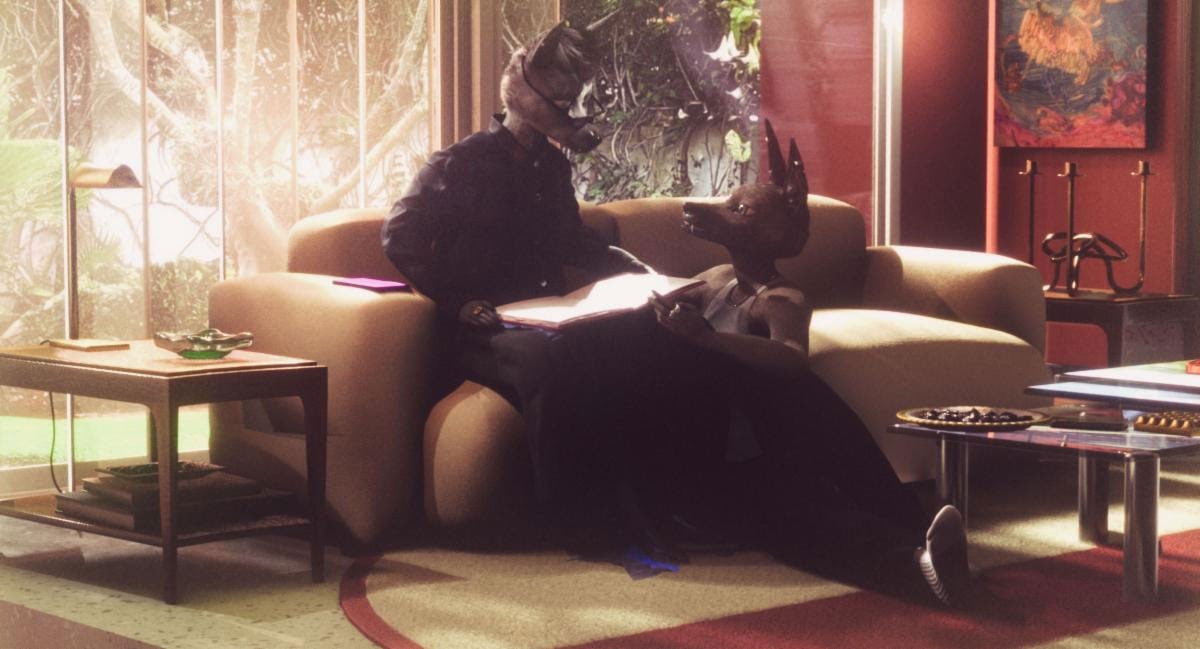
This strategy is further developed in Bouchra, the pair’s first feature, commissioned by the Fondazione Prada and made over a period of roughly two years. It premiered as part of For My Best Family, Bennani’s exhibition at the Fondazione in Milan in late 2024, under its original title, For Aicha, before being re-edited and re-titled for its festival run the following year. The film is largely autobiographical: Bouchra, a queer Moroccan filmmaker in New York, creatively blocked while attempting to direct her first feature, makes a series of long-overdue phone calls to her mother, Aicha, a cardiologist and painter in Casablanca, nine years after a coming-out that left a silence between them. These calls, based on Bennani’s own recordings with her mother, become the material for the film-within-the-film that Bouchra is making, so that Bouchra keeps folding in on itself: we watch our protagonist build, in storyboards and flashbacks, the very movie we are watching. And as in 2 Lizards, the characters are all animals: Bouchra (voiced by Bennani) and her mother are coyotes, her ex-girlfriend Nikki is a cow, a woman she falls for is a bear, and her best friend Yani (Barki) is a lizard.
Unlike 2 Lizards, which was very much digital-native in style, content, and mode of dissemination, Bouchra is a work of cinema. The environments are collaged from 3D scans of real Casablanca and New York streets, while the characters are hand-animated in Blender. The result is hyper-expressive, closer to a video game than a cartoon, with a warm, grainy look roughened by glitches in the fur and the faces. These retro textures jar playfully with the overstimulated grammar of online image culture: at one point we see a phone conversation rendered as a split screen of front-facing selfies, each face half buried under a glowing chat keyboard. In another scene, set at a bar, where Bouchra is out with her ex Nikki, the camera lingers on their martinis, then drops under the table to catch them playing footsie in what look like Prada sneakers and Margiela Tabis, exuding with a glassy shine. The chemistry between the characters is extraordinary, thanks to the documentary exchanges that fuel the dialogue.
While Bennani voices and embodies Bouchra throughout the film, Aicha is a composite of different women: her words are from Bennani’s phone calls with her actual mother, voiced here by an actor, while a different actor voices the onscreen coyote version of Aicha. There are other points of divergence that ensure that the film’s metafictional layers never fully coincide; the film we are watching ultimately goes in a different direction than the one Bouchra is making. Where autobiography and documentary—especially about marginalized communities—promise revelation and understanding, Bouchra holds us at a slight distance, exemplifying Martinican philosopher Édouard Glissant’s notion of the right to opacity: the right not to be completely transparent, not to be reduced to something another can grasp and master. Bouchra proposes that we might be moved by a life, even implicated in it, without being able to fully know it.
Abirami Logendran is a writer and curator based in Oslo.
This story is part of the Summer 2026 issue of Film Comment.
By clicking Sign up, you agree to our site’s Terms of Service and consent to our Privacy Policy.
Get full access to Film Comment with a paid subscription. Already signed up? Log in.
Thank you for signing up for The Film Comment Letter.
Check your email to set up your account and get access to select articles, or become a paid subscriber for full access.